What a Live Weil-Positivity Gauge Can—and Cannot—Show
A new community-built Space turns Weil’s positivity criterion into an interactive spectral experiment. Here is how to read its eigenvalue results, controls, convergence checks, and important limits.

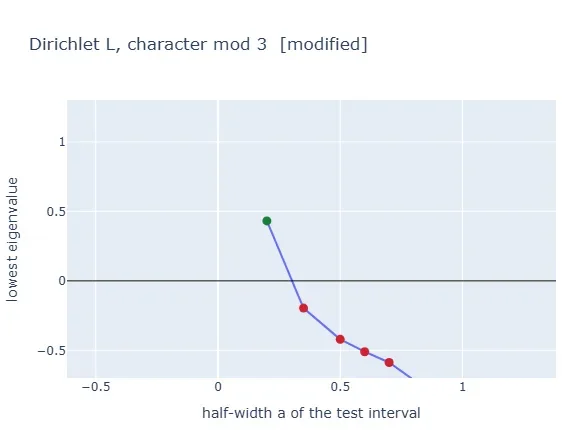
Use the gauge as a reproducible numerical laboratory: inspect controls and convergence, while keeping finite computations and Lean-checked auxiliary lemmas separate from any universal proof claim.
A new community project from FINAL-Bench packages an unusual mathematical experiment as an interactive Hugging Face Space: a numerical gauge for the positivity condition connected to the Riemann Hypothesis. The project reports computations for the Riemann zeta function, four real Dirichlet L-functions, and three deliberately altered comparison objects. It also publishes code, data, and a small collection of Lean-checked supporting identities.
The result is best understood as an explorable numerical instrument, not as a proof engine. That distinction matters especially because the accompanying community post repeats a separate, extraordinary claim that a formal proof of the Riemann Hypothesis was announced on November 20, 2026. The gauge does not independently establish that claim, and finite numerical evidence cannot prove a statement over an infinite domain. Its practical value is narrower: it makes one formulation of the problem visible, testable, and easier to interrogate.
From a positivity criterion to an eigenvalue
Weil’s criterion relates the Riemann Hypothesis to positivity of a quadratic form built from arithmetic and analytic ingredients. The project follows a localized operator formulation attributed to Masatoshi Suzuki. In computational terms, it discretizes that operator on a finite interval and asks for its lowest eigenvalue.
That translation gives the interface a simple visual question: is the smallest computed eigenvalue positive or negative? A negative value for a sufficiently converged calculation supplies useful evidence that the tested form fails positivity at that interval and resolution. A positive value is more delicate. It says the chosen finite-dimensional approximation did not reveal negativity; it does not establish positivity for every possible test function, interval, or resolution.
The post reports positive resolved values for zeta and four Dirichlet L-functions with conductors 3, 4, 5, and 8. At larger interval sizes, several entries are labeled below numerical resolution instead of being assigned a sign. That restraint is important: a tiny computed number should not be promoted to a mathematical conclusion when discretization error is of comparable size.
Why the imitation objects are useful controls
A strong part of the experiment is its use of negative controls. Three imitation objects each alter one component of a genuine L-function construction: removing zeta’s pole term, assigning the wrong parity, or reversing prime-weight signs. The reported lowest eigenvalues become negative, while the genuine cases remain positive wherever the calculation resolves a sign.
These controls do more than make a striking chart. They test whether the pipeline merely emits positive values by construction. If a targeted change produces a stable negative eigenvalue, the numerical method appears sensitive to relevant arithmetic structure. One imitation reportedly tracks its genuine counterpart until the first prime contribution enters the selected interval, then diverges. That is the sort of behavior a reviewer can compare against the implementation rather than accepting only a headline result.
Controls still do not validate every layer. A software defect shared by the genuine and imitation paths could survive, and a plausible outcome is not proof of correct discretization. Independent implementations, varied precision, and tests against analytically solvable cases would strengthen the evidence.
Convergence is the key reading skill
The project uses a finite-element mesh and compares results at two resolutions. The authors describe a ratio near one as evidence that an eigenvalue has stabilized, while a ratio near four signals a value dominated by resolution effects. This is a more informative presentation than listing many decimal places without an error diagnostic.
When exploring the Space, readers should focus on three questions. Does refinement preserve the sign? Does the estimated value settle rather than drift toward zero? Do changes in oversampling, interval size, or numerical precision lead to the expected convergence pattern? A single green indicator is less meaningful than a consistent refinement sequence.
The same caution applies to the reported endpoint behavior of the first eigenfunction. The project proposes a logarithmic decay law based on progressively smaller distance bands. That is an interesting numerical observation, but its reliability depends on resolving a difficult boundary region. Mesh studies and comparison with the ordinary Laplacian provide useful checks; reproduction at higher precision would provide more.
What the Lean files verify
The project also lists ten statements checked by the Lean kernel, concerning constants and recurrence properties used around the operator’s Archimedean terms. Kernel checking gives a precise guarantee about those formalized statements, subject to the stated axioms and dependency versions. It does not automatically extend to the numerical solver, the plotted data, the derivation of the discretization, or the broader Riemann Hypothesis claim.
This separation is a useful general lesson for projects combining formal methods and scientific computing. A review should map each conclusion to its evidence: theorem prover output for formal lemmas, convergence tests for numerical approximations, and independent source and build verification for external proof claims. The strongest presentation makes those boundaries explicit.
A practical reproduction checklist
The published repository and dataset make the gauge more valuable than a static screenshot. A careful reproduction should pin the stated code and dependency versions, regenerate the tables rather than reusing bundled outputs, and record hardware, precision, mesh size, and oversampling. Reviewers can then compare genuine objects with all three controls and inspect whether the lowest eigenvalue behaves monotonically under refinement as the method predicts.
It is also worth separating reproducible observations from interpretation. “This mesh produced this eigenvalue” is an auditable computational result. “The form is positive everywhere” is a universal mathematical claim that the finite experiment cannot deliver. Used with that boundary in view, the Space offers an approachable laboratory for spectral numerics, L-functions, and the relationship between formal and computational evidence.
Source: Seeing the Riemann Hypothesis Hold: A Live Weil Positivity Gauge for Zeta and Dirichlet L-Functions ↗. How we write


