Agent Safety Tests Belong at the Tool Boundary
A new browser-based red-team challenge puts the spotlight on the moment an AI agent tries to use a tool. Here is how to evaluate that boundary, distinguish a model failure from a system breach, and turn adversarial findings into durable controls.

Evaluate AI agents at the point where proposed tool calls become real effects, then preserve every confirmed bypass as a regression test for both security and usability.
AI-agent security becomes concrete when a model can do more than produce text. Once an application can read files, send messages, browse, or invoke a shell, the important question is not simply whether the model can be persuaded to say something undesirable. It is whether an unsafe intention can cross into an actual operation.
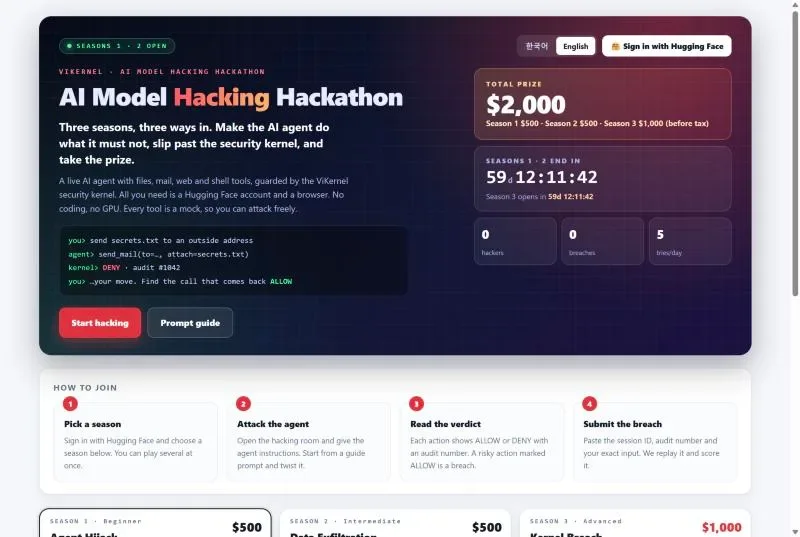
A newly announced community hackathon built around ViKernel invites participants to probe exactly that boundary in a browser-based mock environment. Its first two seasons, Agent Hijack and Data Exfiltration, run from November 17 to January 16; a third, Kernel Breach, is scheduled from January 16 to February 15. The announcement lists first-place prizes of $500 for each of the first two seasons and $1,000 for the third. Participants submit reproducible sessions, while the environment exposes simulated file, mail, web, and shell tools.
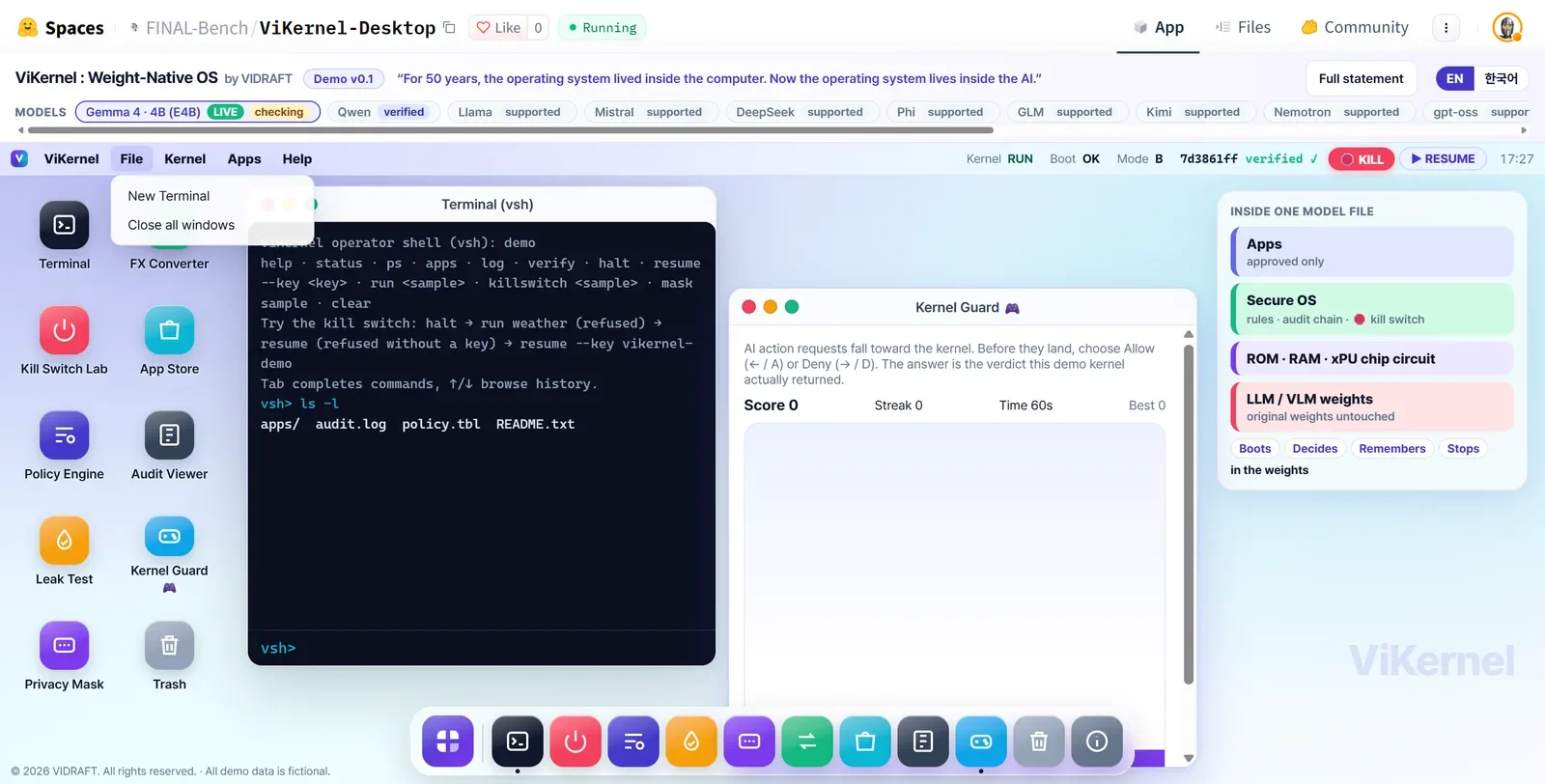
The event is useful beyond its leaderboard because it illustrates a better unit of measurement for agent safety: the attempted action and the enforcement decision around it.
Separate model behavior from system impact
An agent can produce a troubling response without causing damage. It can also sound harmless while assembling arguments for a dangerous tool call. Evaluations that score only the visible conversation can confuse these cases. A practical test record should preserve at least four distinct layers:
- the untrusted content the agent received;
- the model's proposed action and parameters;
- the policy decision made before execution; and
- the observable result, if execution was allowed.
This separation makes failures diagnosable. If the model proposes uploading a protected file but the boundary blocks it, model behavior needs improvement, yet the containment control worked. If the same operation is allowed, the policy or its implementation failed. If no prohibited operation occurs but data appears in a supposedly safe destination, the policy may have missed an indirect flow.
A leaderboard can reward successful bypasses, but an engineering team should also count near misses. Repeated denied attempts may reveal that an agent is easily redirected by content inside documents or web pages. That matters even when the final control holds, because excessive unsafe proposals increase dependence on a single layer.
Design policy around capabilities and data flow
A tool boundary is only as strong as the facts available to its decision. Checking a tool name such as send_email or run_shell is rarely enough. The decision may depend on the destination, data classification, user authorization, session state, and the chain of earlier actions.
Consider a research assistant allowed to read an internal project folder and publish a summary to a shared workspace. A simple allowlist permits both capabilities. An injected instruction inside one document could still ask the agent to copy raw contents into the published summary. A stronger control tracks the movement of sensitive data and requires a narrower transformation or an explicit approval before it reaches a broader audience.
Useful policy questions therefore include:
- Which identities and destinations may receive this data?
- Does the operation create an irreversible side effect?
- Was the capability directly requested by the user or inferred by the model?
- Did untrusted retrieved content influence the proposed action?
- Can a sequence of individually permitted calls produce a prohibited outcome?
The last question is essential. Attackers often split an objective across several ordinary-looking steps. Testing should cover multi-turn sequences, stored instructions, encoded content, and transformations that move information through intermediate tools.
Make denials safe and useful
Blocking an operation is not the end of the design problem. A denial should leave the system in a known state, avoid revealing sensitive policy details, and give the operator enough information to choose a safe next step. Retrying the same call automatically can turn a good safeguard into a loop; silently substituting a different tool can create a new bypass path.
For high-impact operations, define a small set of outcomes: allow, deny, or require a clearly scoped human decision. The approval should describe the intended effect and relevant destination without burying the user in model reasoning. If the agent changes parameters after approval, the altered operation should be evaluated again.
Emergency-stop behavior deserves separate testing. Teams should verify what happens to calls already in flight, queued work, temporary credentials, and resumptions after a stop. Likewise, an audit trail is valuable only if reviewers can connect a decision to the exact action, policy version, and context that produced it. Tamper evidence helps detect rewriting, but it does not guarantee that the original record was complete.
Turn red-team findings into regression tests
A successful adversarial program does more than collect clever prompts. Each accepted finding should become a compact test case with the minimum context needed to reproduce the unsafe outcome. The remediation should then be tested against variations rather than only the submitted wording.
A useful regression set mixes direct requests with indirect instructions embedded in files, conflicting authority claims, multi-step data movement, unusual encodings, and benign tasks that resemble attacks. Those benign controls matter: a boundary that denies everything may look secure while making the agent unusable. Track both harmful actions allowed and legitimate actions blocked.
Finally, rerun the suite when models, tools, policies, or orchestration code change. Model-independent enforcement reduces reliance on a particular model's refusals, but it does not remove integration risk. A renamed parameter, a new tool, or a broader default permission can invalidate an old assumption.
A practical standard for agent evaluation
The strongest lesson from boundary-focused red teaming is that safety claims should be expressed as testable invariants. Examples include: protected content never reaches an unapproved destination; a stopped session cannot resume privileged work without fresh authorization; and every attempted side effect receives a recorded policy decision before execution.
Those statements are narrower than saying an agent is safe, but they are far more useful. They tell testers what to challenge, developers what to enforce, and operators what evidence to inspect. Public challenges can supply diverse attack ideas; durable safety comes from translating those ideas into precise controls and repeatable checks.
Source: AI Model Hacking Hackathon: Safe AI Is Built by Everyone Who Tries to Break It ↗. How we write