A Laptop-Friendly Challenge Turns Superconductor Screening Into a Reproducible Workflow
The Open Superconductor Challenge invites participants to rank 2D materials with lightweight methods, while reserving expensive many-body computation for verification. Here is how to interpret the task, compare approaches, and avoid mistaking a screening score for a discovery.

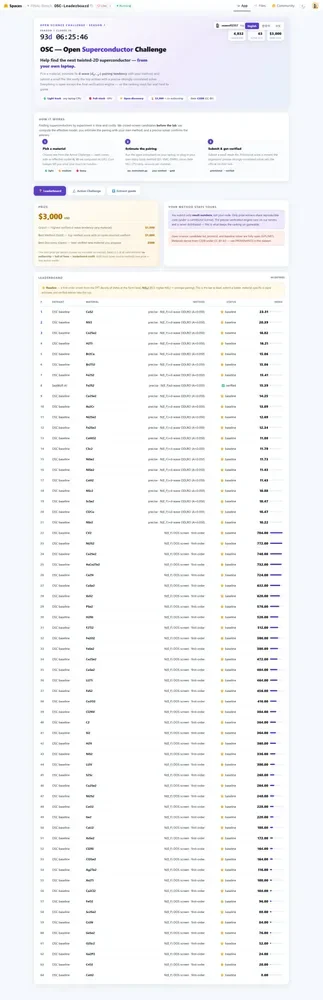
Treat the leaderboard as a candidate-ranking experiment: document assumptions, test ranking stability, and reserve claims of superconductivity for higher-fidelity calculations and laboratory evidence.
The Open Superconductor Challenge reframes a difficult materials-search problem as a staged computational workflow. Participants receive effective models for two-dimensional materials, estimate their tendency toward d-wave pairing, and submit compact results. The organizers then apply more expensive many-body calculations to leading entries. The announced first season is scheduled to close on December 31, 2026 at 23:59 KST, with a $3,000 total prize pool and several forms of contributor credit.
The important word is screening. A high score is a reason to investigate a material more carefully, not evidence that it superconducts in the laboratory. Keeping that distinction visible makes the challenge useful beyond its leaderboard: it becomes an accessible exercise in building, testing, and communicating scientific approximations.
Why the staged design matters
Scientific search often has a funnel shape. A cheap calculation can reject many unlikely candidates, while a smaller set advances to slower simulations, synthesis, and measurement. Spending the highest-fidelity compute on every possibility would be wasteful, but trusting the cheapest proxy as a final answer would be scientifically weak.
The challenge formalizes that funnel. Broad participation supplies diverse first-pass estimators; centralized verification applies a common reference to promising submissions. This separation also creates a useful comparison between ranking quality and raw numerical output. A method does not need to reproduce the eventual reference value perfectly to be valuable. It may be enough for it to place genuinely promising candidates near the top consistently.
That suggests a practical objective for participants: design an estimator whose assumptions are explicit and whose ranking remains stable under reasonable changes. A sophisticated model with fragile settings can be less useful than a simpler approach that behaves predictably across the material set.
What participants are actually estimating
Each active material comes with a downfolded Hubbard-model description. The supplied quantities include nearest-neighbor hopping, on-site interaction, and density of states at the Fermi level; the challenge fixes the correlated regime at U/t = 8. Participants are asked to improve on a first-order screen with a material-specific estimate of d-wave pairing tendency.
These abstractions make computation manageable, but they also define the boundary of any conclusion. A downfolded model deliberately leaves out detail. Results can depend on choices made when converting a real material into model parameters, as well as on finite-size effects, numerical approximation, and the observable chosen as a proxy. Even an accurate solution to the effective model is not the same as an experimental transition-temperature measurement.
For readers evaluating a submission, three questions are more revealing than the headline score:
- What information enters the estimator? A method that mostly follows density of states may add little beyond the baseline.
- Which approximation controls the result? Mean-field, exact diagonalization, variational methods, tensor-network methods, and machine learning fail in different ways.
- Can the ranking be reproduced? Dependencies, seeds, parameter choices, and preprocessing should be documented even when the submission format only requires result numbers.
A sensible experiment plan
A strong entry can start small. First, reproduce the supplied baseline on one or two materials and confirm units, conventions, and output format. Next, choose a method whose computational cost fits the available hardware. Record every assumption before tuning against leaderboard feedback; otherwise repeated submissions can quietly turn the leaderboard into a test set.
Then run controlled comparisons. Hold the method fixed while varying one modeling choice at a time. Check whether modest parameter changes reorder the top candidates. If they do, report that instability instead of presenting a precise rank as robust. Negative and ambiguous results are informative because they reveal where the inexpensive screen needs stronger verification.
A useful local evaluation table might contain the material identifier, baseline estimate, proposed estimate, runtime, convergence indicator, and a short caveat. That table does not prove physical validity, but it makes errors easier to spot and gives collaborators a reproducible trail. Before submission, rerun the exact procedure from a clean environment and make sure the claimed author and material identifiers are correct.
Reading the leaderboard responsibly
The announced active set contains 63 modeled materials drawn from a larger universe of 4,832. The published snapshot lists CuS2 first among the verified entries, followed by NV2, Co2Se2, H2Ti, and Br2Cu. Those ranks describe performance under the challenge's current screen and reference procedure. They should not be generalized into claims about confirmed superconductivity or critical temperature.
Leaderboard movement can have several causes: a better physical approximation, a correction to an earlier result, expanded material coverage, or sensitivity to the verification setup. Method descriptions therefore matter as much as rank. Open, reproducible winning approaches may also become useful baselines for later work, while opaque scores are harder to learn from.
What would count as progress
The most valuable outcome is not merely a winning number. Progress would include an inexpensive estimator that reliably prioritizes candidates under independent verification, a clear account of where that estimator breaks down, and a shortlist worth studying with higher-fidelity theory or experiments.
That is also why the laptop-friendly entry point is meaningful. It lowers the cost of contributing hypotheses without lowering the standard needed to call something a discovery. Participants can help improve the early stages of the search funnel, while the challenge's verification layer and the wider scientific process retain responsibility for stronger claims.
Source: Open Superconductor Challenge: Help Discover the Next 2D Superconductor — From Your Laptop ↗. How we write