Testing LLM Societies Without Mistaking Plausibility for Evidence
Language-model agents can make social simulations more expressive, but convincing dialogue is not proof of valid collective behavior. A practical evaluation framework separates semantic capability from social mechanism and tests each layer independently.

Evaluate LLM societies in layers, keep consequential social state inspectable, and require stable trajectories plus intervention tests before making causal claims.
Large language models give agent-based simulations a new interface: people in the model can exchange arguments, recall prior conversations, react to ambiguity, and produce context-sensitive replies. That is a meaningful expansion over agents represented only by a handful of numbers. It also creates a tempting shortcut in evaluation. When dialogue sounds natural and a group produces a recognizable pattern, the simulation can feel more credible than the evidence warrants.
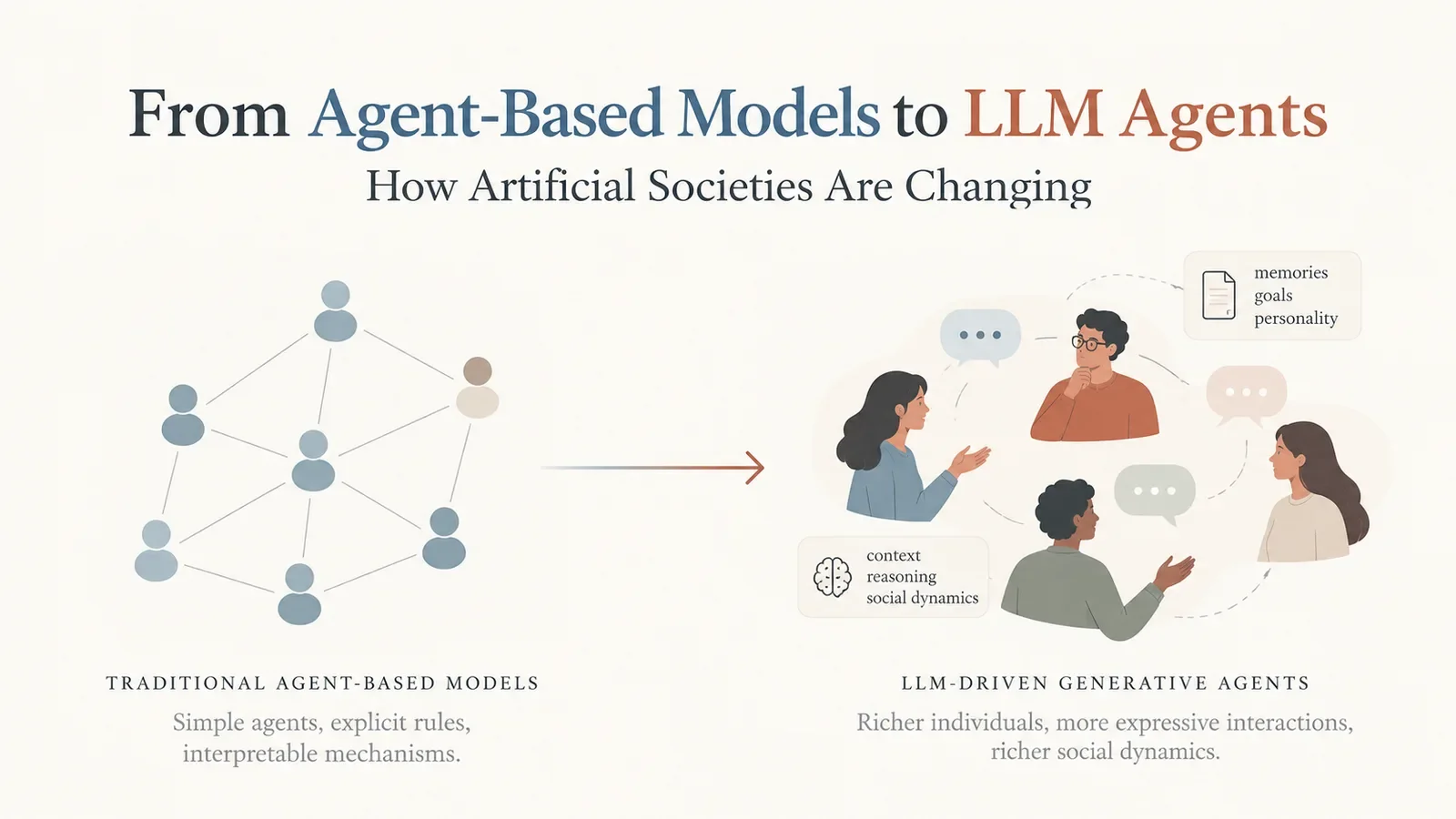
A recent Hugging Face community article makes the central methodological point clearly: language models do not eliminate modeling assumptions; they move some of those assumptions into prompts, memory systems, retrieval rules, sampling choices, and learned model behavior. The article argues for hybrid designs in which language processing remains generative while important social variables stay explicit. That distinction offers a useful foundation for building tests.
Separate the claims before running the simulation
An artificial society can support several different claims, and success on one does not establish the others. Start by writing the intended claim in a form that can fail.
An individual-behavior claim asks whether an agent responds like the population it represents under defined conditions. An interaction claim asks whether communication changes beliefs or actions through an appropriate mechanism. A collective claim concerns trajectories across the whole population: diffusion, clustering, coordination, or polarization. An intervention claim predicts what will happen after changing the environment.
These levels need distinct evidence. A model that gives a plausible answer to a survey item may still transmit rumors too readily. A population that ends in two clusters may reach them through an unrealistic exposure process. A simulator that recreates a historical outcome may fail when a recommendation rule changes. Labeling the claim prevents an attractive demonstration from silently becoming a causal conclusion.
Keep semantic work and social state distinguishable
A practical hybrid agent can assign the language model a narrow but valuable role. Give it the message, relevant memories, and enough context to extract structured judgments such as the claim being made, its apparent evidence, emotional framing, and relation to the recipient's goals. Store consequential state elsewhere: belief, uncertainty, trust, exposure history, network position, and available actions.
This is not a requirement that every human quality become a scalar. It is an experimental boundary. The language model interprets meaning; an inspectable update rule determines how that interpretation affects state. A response generator can then turn the updated state into a message or action. Researchers can replace any one component without rebuilding the entire society.
For example, imagine an agent receiving an unsourced message that an exam has moved. The interpreter might identify the proposition, detect missing evidence, and note that the sender is a friend. A separate mechanism combines those outputs with stored trust and current uncertainty. The resulting belief then controls whether the agent checks an official source, forwards the rumor, or waits. Each step leaves an observable trace that can be challenged.
Use invariance tests to expose fragile results
Before comparing a simulated society with real behavior, test whether its conclusions survive changes that should be irrelevant. Paraphrase messages without changing their meaning. Reorder neutral details. Run multiple random seeds. Swap equivalent persona wording. Change the underlying model while holding the social mechanism fixed, when the study's claim should not depend on one model family.
The expected outcome is not identical dialogue. The important population measure should remain within a prespecified tolerance. If a harmless wording change reverses which group adopts a belief, the result is probably entangled with prompt sensitivity. Report that dependence instead of averaging it away.
Then vary factors that should matter. Remove a network bridge, lower communication bandwidth, alter source credibility, or introduce a correction through a trusted node. The direction and timing of the response should follow the proposed mechanism. These paired tests are more informative than inspecting a few memorable transcripts.
Validate trajectories, not only endpoints
Many different mechanisms can produce the same final average. Evaluation should therefore preserve time and structure. Compare which agents move first, where information travels, how long minorities persist, how uncertainty changes, and whether activity concentrates in the same parts of the network.
Define those measurements before examining the preferred run. Useful outputs might include adoption curves by subgroup, path lengths from the originating message, trust-weighted exposure counts, transition timing, and variance across seeds. Where real longitudinal data exist, initialize the simulator from an early segment and reserve later events for evaluation. This makes it harder to tune a compelling story around a known ending.
Scale also changes the review method. At hundreds or thousands of agents, reading transcripts cannot establish validity. Sample conversations can diagnose failures, but aggregate tests, component ablations, and uncertainty intervals must carry the main argument.
Treat realism as a property to demonstrate
Believable characters are valuable for games, training environments, and exploratory prototypes. Scientific or policy-facing simulations need a stricter standard. Document what the model controls, what remains explicit, which outcomes are stable, and which interventions were tested out of sample.
The strongest design is not necessarily the most human-sounding one. It is the design that makes competing explanations separable. Language models can supply semantic flexibility that conventional agent rules struggle to express, while explicit state and controlled experiments preserve the ability to learn why a collective pattern appeared. Together, those choices turn an artificial society from a persuasive performance into a testable model.
Source: From Agent-Based Models to LLM Agents: How Artificial Societies Are Changing ↗. How we write