A Generative Surgical Simulator Needs More Than Convincing Video
NVIDIA's Cosmos3-H-Dreams brings action-conditioned video generation into clinical surgical scenes, making validation of control fidelity, temporal stability, and safety boundaries the central engineering challenge.

Evaluate generative surgical simulators for control response, interaction fidelity, and long-horizon consistency before treating visual realism as useful simulation evidence.
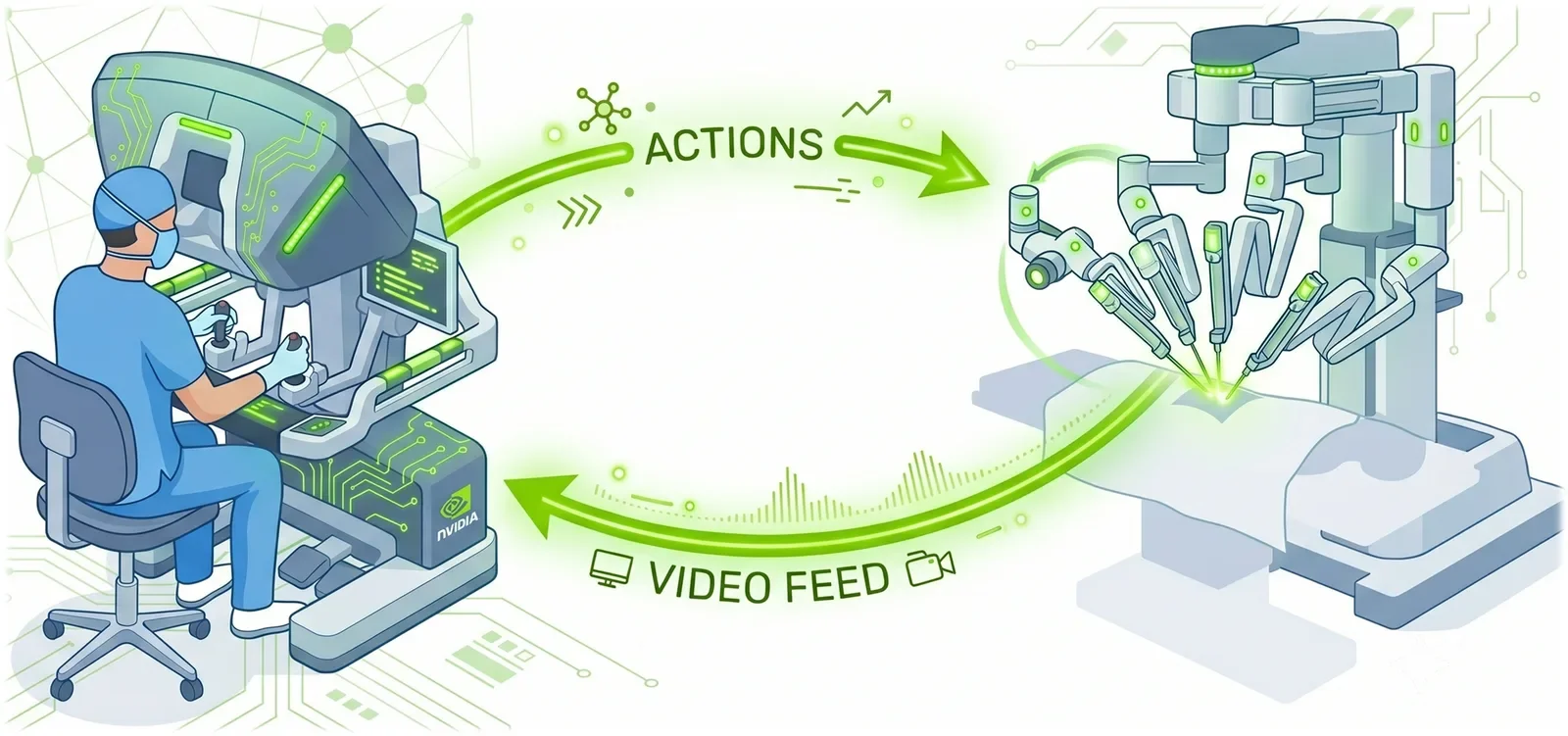
NVIDIA's Cosmos3-H-Dreams extends interactive generative simulation from tabletop suturing to recorded clinical cholecystectomy scenes. The research system starts from an image and responds to surgical-tool actions, producing video continuations intended to reflect instrument motion, tissue deformation, occlusion, reflections, and smoke. It is an ambitious setting because a visually minor control error can compound across a long rollout while the output remains superficially plausible.
The release specializes a Cosmos 3 model on synchronized procedure video and robot kinematics from the CMR Surgical Versius platform. Its action representation has 28 dimensions covering two arms, grippers, energy controls, and thumbstick inputs. NVIDIA provides separately trained four-step and two-step student checkpoints; the latter trades some visual quality for faster inference. FlashDreams supplies streaming inference, with an adapted memory mechanism for managing attention history during longer sequences. NVIDIA describes interactive operation on one RTX PRO 6000 GPU. This is a research simulator, not a system validated for patient care.
Realism is only the first test
A generated surgical video can look credible while responding incorrectly to the requested action. That distinction makes ordinary visual-quality judgments insufficient. An evaluator needs to ask at least three separate questions: does the tool move as commanded, does the surrounding scene respond coherently, and does the generated anatomy remain consistent over time?
These questions should be measured independently. Control fidelity can compare commanded and visible tool trajectories, including direction, timing, rotation, and gripper state. Interaction fidelity can examine whether contact produces a localized, temporally appropriate response rather than a generic visual change. Persistence tests can track landmarks and tool geometry across a rollout, looking for drift, duplication, disappearance, or abrupt changes after occlusion. A single combined score could hide a serious weakness in one of these layers.
Visual review still matters, but it should be structured. Reviewers can inspect fixed-duration clips without knowing which checkpoint produced them, use a shared error taxonomy, and record the first frame where a failure becomes apparent. That produces more actionable evidence than asking whether an entire clip looks realistic.
Test interventions, not just familiar replays
A simulator intended for interaction should be evaluated on differences caused by actions. One useful design starts several rollouts from the same initial frame, then changes only one control variable. If the left instrument translates while every other command stays fixed, the resulting difference should be localized and directionally consistent. A no-action or neutral-action continuation can serve as another comparison.
Counterfactual pairs are especially useful because they reduce dependence on an exact reference video. There may be many plausible futures from one frame, so pixel matching against a single recording can punish valid variation. Comparing whether controlled changes have the expected qualitative effect instead tests the simulator's responsiveness without claiming there is only one correct image sequence.
Coverage must also extend beyond common trajectories. Evaluation sets should separate routine motion from unusual tool positions, partial occlusions, smoke, specular highlights, and prolonged interactions. Performance should be reported by slice. An average dominated by easy, well-represented scenes could obscure failures in precisely the conditions where a simulator is supposed to help researchers explore uncertainty.
Long rollouts expose a different failure mode
Short clips mainly test immediate response and image quality. Long autoregressive rollouts test whether small mistakes feed back into later generations. A slightly altered instrument tip may become context for the next block; a shifted anatomical boundary may then drift further. This makes rollout duration an experimental variable rather than a presentation choice.
Teams can evaluate at several fixed horizons and plot error incidence against generated time. They should preserve the full sequence when a failure occurs, because the visible break may be downstream of an earlier subtle inconsistency. Tests should also distinguish model behavior from runtime behavior: dropping history, changing cache policy, or missing a control timestamp can resemble a modeling failure. Input actions, timestamps, checkpoint identity, runtime configuration, and initial frame should therefore travel together as one reproducible test case.
Define the boundary before using the simulator
Generative simulation may be useful for policy research, controller prototyping, scenario visualization, and forming new evaluation questions. None of those uses establishes anatomical or biomechanical validity. A model trained from observations can reproduce recurring visual patterns without representing forces, contact, or tissue mechanics in a way that supports a safety claim.
The deployment boundary should state which procedure phase, instruments, camera conditions, and action ranges are represented. Out-of-distribution inputs should be detected or at least logged, and downstream policies should not treat photorealism as evidence that an action is safe. Expert surgical review and comparison with measured or numerical models remain complementary checks.
Cosmos3-H-Dreams is valuable because it makes a difficult interactive setting concrete. Its most important contribution may be the evaluation agenda it creates: separating appearance from control, measuring drift across time, and treating clinical realism as a hypothesis to test rather than a conclusion drawn from compelling video.
Source: NVIDIA Cosmos3-H-Dreams: Bringing Clinical Surgery to Life Through Generative Simulation ↗. How we write