What a Talking Haunted House Teaches About Real-Time Voice Agents
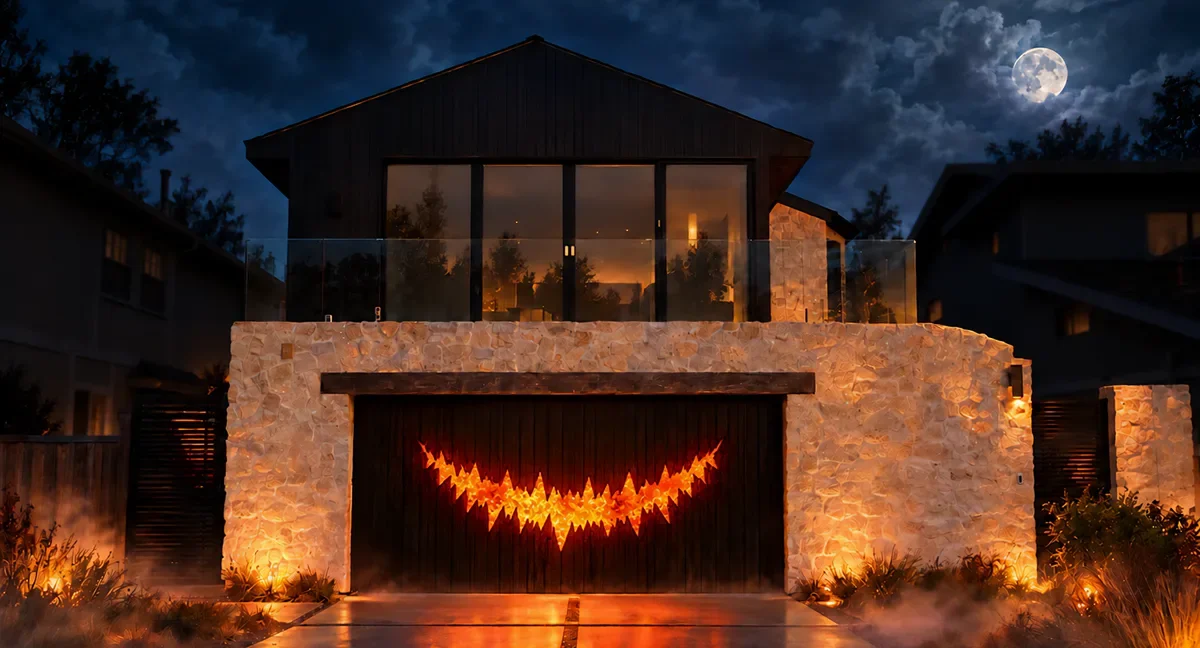
NVIDIA's MonsterHouse project turns a garage door into a responsive Halloween character. Its architecture offers practical lessons in latency, state, speech animation, fallbacks, and honest evaluation for any real-time voice agent.

The strongest real-time voice agents separate model responsibilities, keep durable state in application logic, cache predictable moments, and treat fallbacks and field testing as core design work.
An animated garage door that argues with trick-or-treaters sounds like a novelty. As a systems example, however, NVIDIA's MonsterHouse is unusually revealing. The October 30 project combines streaming speech recognition, a compact language model, zero-shot text-to-speech, facial animation, optional visual understanding, and explicit encounter state on one workstation. Its creator uses Nemotron 3 ASR, Nemotron 3.5 Bolt E4B, Magpie TTS Zeroshot, Audio2Face-3D, and an optional Nemotron 3 Nano Omni observer.
The useful lesson is not that every voice application needs a flaming mouth. It is that a convincing interactive character depends on coordination around the models: when to listen, what to remember, how quickly to respond, and what to do when a component is slow or unavailable.
Treat the agent as a pipeline, not a single model
A real-time character has several distinct jobs. Recognition turns audio into text. Dialogue logic decides what should happen next. A language model supplies flexible wording. Speech synthesis produces a voice, while animation translates clean audio into motion. Optional perception adds context such as the number of visitors or a broad costume description.
Keeping those responsibilities separate makes the system easier to reason about. A poor reply can be traced to recognition, state, prompting, or generation instead of being blamed vaguely on “the AI.” Components can also operate at different rates. The visual observer does not need to analyze every frame merely to tell the dialogue layer that a group has arrived. Animation benefits from clean speech even when the audience hears a heavily processed voice.
For a new project, define the contract between stages before choosing the largest available model. Write down the input, output, timeout, and fallback for each stage. That exercise exposes hidden dependencies early and makes later substitutions less disruptive.
Put durable facts outside the conversation
MonsterHouse has a simple dramatic rule: persistence may soften the character, “please” can change the encounter, and “thank you” earns a warmer farewell. The important engineering choice is to store that progress in application state rather than relying on the model to reconstruct it from dialogue alone.
This pattern generalizes. A museum guide might track which exhibit has already been explained. A game character might store completed objectives. A service kiosk might record which verification step is finished. These facts should have explicit fields and transitions. The model can express the next response naturally, but it should not be the sole database for facts that determine behavior.
A small state machine also makes testing concrete. Evaluators can ask whether the same input produces the right transition, whether interruptions preserve the current stage, and whether a returning participant is incorrectly sent back to the beginning. Personality then becomes a presentation layer around reliable rules rather than a substitute for them.
Design latency around the audience's experience
The project reports that it streams speakable text before a full answer is complete and uses prepared text or cached recordings for familiar moments. That is a useful hierarchy: generate only when novelty adds value. Greetings, recovery messages, and repeated instructions are good cache candidates; a response to an unusual costume may justify live generation.
Perceived speed also includes turn detection, synthesis startup, animation buffering, and playback—not just model inference. Teams should measure from the end of the user's utterance to the first audible response, then break that total into stage-level timings. Median latency alone is insufficient: long-tail stalls are exactly what a live audience notices. Record interruption handling, empty recognition results, and component timeouts as separate outcomes.
Caching has a creative tradeoff. Too little makes the character hesitant; too much makes it repetitive. A practical response bank therefore needs multiple approved variants, a rule against immediate repetition, and a path back to live generation when context matters.
Build fallbacks as part of the performance
MonsterHouse includes a microphone mode that bypasses recognition, dialogue generation, and synthesis while still driving the animated mouth. That manual route is not an embarrassment; it is an operational control. Public installations need a safe way to continue, pause, or hand control to an operator when automation misbehaves.
Fallbacks can be layered. If visual analysis is unavailable, dialogue can remain generic. If generation times out, a cached line can acknowledge the visitor. If speech synthesis fails, the system can display text or enter a controlled pause. Every fallback should preserve the character's boundaries and avoid pretending that a failed capability still works.
Evaluate the whole encounter
Model benchmarks cannot answer whether an embodied agent feels coherent. Evaluation should cover recognition under actual noise, response relevance, state transitions, repetition, voice consistency, audio-animation alignment, frame-rate stability, and recovery from failure. Safety checks matter too, especially when children or an open microphone are involved.
The source is candid that synthetic costume tests are not proof of performance in a real driveway and that real visitors, costumes, and night lighting still require testing. That distinction is worth preserving in any project report. A staged demo verifies integration under chosen conditions; a field trial reveals the distribution the system must actually handle.
MonsterHouse ultimately works as a design case study because its theatrical goal forces every subsystem to contribute to one experience. The broader recipe is straightforward: separate responsibilities, keep authoritative state in code, spend latency where novelty matters, rehearse the common paths, and make failure recoverable. A memorable character begins with a voice, but it becomes dependable through systems engineering.
Source: nemotron-halloween ↗. How we write