What Nemotron's Olympiad Results Reveal About Specialist AI Systems
Nemotron's IOI and IMO systems show why domain adaptation, verification, and test-time search should be evaluated as one pipeline rather than as an isolated model checkpoint.

Specialist models deliver their strongest results when domain training, verification, and bounded test-time search are evaluated together as one system.
NVIDIA's latest Nemotron work presents two unusually demanding specialization cases: competitive programming and olympiad mathematics. The headline results are strong, but the more transferable lesson is architectural. Neither outcome belongs to a checkpoint alone. Training data, post-training, candidate generation, criticism, refinement, and final selection all contributed to the system being evaluated.
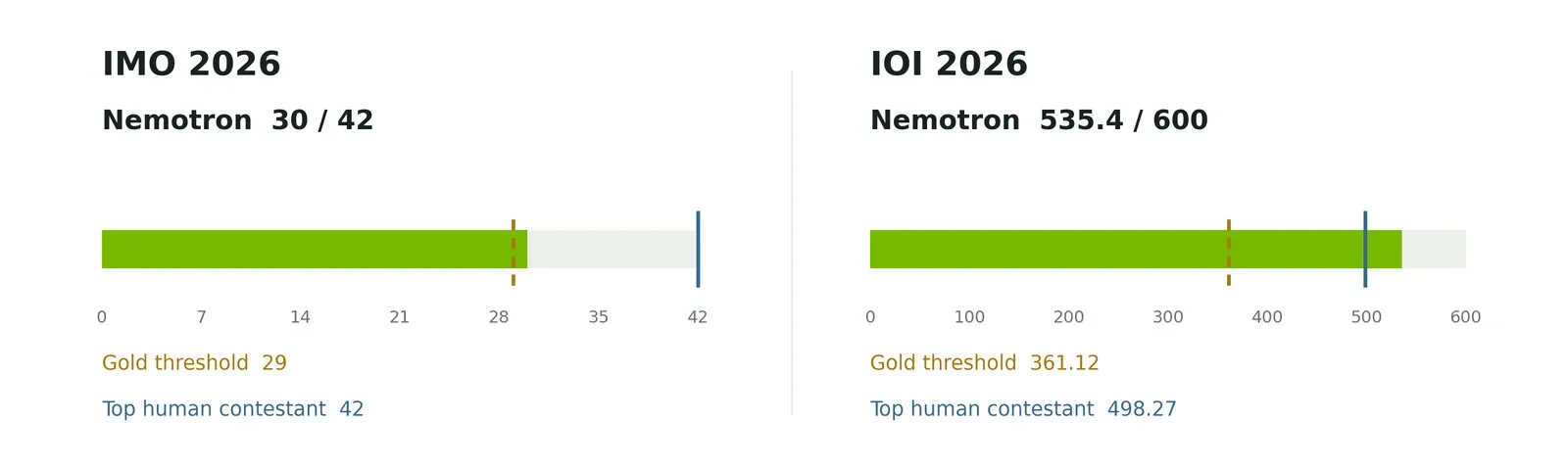
For IOI 2026, Nemotron-3-Ultra-CC scored 535.4 out of 600 in an unofficial prospective run conducted under human-like time, submission, and internet constraints. That exceeded both the stated gold threshold of 361.12 and the top human score of 498.27, though the system was not part of the official ranking. For IMO 2026, an ensemble using general, supervised fine-tuned, and reinforcement-learned Nemotron 3 Ultra checkpoints earned 30 out of 42; official graders assessed the submitted proofs, and the gold threshold was 29. These are different evaluation settings, so the numbers should not be collapsed into a single claim about general intelligence.
The checkpoint is only one layer
A useful way to read these projects is as a pipeline with four layers. The base model supplies broad language, coding, and reasoning capability. Domain data changes the distribution of responses it can produce reliably. Post-training emphasizes behaviors such as constructing proofs or correcting programs. Finally, an inference controller spends additional computation to generate alternatives, inspect them, and revise promising candidates.
This separation matters when adopting a model. Downloading a released specialist checkpoint may reproduce only the second and third layers. If the published result also depends on multiple rounds of generation, critics, or a high-compute selector, a single prompt against that checkpoint is testing a different system. Model cards and benchmark tables are therefore starting points, not deployment specifications.
The same distinction helps explain why supervised fine-tuning and reinforcement learning need not contribute equally. Supervision can efficiently teach the shape of a good solution: what intermediate reasoning to expose, how a proof is organized, or how a program is revised after feedback. Reinforcement learning can then shift preferences toward solutions that satisfy a verifier or reward signal. Its value depends on reward quality and on how much useful behavior supervised training has already established.
Verification differs across domains
Programming and proof generation may share a generate-check-revise loop, but their checkers are not interchangeable. Code can be compiled and run against tests, producing concrete feedback. Hidden tests still leave uncertainty, yet failures often have an operational signal: a wrong answer, timeout, or runtime error. This makes automated iteration relatively direct.
Natural-language proofs are harder to score automatically. A persuasive-looking argument can conceal an unjustified step, a missing case, or circular reasoning. A model acting as critic may share the generator's blind spots. Repeating critique does not guarantee that those errors disappear; it can instead make an incorrect answer more polished. Human grading in the IMO result is consequently important evidence about the final artifacts, while it does not imply that every internal verifier was dependable.
Teams building similar systems should match verification to the task. Executable domains benefit from tests, static checks, and resource limits. Mathematical or policy-heavy domains need explicit rubrics, adversarial review, and escalation for ambiguous cases. When no authoritative automatic verifier exists, confidence scores should route work for review rather than masquerade as proof of correctness.
A practical evaluation ladder
A small evaluation can separate the sources of improvement before a team commits to expensive training or inference. Start with a frozen test set that represents the real distribution and cannot leak into training. Record a base-model, single-attempt result first. Then add changes one at a time:
- Measure the specialist checkpoint with the same prompt and compute budget.
- Add a fixed number of candidate samples without critique.
- Add the verifier or critic while keeping the sample budget fixed.
- Add refinement rounds and measure both quality and compute.
- Have qualified reviewers audit a stratified sample of accepted and rejected outputs.
This ladder reveals whether gains come from specialization, broader search, better selection, or simply more tokens. It also exposes regressions hidden by aggregate scores. For coding, track validity, correctness, runtime, and duplicate failure patterns separately. For proof tasks, label unsupported steps, incomplete case analysis, and verifier disagreements. Report the worst recurring error categories alongside the headline average.
Compute should be part of the result. Candidate count, refinement rounds, latency, and hardware cost can change which approach is practical. A system that succeeds after extensive search may be appropriate for a six-problem competition but unsuitable for an interactive assistant. Conversely, a compact specialist with modest search may offer a better reliability-per-cost tradeoff even with a lower maximum score.
What can transfer beyond competitions
The reusable idea is not that every application needs an olympiad-scale model. It is that training and inference should be designed around the structure of the available feedback. A customer-support system might retrieve policy passages, draft alternatives, check citations, and escalate conflicts. A data-analysis assistant could generate queries, execute them in a sandbox, inspect failures, and revise. In each case, the verifier must represent the actual acceptance criteria rather than a convenient proxy.
Competition results are deliberately narrow and unusually measurable. Real deployments introduce shifting data, incomplete requirements, privacy constraints, and consequences that cannot be reduced to a score. The right follow-up is therefore a domain-specific evaluation with realistic budgets and human review—not an assumption that medal-level performance transfers automatically. Nemotron's results make a compelling case for specialist pipelines; they also show exactly why the whole pipeline must be documented and tested.
Source: One Model Family, Two Gold-Level Results: Fine-Tuning Nemotron for IOI and IMO ↗. How we write