What a Qatar AI Hackathon Reveals About Designing Useful Local Challenges
A Doha hackathon offers a practical blueprint for turning broad AI enthusiasm into locally grounded prototypes, while highlighting the evaluation questions that matter after demo day.

Locally framed hackathons work best when teams prove one bounded capability, expose failure cases, and leave with evidence-driven next steps beyond the demo.
A good AI hackathon is less about compressing ordinary product development into a weekend than about creating a disciplined environment for discovering which ideas deserve more work. The strongest format gives teams a concrete setting, enough technical range to explore different approaches, and a judging process that rewards an understandable problem-solution fit.
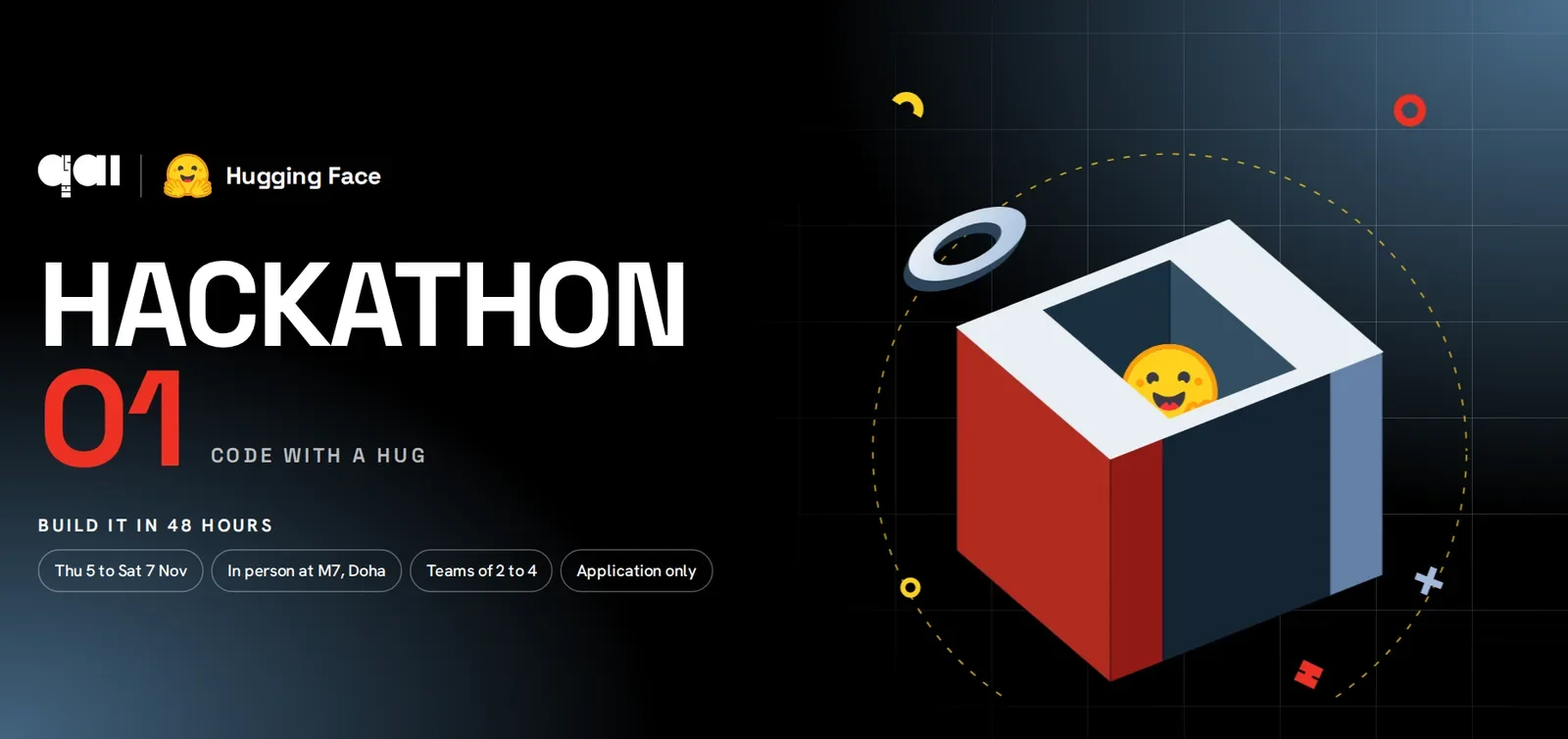
A community report on the Qai and Hugging Face hackathon in Doha provides a useful case study. The event ran from November 5 through 7, 2026, and asked participants to identify a problem in Qatar, use the Hugging Face ecosystem, and propose a solution. According to the organizers, more than 500 people applied; 150 participants were selected and organized into 40 teams. Fifteen submissions became finalists, from which three winners were chosen. Sessions during the event introduced Hugging Face, image and video generation with Diffusers, and local AI.
Those numbers describe the funnel, but the more reusable lesson lies in how a locally framed challenge can be evaluated without confusing a polished demo with a deployable system.
Local framing narrows the discovery problem
“Build something with AI” is too open-ended to guide useful exploration. Asking teams to start with a problem in Qatar adds a geographic and social constraint. That constraint can help participants investigate a recognizable user, workflow, language need, public service, industry, or accessibility gap before choosing a model. It also gives judges a clearer question: does the prototype respond to the stated context, or could the same pitch have been presented anywhere?
Local relevance should not become a demand for sweeping social impact claims. A weekend prototype will rarely establish adoption, cost effectiveness, or long-term benefit. A credible submission can instead define one bounded user journey, explain why existing tools are insufficient, and demonstrate the riskiest technical step. For example, a team addressing multilingual document access might test whether a model preserves key terms across a small, permissioned sample rather than claim that it has solved access for an entire population.
This distinction improves both ambition and honesty. The local problem supplies direction; the prototype supplies evidence about feasibility. Neither alone proves that the idea is ready to scale.
Tool choice should follow the evidence needed
The event's educational sessions covered a broad spectrum: an ecosystem overview, generative image and video tooling, and local AI. That breadth matters because teams can easily treat the most visible model category as the default answer. In practice, the right technical path depends on what the demo must establish.
A visual-generation project may need to show controllability, consistency, provenance, and safe handling of source material. A local inference project may prioritize privacy, offline operation, device constraints, or predictable latency. A retrieval or classification workflow may be more appropriate than generation when traceability matters. The model should therefore be selected after writing down the intended user action and the failure that would make the system unhelpful.
Teams also benefit from separating the interface from the core experiment. A polished front end can make a weak model appear convincing, while a rough interface can hide a genuinely useful capability. Judges can ask for a short architecture description, the origin and permissions of any data, a baseline comparison, and several examples that include failures. These artifacts reveal more than a rehearsed best-case path.
A selection funnel needs consistent criteria
Moving from 40 submissions to 15 finalists and then three winners creates two different evaluation stages. The first stage has to be fast and comparable; the final stage can examine depth. Using the same vague rubric at both points risks rewarding presentation quality twice while leaving technical and contextual risks underexplored.
An initial screen could check four basics: the problem is specific, the proposed user is identifiable, the prototype works at least once, and the use of AI is necessary rather than decorative. Final judging can then examine evidence quality, robustness, responsible data use, practical constraints, and the team's understanding of failure modes. Scores should use anchored descriptions so that “strong” means something more precise than a judge's overall impression.
The best demonstrations include counterexamples. If a system summarizes local information, show a document it handles and one it does not. If it operates in multiple languages, identify which varieties were checked and which remain untested. If it runs locally, state the tested hardware rather than implying support for all devices. Boundaries are a sign that a team understands its prototype, not a reason to hide it.
The valuable work begins after the awards
A finalist collection preserves visibility, but continued progress needs a path beyond ranking. Teams should leave with concrete next questions: which assumption needs user research, which dataset requires permission, which metric captures success, and which failure creates the greatest harm? A lightweight follow-up review can assess whether the project found evidence for those questions rather than whether it added more features.
Organizers can also publish reusable lessons without exposing private data or overselling winners. Common technical obstacles, evaluation templates, model cards, and clearly licensed sample assets can improve the next cohort. Mentors gain evidence about where documentation or tooling is confusing, while participants gain a more realistic view of the work between a demonstration and a dependable product.
The Doha event shows the value of combining a local problem frame with a broad technical ecosystem and a staged selection process. Its most durable outcome will not be the number of applications or demos, but whether teams can turn short-term experimentation into well-scoped questions, reproducible evidence, and responsible next steps.