EXPLORE THE ECOSYSTEM
Models
Small language models, multimodal releases, and the open-weight ecosystem.
53 articlesNewest announcements first

Ai2’s OlmoEarth v1.3 release pairs a satellite foundation model with annual, global embeddings and an interactive explorer. The practical shift is from repeatedly processing raw imagery to testing mapping ideas with reusable feature vectors.

A Hugging Face and Farsight article argues that financial firms increasingly judge AI by where models run and how access is governed. The useful lesson is broader: deployment architecture, controls, and workflow evidence must be evaluated together.

IBM Research has packaged four Granite forecasters behind one quantile-forecasting interface. Here is how to evaluate the ensemble’s accuracy, calibration, cost, and operational fit before choosing it over a single model.
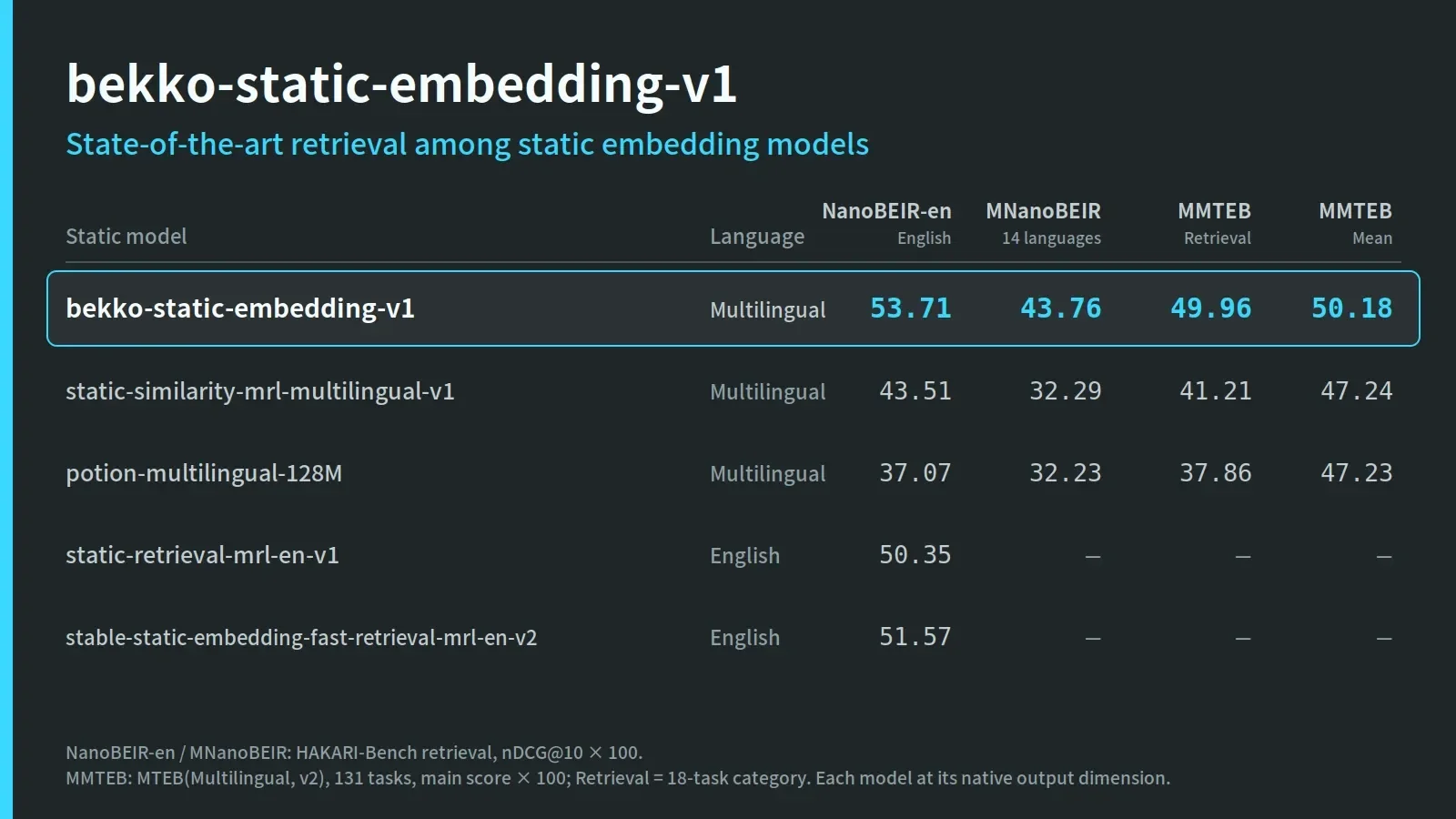
Bekko's new multilingual static embedding model highlights a useful retrieval tradeoff: extremely cheap encoding can be valuable even when contextual models retain the quality lead.

LightOn’s SlideOn and mSlideOn explore a practical middle path in neural search: convert dense or late-interaction token representations into learned sparse features that can be served through an inverted index.

Reflection's 501B-parameter Beam model pairs sparse expert routing with a one-million-token context window, but its real test is whether teams can turn open weights into an operable, measurable system.

A useful memory system must do more than preserve and retrieve old information. When facts change, agents need explicit rules for deciding whether to append, replace, discount, or reconcile what they previously knew.
FLUX.3 Image Klein arrives in Diffusers with one pipeline for generation, reference-based editing, and bounding-box layout control. Here is how to evaluate the new control surface, its compute tradeoffs, and where structured prompts help most.

IBM's Granite Switch 4.1 combines conversational generation, decision adapters, and speech recognition behind a shared serving path. The interesting question is not how many modes fit in one model, but when shared infrastructure improves a real workflow.
Meta's Muse Spark Open combines a very large mixture-of-experts model with text, image, audio, and video inputs. Its release is a useful case study in planning memory, context, routing, and evaluation as one deployment system.
 Article·6 min