SOV-Transcribe-1 Puts Controllable Speech Recognition in Focus
Salesforce's new open-weight ASR model combines non-streaming transcription with instruction-driven formatting and contextual hints, highlighting why deployment control and task-specific evaluation matter as much as headline word error rate.

Evaluate SOV-Transcribe-1 on critical entities, instruction consistency, distractor-heavy context lists, latency, and language-specific audio before choosing it for a production speech workflow.
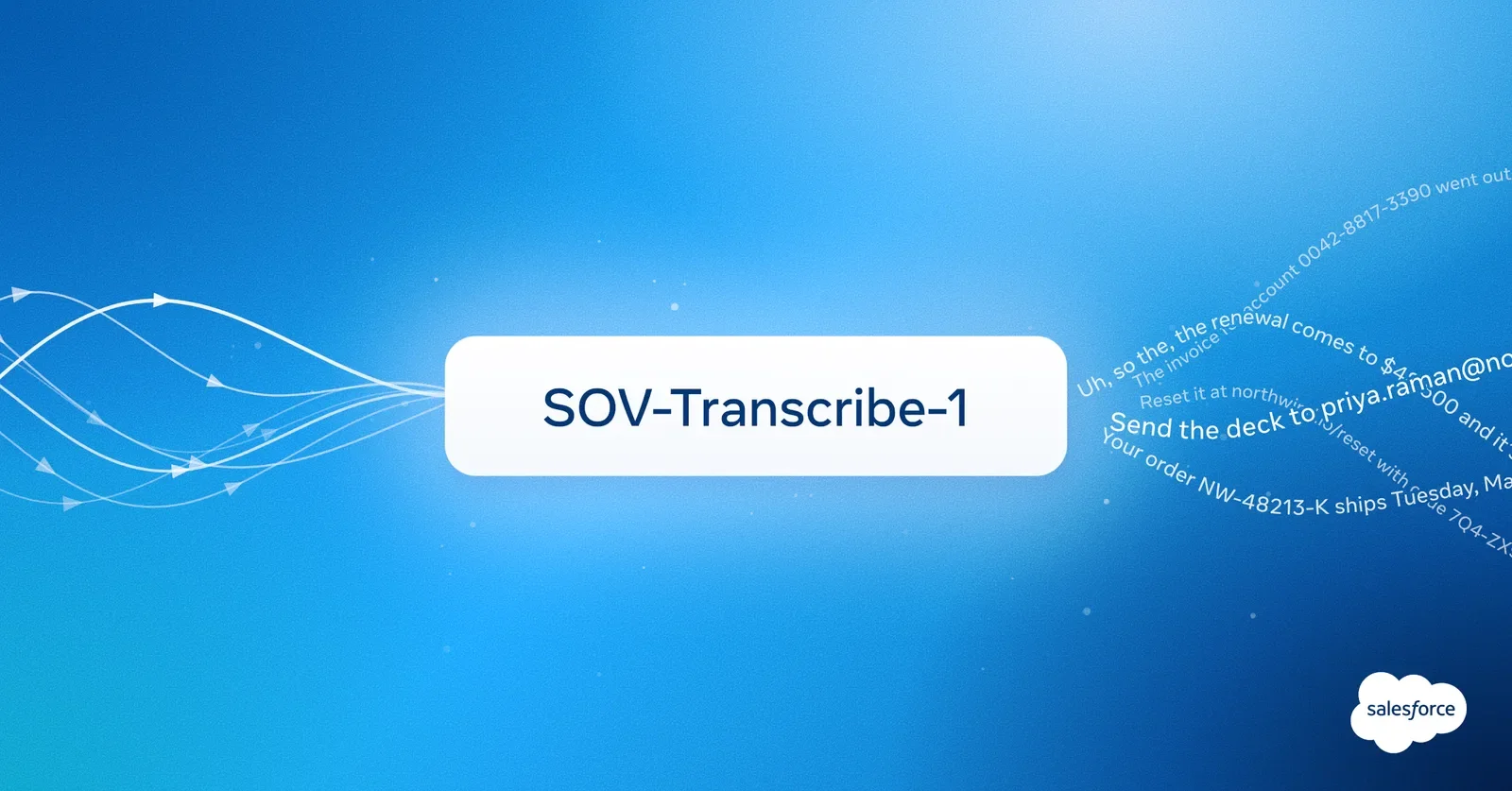
Salesforce has released SOV-Transcribe-1, an open-weight automatic speech recognition model aimed at applications where a transcript must preserve more than the general meaning of an utterance. The model is designed for non-streaming transcription and adds two controls that are especially relevant in production: natural-language instructions for transcript style and contextual hints for unusual terms.
The release is a useful reminder that speech recognition quality is multidimensional. A low average word error rate can coexist with damaging mistakes in an email address, product name, account number, or punctuation convention. Choosing an ASR system therefore requires matching its evaluation to the workflow around it, rather than selecting from a single leaderboard column.
What the release adds
SOV-Transcribe-1 has 4 billion active parameters and 26 billion total parameters. Salesforce describes it as a speech-augmented language model and publishes the weights under Apache 2.0. The announcement reports a 2.28% word error rate on the Artificial Analysis evaluation and identifies it as the leading open-weight non-streaming system on that leaderboard as of November 12, 2026. Rankings are snapshots, so the underlying test conditions and current leaderboard should be checked before making a comparison.
Two capabilities distinguish the model from a plain audio-to-text interface. Style steering lets an application request conventions such as digits instead of spelled-out numbers, removal of disfluencies, or particular casing. Context biasing supplies keywords or a short description to help resolve rare and confusable terms. The announcement also reports multilingual support, although its strongest headline claims concern English; language coverage should be validated separately for any intended locale.
Why entity accuracy changes the evaluation
Consider a support caller saying an address such as marie_7@example.com. A transcript can be almost perfect by word count while replacing the underscore, digit, or domain. To a reader, that may look like a minor blemish. To software that uses the transcript as a tool argument, it is a failed task. The same pattern applies to serial numbers, URLs, stock symbols, medication names, and snippets of dictated code.
That gap explains the value of entity-oriented measures alongside conventional word error rate. The release cites VoiceCodeBench results based on complete task success and entity matching, plus contextual tests centered on names and products. For a practical review, teams should create a private test set that reflects their own high-cost tokens. It should include realistic acoustic variation, similar-sounding alternatives, and examples where the context list contains distractors rather than only the correct answer.
Evaluation should also distinguish correction from invention. Context biasing may improve recognition of a known catalog, but an application must check whether hints cause absent terms to appear. Useful measurements include exact field validity, false insertion rate, successful downstream actions, and performance when no hint is supplied. Those measures connect recognition behavior to actual operational risk.
Treat formatting as an interface contract
Instruction-controlled transcription can reduce the amount of cleanup code between recognition and an application. A dictation tool may want polished prose, while a legal record may require fillers and repetitions. A voice agent may need normalized numbers but must preserve a customer identifier exactly. These are different output contracts, even when the audio is identical.
Prompts do not remove the need for deterministic validation. Applications should keep formatting instructions versioned, test them against a fixed audio suite, and validate structured fields after transcription. Where auditability matters, retaining the audio and an unmodified verbatim transcript alongside any cleaned rendering makes later review easier. A user interface should also make transformations visible instead of presenting edited text as a literal record.
The model is non-streaming, which creates another boundary. It may fit post-call processing, uploaded media, voicemail, and batch dictation, but it does not by itself establish suitability for low-latency captions or turn-taking voice agents. Teams should measure end-to-end delay, memory requirements, throughput, and maximum practical audio length on their own infrastructure. Parameter counts alone do not answer those deployment questions.
A grounded adoption checklist
Start with the model's license and open weights, then evaluate the complete system that will run them. Confirm hardware fit and inference behavior without assuming that benchmark efficiency translates directly to a particular accelerator. Separate clean speech, background noise, overlapping speakers, accents, and every required language in the test report. Break out results by group so an overall average cannot hide a weak segment.
Next, define the costly errors before testing. If phone numbers trigger calls or names select customer records, score those fields exactly and require confirmation when confidence or validation fails. Test style instructions for consistency, adversarial phrasing, and regressions after prompt changes. Test context lists at realistic sizes, including irrelevant entries. Finally, compare against the existing system using the same audio, preprocessing, and success criteria.
SOV-Transcribe-1 expands the open-weight options for controlled, domain-aware transcription. Its most important contribution may be the evaluation question it raises: not simply how many words are correct, but whether the transcript is correct in the precise ways the application depends on.
Source: Introducing Salesforce SOV-Transcribe-1: #1 Open-Weight Model Built for Real-World Speech ↗. How we write