Bounded AI Decisions Need Better Contracts, Not Just Shorter Outputs
A preview decision-oriented API highlights a useful architecture for routing, triage, and agent control. The real engineering work lies in defining answer spaces, measuring abstention, and keeping authorization outside the model.

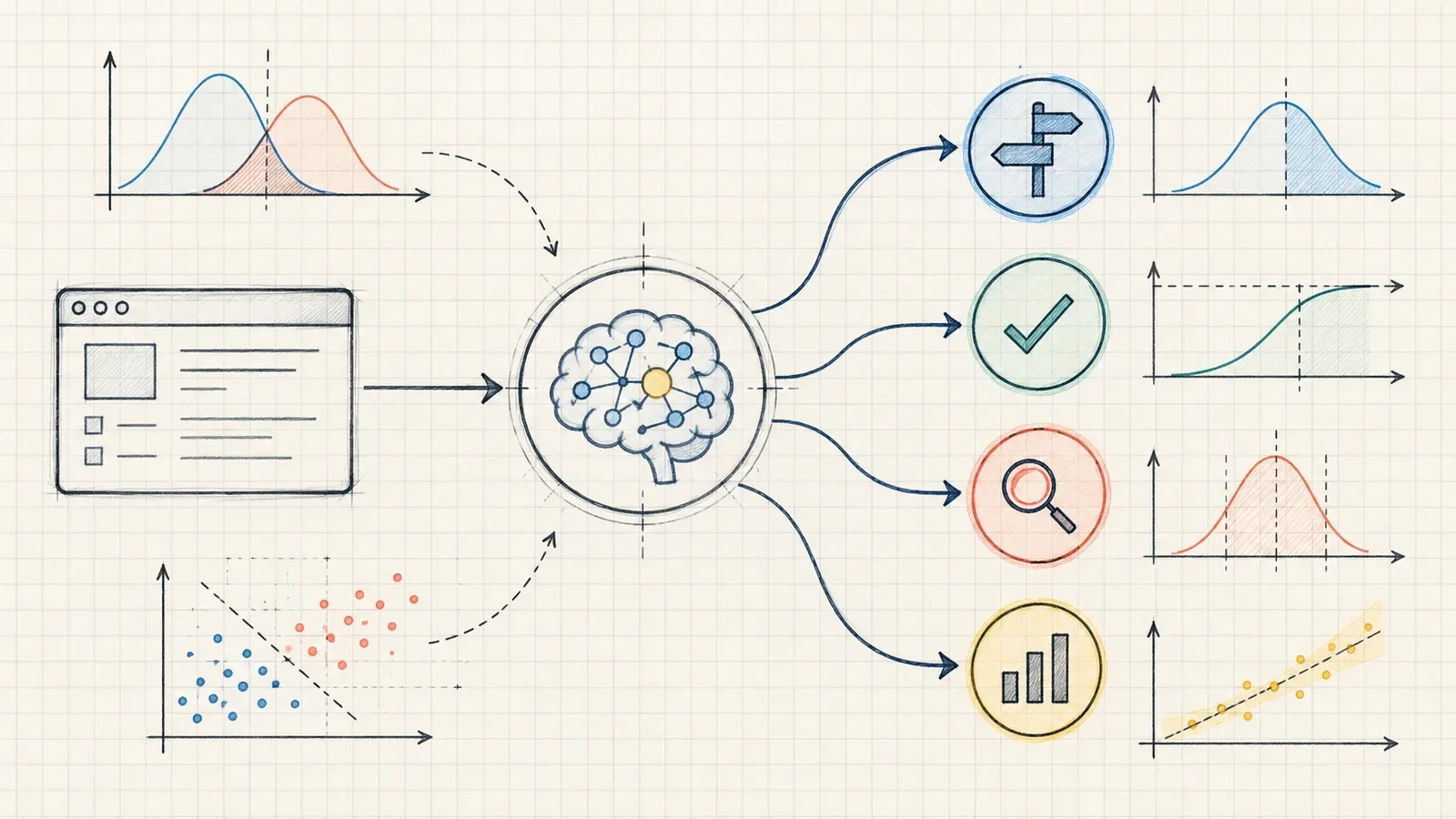
A bounded decision endpoint is most useful when its taxonomy, abstention path, policy checks, and downstream evaluation are designed as one system.
Many AI features do not actually need a paragraph. A support system needs a queue, a moderation pipeline needs a category, and an agent may need to choose its next step from a short allowlist. Treating every such choice as a miniature conversation adds parsing, retries, and ambiguity to a job whose output is ultimately a branch in code.
A new community guide examines OpenAI's limited-preview Decisions API through this lens. According to the guide's account of the DevDay announcement, the interface is intended for bounded questions over developer-defined answers, with text or image context and a specialized version of GPT-6 Luna. The guide also reports early coverage describing low latency, while repeatedly warning that developers must verify the changing preview contract. Those details are useful context, but the broader lesson does not depend on a particular endpoint: a model judgment becomes safer and easier to evaluate when its possible outputs are explicit before inference.
Start with the decision contract
A good bounded question has three parts: relevant evidence, a precise question, and a complete set of allowed outcomes. For a support ticket, that could mean the message, customer tier, and recent account events; the question "Which team owns this case?"; and four named queues plus an "uncertain" option.
The final option matters. If the available labels do not cover ambiguous or novel cases, the model must force every input into a route. That turns uncertainty into confident-looking misclassification. An abstention path creates a place for manual review and supplies data for improving the taxonomy.
The answer space also needs operational meaning. Two engineers should agree about the boundary between "billing" and "account" before the model is evaluated. Written rubrics, labeled edge cases, and ownership rules are part of the API contract even if they never appear in the request payload. Without them, an apparently neat enum only hides inconsistent policy.
Keep judgment separate from authority
Structured output removes some parsing risk, but it does not grant permission. A model may select send_email, issue_refund, or delete_record; the host application still must check identity, scope, business rules, rate limits, and required approvals. The safest design treats the selection as evidence supplied to a deterministic policy layer.
This separation is particularly important in agent loops. Give the decision layer only actions that are valid for the current state, then validate the chosen action and its arguments again before execution. High-impact actions should require an independent condition such as explicit user confirmation or a policy-engine approval. A score, however high, should never expand the caller's privileges.
Audit records should capture the input schema version, option set, model version, returned choice, policy result, and eventual outcome. That history makes it possible to distinguish a model error from a bad taxonomy or an authorization bug. It also supports replay when a prompt, model, or policy changes.
Evaluate the branch, not just the label
Aggregate accuracy is not enough for a routing system. A rare false negative may be far more expensive than several false positives, and a classifier that looks strong overall can fail on one language, customer segment, or image type. Evaluation should therefore mirror the action that follows each label.
Begin with historical examples and freeze a test set before tuning. Compare the model with simple rules and with the current workflow. Report a confusion matrix, per-class precision and recall, abstention coverage, and downstream cost at candidate thresholds. If the service returns a confidence-like score, test calibration rather than assuming that 0.9 means a 90 percent chance of correctness.
Shadow mode is the safest next step: run the decision without allowing it to control production, then compare it with the real outcome. For triage, measure whether the selected queue resolved the case without transfer. For model routing, include the quality and cost of the model ultimately chosen. For agent actions, record whether policy rejected the recommendation and whether a human changed it. These end-to-end measurements reveal value that an isolated classification score cannot.
Latency and cost need workload tests
A specialized decision endpoint may avoid generating explanatory prose, which can make repeated control loops faster and cheaper. But total performance includes network time, input length, queueing, retries, observability, and whatever happens after the choice. A fast classifier that frequently routes work to an expensive fallback may cost more than a slower but better-calibrated alternative.
Benchmark with the actual option count, context size, concurrency, and geographic path. Track p50, p95, and p99 latency rather than a single headline number. Include malformed inputs, timeouts, unavailable models, and unknown response values in the test plan. The application should have deterministic fallback behavior for every one of those cases.
Treat preview integrations as replaceable
Preview APIs can change names, schemas, limits, score semantics, availability, and pricing. A small internal adapter can isolate those changes. The rest of the application should depend on a stable domain object—such as a route, confidence metadata, and abstention reason—rather than on a vendor response shape.
This architecture also makes comparison easier. A rules engine, local classifier, general-purpose model with structured output, or dedicated decision service can all implement the same internal interface. Teams can then choose on measured quality, latency, privacy, and cost instead of assuming that a new endpoint category is automatically the right fit.
The useful shift is from prompting for prose to designing a controlled decision surface. Bounded outputs can simplify integration, but only a clear taxonomy, an abstention path, deterministic authorization, and workflow-level evaluation turn them into dependable software.
Source: What Is OpenAI Decisions API? A Practical Guide ↗. How we write