Falcon-ASR Puts Emirati Speech at the Center of Multilingual Transcription
TII's 1.6B-parameter Falcon-ASR targets Arabic speech, especially Emirati, while sharing one set of weights across five languages. Its reported results are promising, but deployment decisions still require tests on real accents, audio conditions, and workflows.

Falcon-ASR is a promising dialect-aware candidate, but teams should validate it on their own Arabic varieties, code-switching patterns, audio channels, and correction workflows before production use.
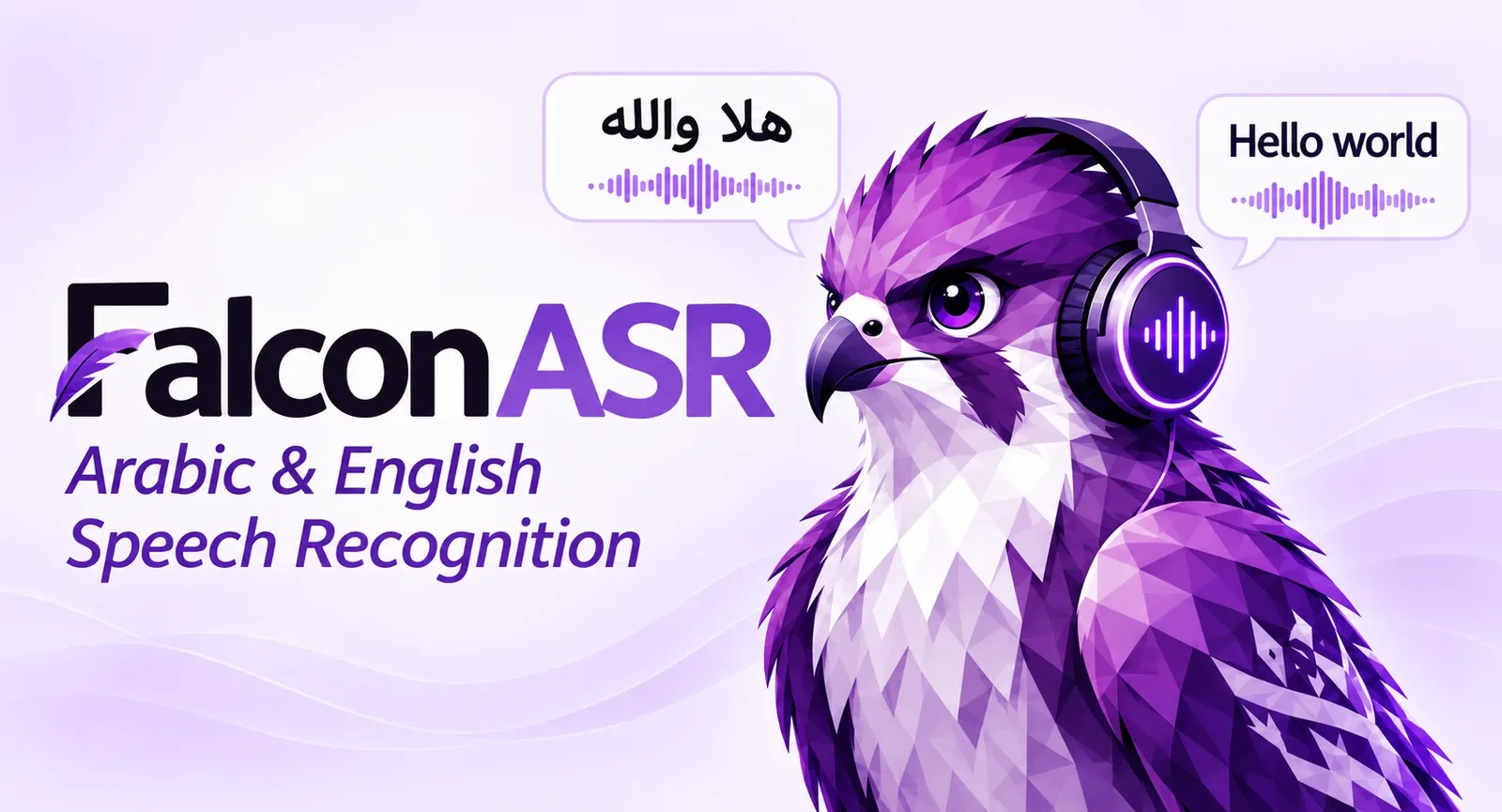
Speech recognition quality is rarely uniform across a language. Arabic makes that gap especially visible: a system that handles carefully read Modern Standard Arabic can still stumble on regional vocabulary, rapid conversation, code-switching, or a noisy phone call. Falcon-ASR, a new 1.6-billion-parameter model from the Technology Innovation Institute (TII), is designed around that practical problem, with particular attention to Emirati speech.
The model covers Arabic, English, French, Spanish, and Portuguese using the same weights and without requiring a language flag. TII also reports word-level timestamps, which can make the output more useful for subtitling, search, and review tools. The release is therefore interesting not simply as another multilingual recognizer, but as an attempt to give a comparatively under-served Arabic variety a central role in model design and evaluation.
What the reported numbers establish
TII evaluated Falcon-ASR using the six-test-set protocol of the Open Universal Arabic ASR Leaderboard. The reported equal-weight average word error rate (WER) is 20.92%, versus 23.17% for the strongest published result in the leaderboard snapshot checked on September 30, 2026. That is a difference of 2.25 percentage points under that specific protocol. Lower WER means fewer word-level insertions, deletions, and substitutions relative to the reference transcripts.
For additional Emirati and Gulf recordings, TII reports an internal evaluation with human-validated reference transcripts. Falcon-ASR reached 22.73% WER and 10.19% character error rate (CER), and had the lowest errors among the systems included in that comparison. The internal set complements the UAE portion of the public Casablanca benchmark, but it should be interpreted separately: outside users cannot reproduce an internal evaluation from the announcement alone.
The model also achieved a reported mean WER of 5.74% across seven public English test sets used by the Hugging Face Open ASR Leaderboard. These figures show the model's intended range, but they should not be collapsed into a single idea of “accuracy.” Test composition, transcript conventions, language, and audio quality all change what an error rate means.
Why dialect-focused evaluation matters
A transcript is judged against a chosen written reference, yet spoken Arabic crosses boundaries that writing conventions do not always capture cleanly. Speakers may mix formal Arabic with local forms, alternate between Arabic and English, or pronounce the same borrowed term in several reasonable ways. A benchmark score can penalize a plausible rendering if its spelling differs from the reference. CER can add useful detail in this setting because it measures smaller units, but it does not remove the underlying question of what counts as the preferred transcript.
Falcon-ASR was trained on Emirati, Modern Standard Arabic, other Gulf and Arabic dialects, and English. TII says its training treatment included background noise, overlapping speech, music, reverberation, telephony effects, and changes in speed and pitch. That variety is relevant to meetings and calls, where clean studio speech is the exception. Still, synthetic or curated variation cannot guarantee robustness for a particular microphone, workplace, speaker population, or acoustic environment.
The dialect emphasis has another practical benefit: it encourages evaluators to stop treating “Arabic” as one deployment condition. Product teams should segment results by dialect, speaking style, channel, and code-switching pattern. Averages can otherwise hide severe errors for a smaller but important user group.
A practical evaluation plan
Before adopting any speech model, teams can assemble a small, permissioned test set that resembles the intended workload. The sample should include the major dialects, devices, room types, and call channels the application will encounter. It should also preserve difficult cases such as overlapping speakers, proper names, numbers, addresses, and language switching instead of filtering them away. Sensitive recordings require an explicit retention and access policy.
Evaluation should separate at least four questions:
- Literal accuracy: Measure WER and CER against consistently prepared references, then inspect the most frequent substitutions and deletions.
- Meaning preservation: Review whether errors alter names, amounts, dates, negation, or obligations. Two transcripts with similar WER can carry very different operational risk.
- Timing utility: Check whether word timestamps remain useful after pauses, cross-talk, and long recordings. Subtitle alignment and searchable playback can tolerate different levels of drift.
- Workflow cost: Track how much human correction is required, including dialect normalization and formatting. A lower headline WER is valuable only if it reduces the actual review burden.
Teams should report these slices independently rather than selecting one aggregate score. For example, a meeting assistant may prioritize speaker overlap and named entities, while a captioning tool may care more about timestamp stability and reading speed. A call-analysis system may need reliable handling of telephony compression and frequent Arabic-English switching.
Multilingual convenience has boundaries
Using one set of weights for five languages can simplify a pipeline: applications do not need to route every clip to a separately loaded recognizer. Automatic handling may also help within mixed-language collections. But the absence of a language flag does not prove seamless transcription of rapid code-switching inside a sentence. That behavior needs targeted testing, as do ambiguous names and words shared across languages.
The release announcement says API access and native applications are planned, while a Hugging Face demo is available now. That distinction matters for engineering decisions. A demo can establish whether outputs look promising; it does not establish production latency, concurrency, privacy controls, hosting requirements, or support commitments. Those operational properties should be assessed only when corresponding interfaces and documentation exist.
What to take from the release
Falcon-ASR's strongest contribution is the combination of a multilingual model with explicit attention to Emirati speech and evaluation. Its public Arabic benchmark result gives teams a reproducible starting point, while the separately labeled internal evaluation suggests where TII sees additional gains. Neither replaces testing on the recordings and transcript conventions of a real application.
For teams serving Arabic speakers, the useful next step is not to ask whether the model “supports Arabic.” It is to test which Arabic varieties, speaking conditions, and language mixtures it handles well, then connect those findings to the cost and risk of the intended workflow. Falcon-ASR offers a credible new candidate for that evaluation—and a reminder that dialect coverage should be measured, not assumed.
Source: Introducing Falcon ASR ↗. How we write