What Adapter-Only Synchronization Changes for Distributed RL Training
A new AsyncGRPO workflow separates training from rollout generation by moving compact LoRA adapters through shared storage. The design shows how versioning, cache-aware routing, and explicit consistency rules can replace assumptions built into a tightly coupled cluster.

Compact adapters make loosely coupled RL infrastructure feasible, but immutable versioning and fleet-wide load consistency are essential for correct rollouts.
Reinforcement-learning pipelines for language models often treat training and generation as two halves of one tightly connected system. The trainer updates a policy, inference workers generate fresh rollouts, and new weights must move between them frequently enough to keep the data useful. That is straightforward inside a conventional cluster with shared storage and high-bandwidth collective communication. It becomes harder when each workload runs as an independent cloud job.
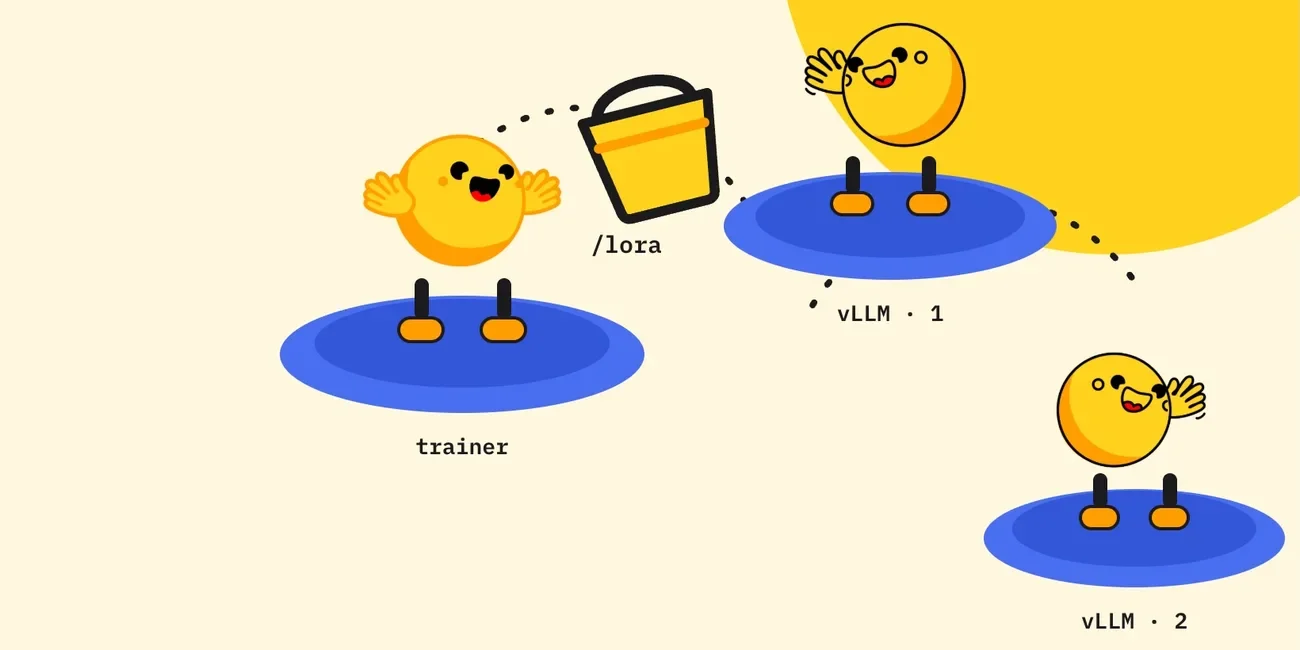
Hugging Face’s recent AsyncGRPO example offers a useful alternative: train a small LoRA adapter, publish only that adapter through a mounted Storage Bucket, and let separate vLLM jobs load it at runtime. A proxy coordinates multiple inference replicas. The important lesson is broader than any one service: shrinking the synchronization unit changes which distributed-systems problems matter, but it does not make consistency automatic.
Why adapter-only synchronization matters
A full policy refresh can involve moving billions of parameters. A low-rank adapter is much smaller, so it can be written as an ordinary versioned artifact rather than transferred through a specialized multi-node collective. In the published setup, TRL’s AsyncGRPOTrainer trains LoRA and periodically saves a new adapter directory. Every job mounts the same bucket at the same absolute path, allowing vLLM to load the files using its runtime adapter endpoint.
This decomposition creates a clean control boundary. The trainer owns policy creation, the bucket carries immutable artifacts, and inference servers own rollout execution. Training and generation can scale independently because they no longer need to share a host. Checkpoints can also survive ephemeral compute when they live in persistent storage.
The tradeoff is latency. A mounted object store is not the same as a local disk: replicas may observe a newly published directory at slightly different times. Adapter size makes this approach practical, but visibility and load completion still have to be coordinated. Teams considering the pattern should measure not only upload time, but the interval from publication until every serving replica confirms the same version.
Version names become a correctness mechanism
An asynchronous trainer intentionally permits some policy staleness. A rollout that began on an older policy can remain valid within a configured version window, so inference may need to retain several adapters simultaneously. Capacity planning must therefore include the current version, all still-acceptable older versions, and temporary room for swapping versions.
Versioned adapter names also protect the KV cache. Prefix caching is valid only when both the token prefix and the model state match. Reusing one adapter name for changing weights risks making cache entries appear compatible after an update. Giving every adapter an immutable policy-version name makes the dependency explicit: cached blocks created for version 3 cannot satisfy a request for version 4.
This is a general design rule for serving mutable model components. An artifact identifier should describe content, not merely a role such as “latest.” A mutable pointer can still tell clients which version to request, but requests, logs, caches, and evaluation records should preserve the immutable version. That makes failures reproducible and prevents optimization layers from silently crossing policy boundaries.
The proxy does more than balance traffic
A conventional load balancer may spread requests evenly, yet that can waste the most valuable inference-side optimization. GRPO sends multiple completions for the same prompt. If those requests reach one replica, later requests can reuse the prompt’s cached attention keys and values. Round-robin routing can force several replicas to repeat the same prefill.
The example proxy tracks chained hashes of complete token blocks, seeded with the adapter version. It uses those hashes to estimate which replica already owns a useful prompt prefix. Shared boilerplate, such as a chat template, is ignored for affinity because it appears everywhere and does not distinguish a prompt. The router prefers the replica with a specific cached prefix unless its queue is too far ahead; then it spills work to a less busy server.
That policy exposes a practical tension. Strong affinity saves prefill compute, while strict balancing limits tail latency. The right spill threshold depends on prompt length, generation length, concurrency, and hardware. Rather than copying one constant, operators should record affinity hits, cold requests, spills, in-flight imbalance, and request latency together. A high cache-hit rate is not a success if one replica becomes a persistent straggler.
The proxy is also a consistency coordinator. State-changing calls—adapter load and unload, pause, and resume—must reach every replica. If one server cannot see a new adapter yet, a bounded retry can accommodate storage propagation. If loading ultimately fails, successful replicas should roll back so that a policy name never means different things across the fleet. Health should likewise describe the whole serving group, not whichever replica answered first.
How to evaluate this architecture
Start with failure tests, not peak throughput. Delay adapter visibility on one replica and confirm that traffic cannot use a partially installed version. Exhaust adapter slots and verify that a still-valid stale policy is not evicted. Restart the trainer and ensure its checkpoint and version counter resume coherently. Send identical prompts under two adapter versions and confirm that their cache identities remain separate.
Next, locate the bottleneck with phase-level timing: training step, adapter save, storage propagation, replica load, prompt prefill, and token decode. Adding inference replicas will not improve throughput when optimization is dominant, while accelerating training can increase synchronization pressure. The useful configuration is the one that balances these stages under the desired staleness budget.
Finally, treat the shared bucket and proxy as production dependencies. Apply least-privilege mounts, keep serving mounts read-only, bound retries, expose per-replica status, and retain enough version metadata to audit every rollout. Adapter-only synchronization removes the need for a tightly coupled communication fabric, but the resulting system succeeds only when artifact identity, cache identity, and fleet state agree.
Source: Async GRPO with LoRA across HF Jobs: a bucket, a proxy, and no NCCL ↗. How we write