A 2.8-Trillion-Token Indic Corpus Makes Data Design the Main Experiment
NVIDIA and AI4Bharat's forthcoming Indic corpus pairs broad language and script coverage with an open generation workflow. Its greatest value may be the ability to audit, adapt, and test the recipe—not merely the headline token count.

Treat the corpus as an auditable multilingual data pipeline: group splits by source, track language and script mixtures, and verify gains with controlled, per-language evaluation.
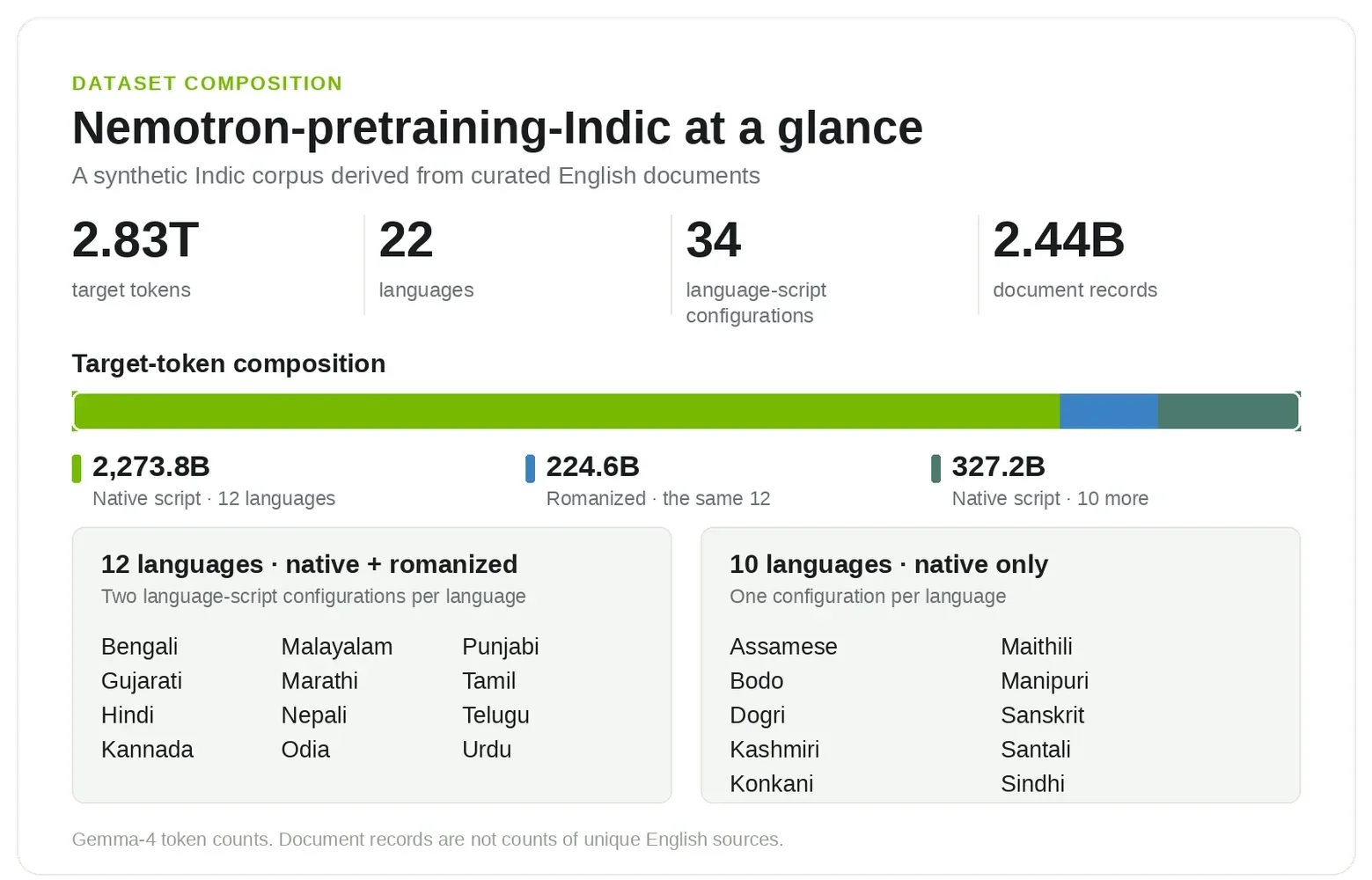
NVIDIA and AI4Bharat have announced Nemotron-pretraining-Indic-v1, a forthcoming corpus of roughly 2.8 trillion tokens spanning the 22 languages listed in India's Constitution. Native-script material covers every language, while twelve languages also receive romanized variants, producing 34 language-and-script configurations. The release is paired with an open, GPU-accelerated generation pipeline rather than presented only as a static dataset.
That distinction is important. A very large multilingual corpus can increase the supply of training material, but its usefulness depends on provenance, mixture design, script handling, and evaluation. An inspectable recipe gives model builders more ways to study those decisions and adapt them to a particular domain.
The unit of value is a traceable record
The project begins with curated English documents and produces Indic-language versions while retaining source identifiers. Twelve languages use a workflow built around full-document translation, automated assessment, targeted repair, and, for a subset, conversion into Latin script. Outputs must reach a rubric score of at least 75 out of 100; that number is an acceptance threshold, not a claim of 75 percent accuracy. The announced total includes 438.4 billion tokens recovered through repair. Ten other languages use a separate translation path, with special handling for long Santali documents and Manipuri script conversion.
For downstream teams, provenance is more consequential than a raw row count. If several records are translations or script variants of one source, a random split can place closely related content in both training and evaluation sets. That creates leakage without any exact duplicate. Splits should therefore be grouped by source identifier before language or script variants are assigned. The same grouping can support audits: reviewers can compare an output, its source, and related variants as one family.
Token counts also require careful interpretation. They vary with the tokenizer, and parallel variants can express substantially the same information. The corpus inventory is not automatically the number of distinct facts a model sees, nor the token budget that should be used in a training run.
Native and romanized text solve different problems
Romanized language is not simply noisy native script. It can represent how people actually type when a Latin keyboard is convenient, and spelling often varies by person, region, and context. Native-script and romanized examples therefore provide different exposure even when their semantic source is shared.
A practical mixture should track at least three axes: language, script, and origin type. Origin type separates translated synthetic material from naturally authored text. Without those labels, aggregate loss or benchmark scores can conceal an improvement for a high-volume language alongside regressions for smaller ones. A useful experiment holds the total token budget fixed, changes one mixture dimension at a time, and reports results per language and script.
Natural text remains essential. Translation can carry technical explanations into more languages, but it cannot manufacture local cultural knowledge, region-specific terminology, or the full range of idiomatic usage. Synthetic translations are best treated as one component of a corpus, combined with properly licensed, locally authored material and reviewed by speakers familiar with the target domain.
The training result is evidence for a recipe, not attribution
The announcement reports that a Nemotron 3.5 Super VL continued-pretraining stage used 100 billion tokens, including 10 billion tokens from a mixture of synthetic and natural Indic data. Scores rose across five reported Indic knowledge and reasoning benchmarks between the checkpoints before and after that stage. The comparison supports the combined stage, but it does not isolate the contribution of this synthetic corpus, any single language, or the natural-data share.
That boundary suggests a better evaluation plan for teams adopting the data. Start with a baseline, then compare natural-only, synthetic-only, and combined mixtures at equal budgets. Measure English retention as well as Indic performance. Add language-quality review for fluency, script fidelity, terminology, and unwanted residual English. Automated metrics can identify broad trends, while native-speaker review is needed to detect errors that remain grammatical yet change meaning.
For technical corpora, preservation tests deserve their own scorecard. Equations, code blocks, URLs, tables, and named entities can be damaged even when surrounding prose reads smoothly. Tests should include deliberately difficult documents and should record failure categories, not only a single average score.
How to evaluate the release responsibly
Before scaling a training job, inspect a small stratified sample from every intended configuration. Confirm the dataset card and license, pin a revision, and check whether fields expose the provenance needed for grouped splits. Sample short and long documents, technical and general material, accepted first-pass translations and repaired records where distinguishable.
Then define rejection and escalation rules. Low automated scores may trigger repair, but high scores should not exempt a sample from human review. Translator and judge independence also matters: when one model performs both roles, shared blind spots can make errors appear acceptable. A smaller audit using a different model or human reviewer can expose correlated failures.
Finally, publish mixture proportions and per-language outcomes with any derived model. The open pipeline makes prompt changes, thresholds, windowing, and script mapping part of the experimental configuration. Recording those choices turns a huge dataset from an opaque input into a reproducible data-design study. The release's lasting contribution may therefore be less about reaching 2.8 trillion tokens than about making multilingual corpus construction easier to question, measure, and improve.
Source: Scaling Indic Pretraining: 2.8 Trillion Tokens and an Open Data Generation Pipeline ↗. How we write