What It Takes to Evaluate Training on an Inference-First NPU
VKORE-46M-NPU turns an unusual hardware claim into a useful evaluation case: can an inference-oriented accelerator execute a complete training loop, and what evidence is needed before that result generalizes?

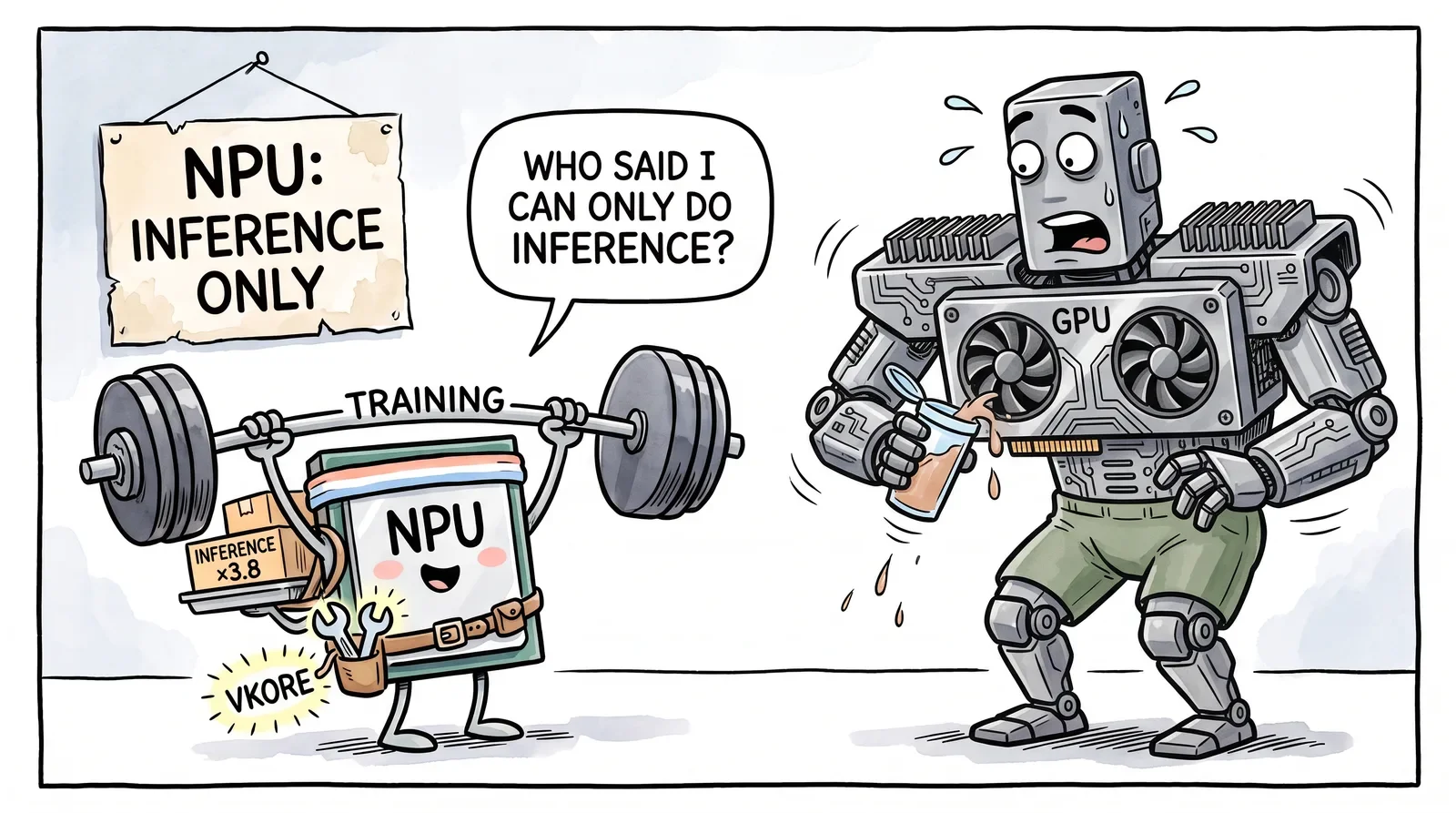
Treat inference-NPU training as a systems claim: matched reference runs, transparent timing boundaries, and scaling tests matter more than a falling loss curve alone.
A processor sold for inference is usually judged by how quickly and efficiently it executes a fixed graph. Training asks for something fundamentally less convenient: activations must remain available, gradients must flow backward, parameters must change, and optimizer state must persist. That makes any claim of pretraining on inference-oriented silicon interesting—but it also makes careful evaluation more important than the headline.
FINAL-Bench's VKORE-46M-NPU is a compact case study. The team reports pretraining a roughly 46-million-parameter decoder-only transformer from scratch on 32 first-generation NPUs introduced in 2025. The model uses a character-level tokenizer and TinyStories, with a conventional modern architecture built from RoPE, SwiGLU, RMSNorm, and grouped-query attention. Its released artifacts are meant to demonstrate the training path, not to compete as a general assistant.
Why backward execution changes the problem
An inference graph mostly moves in one direction. Its parameters can be treated as constants, operators can be fused aggressively, and memory can be reclaimed as soon as intermediate values are no longer needed. A training step reverses many of those assumptions. It needs saved activations, gradient buffers, mutable weights, and optimizer statistics. The backward graph also has operators and numerical sensitivities that an inference compiler may never have been designed to represent.
This distinction helps separate three achievements that are easy to conflate. Running a model on an NPU demonstrates inference support. Updating a small subset of adapters demonstrates a limited training path. Pretraining every parameter from a random initialization requires a complete loop: forward pass, loss, backward pass, optimization, and repeated parameter updates. The last case is a substantially stronger systems test, even when the model itself is small.
Precision is another boundary. Formats that preserve output quality during inference may not preserve small gradients or stable accumulations during training. A credible implementation therefore needs more than kernels that execute; it needs numerical behavior that stays close enough to a trusted reference across many updates. Memory pressure also grows because parameters are only one part of the footprint. Activations, gradients, and optimizer state can dominate the budget.
The comparison is more useful than a falling curve
The project's central validation is a matched GPU run. According to the release, the NPU and GPU experiments used identical initialization, data order, and schedule, and their loss trajectories had a reported correlation of 0.99. The team also says throughput converged to a comparable level. Those observations are meaningful evidence of similar optimization behavior under the tested setup, but they are not a universal performance result.
A decreasing training loss alone is a weak check. A faulty gradient, unstable low-precision path, or subtle parameter-update error can still move loss downward. A controlled reference makes divergence visible. For another accelerator project, the practical evaluation recipe is straightforward:
- Fix initialization, examples, ordering, and hyperparameters across devices.
- Record loss at the same logical training steps rather than merely comparing wall-clock plots.
- Compare intermediate checkpoints or parameter deltas, not only the final sample output.
- Report warm-up, compilation, synchronization, and input-processing costs separately from steady-state compute.
- Repeat with more than one seed before treating close trajectories as robust.
Correlation is helpful, but it can hide a consistent offset or scale difference. Absolute and relative loss error, gradient norms, checkpoint distances, and the location of any divergence would make the diagnosis stronger. Likewise, comparable token throughput is hard to interpret without batch size, sequence length, precision, power, and end-to-end timing boundaries. These are natural next measurements, not reasons to dismiss the demonstrated run.
What the release does and does not establish
The narrow scale is a feature for isolating the systems question. A 46-million-parameter character model on a simple story corpus keeps attention on whether full training executes correctly. It does not establish that the same approach will scale efficiently to billion-parameter models, long contexts, large vocabularies, or heterogeneous real-world data. Each expansion changes communication, memory, kernel coverage, and numerical demands.
Reproducibility also has a clear limit. The weights, model card, and comparison data are shared, while the core training method and code remain private pending intellectual-property work. Independent users can inspect the resulting model and reported evidence, but they cannot yet reproduce the NPU training stack from the release alone. That distinction should remain visible whenever the result is cited.
The model's outputs deserve similarly modest expectations. TinyStories and character-level tokenization make it suitable for short demonstrations and artifact inspection. They do not provide evidence of broad language understanding, instruction following, or production readiness. Model quality and accelerator capability are separate questions here.
A better checklist for future NPU training claims
For teams considering inference-first accelerators, the most useful next question is not simply whether backpropagation can run. It is where the approach remains competitive after all costs are included. Evaluation should cover compilation time, supported operator coverage, optimizer choices, checkpoint portability, failure recovery, host-device traffic, and scaling efficiency across chip counts. Energy per completed training step would be especially informative, provided measurement boundaries are explicit.
The strategic appeal is clear: one hardware pool that can serve models and perform updates could improve utilization and simplify deployment. It could also enable local adaptation where data cannot leave a site. But those benefits depend on software maturity, debuggability, and predictable scaling as much as on raw arithmetic. VKORE-46M-NPU supplies an intriguing proof point and a useful reference protocol. The next stage is to turn that bounded demonstration into independently testable evidence across larger models and more demanding workloads.
Source: Backpropagation on an Inference-Only NPU: Pretraining VKORE-46M-NPU From Scratch ↗. How we write