Why Classical GPU Benchmarks Can Make Quantum Algorithms Easier to Evaluate
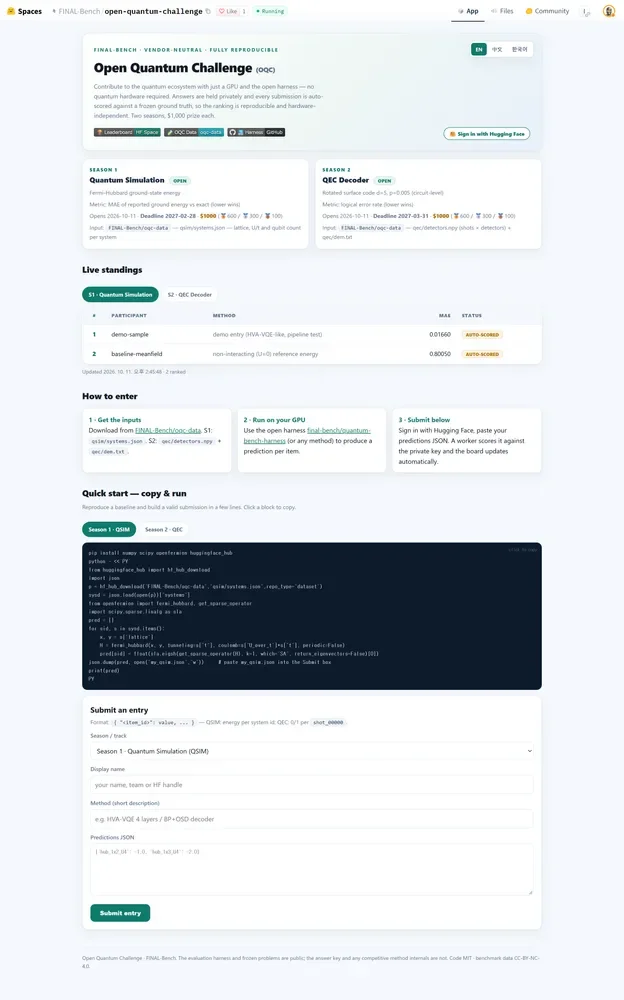
FINAL-Bench's Open Quantum Challenge turns quantum simulation and error-correction decoding into two public GPU tasks. The format highlights how fixed targets and shared harnesses can make specialized research easier to compare, reproduce, and enter.

Shared GPU harnesses can lower the entry barrier to quantum algorithm research, but durable results still require controlled measurements, slice-level analysis, and explicit limits on what a leaderboard score proves.
FINAL-Bench has opened a two-track competition that asks participants to tackle quantum-computing problems without using a quantum computer. One track focuses on simulating a target quantum system; the other focuses on decoding errors from quantum error-correction syndromes. Both use classical GPUs and a public evaluation harness, and the organizers list a combined prize pool of $2,000.
The immediate attraction is accessibility, but the more interesting idea is methodological: some quantum workloads can be framed as ordinary benchmark problems with explicit inputs, known reference targets, and repeatable scoring. That makes the challenge useful as a case study in benchmark design, even for practitioners who do not intend to compete.
Two tasks, two different optimization problems
Quantum simulation and error-correction decoding sit at different layers of the stack. A simulator attempts to reproduce aspects of a quantum system on classical hardware. Its central tension is familiar to anyone who has optimized scientific software: greater fidelity generally demands more computation and memory. A strong entry therefore needs more than a correct formula. It needs a representation and execution strategy that uses the available GPU budget effectively.
A decoder starts from syndrome data, which signals that errors have occurred without directly revealing the protected quantum information. The decoder must infer a suitable correction. Here the practical tension is between decision quality, latency, and resource use. A method that produces good answers but cannot keep pace with the intended workload may be less useful than its headline accuracy suggests.
Those distinctions matter when reading a leaderboard. A single score can summarize performance for ranking, but it cannot explain why a system performs well or whether that advantage will survive a change in scale, noise regime, or hardware. Participants should treat the official metric as the entry point for analysis rather than its endpoint.
Why a public harness changes the value of a result
A shared harness removes several sources of ambiguity. Entrants receive the same task definition, outputs can be compared against defined targets, and other people can rerun the evaluation. This is a substantial improvement over results produced with private preprocessing, undocumented test cases, or incompatible measurement conventions.
Reproducibility still requires discipline. GPU model, numerical precision, library versions, random seeds, warm-up behavior, and timing methodology can all affect results. A useful submission should record these conditions alongside its score. It should also separate algorithmic gains from engineering gains. Kernel fusion, memory-layout changes, batching, and reduced precision may be excellent improvements, but they answer a different question from whether a new decoding or simulation method is intrinsically better.
Public evaluation also creates a familiar benchmark risk: repeated optimization against a visible test procedure can produce solutions that fit the harness more closely than the broader problem. Robust leaderboards counter this with held-out cases, varied instance families, clear resource limits, and enough metadata to distinguish general improvements from narrow tuning. Competitors can help by reporting performance across meaningful slices rather than presenting only an aggregate number.
A practical way to approach either track
The safest starting point is a small, transparent baseline. Confirm that it produces valid outputs, measure it under controlled conditions, and preserve those results. Only then change one dimension at a time. For a simulator, that might mean comparing state representation, precision, batching, or contraction strategy. For a decoder, it might mean isolating feature construction, inference method, and post-processing.
A simple evaluation table should include correctness or task quality, wall-clock time, peak memory, hardware, software environment, and instance size. Where randomness is involved, report multiple runs and describe the spread rather than choosing the best result. Profiling should come before elaborate redesign: if data movement dominates runtime, a more sophisticated mathematical method may not improve end-to-end performance.
Failure analysis is equally valuable. Group cases by circuit depth, system size, error pattern, or another task-relevant property, then inspect where performance deteriorates. This can reveal whether an optimization shifts a boundary or merely improves easy cases. It also makes a competition entry more informative to researchers who want to build on it.
What the benchmark cannot establish on its own
Success on a classical GPU benchmark does not demonstrate an advantage on quantum hardware, nor does it resolve the engineering requirements of a fault-tolerant quantum computer. Simulation results remain bounded by the chosen model and tractable instance sizes. Decoder results depend on the supplied error assumptions, code family, and evaluation distribution. Transfer to another setting must be tested rather than assumed.
The challenge nevertheless offers a useful bridge. GPU programmers can engage with concrete quantum problems using familiar tooling, while quantum researchers gain a common environment for comparing implementations. The strongest outcome would not simply be a winning score, but a set of well-documented methods whose limits are as clear as their gains. That is the standard that turns an open competition into durable technical evidence.
Source: The Open Quantum Challenge: Quantum Simulation and QEC Decoding on Classical GPUs ↗. How we write