From Model Wish List to Reproducible Experiment: A Practical ML Intern Workflow
ML Intern turns a model idea into a budgeted training workflow. The valuable lesson is not full automation, but a disciplined brief: establish a baseline, run a smoke test, define acceptance criteria, and preserve evidence for review.

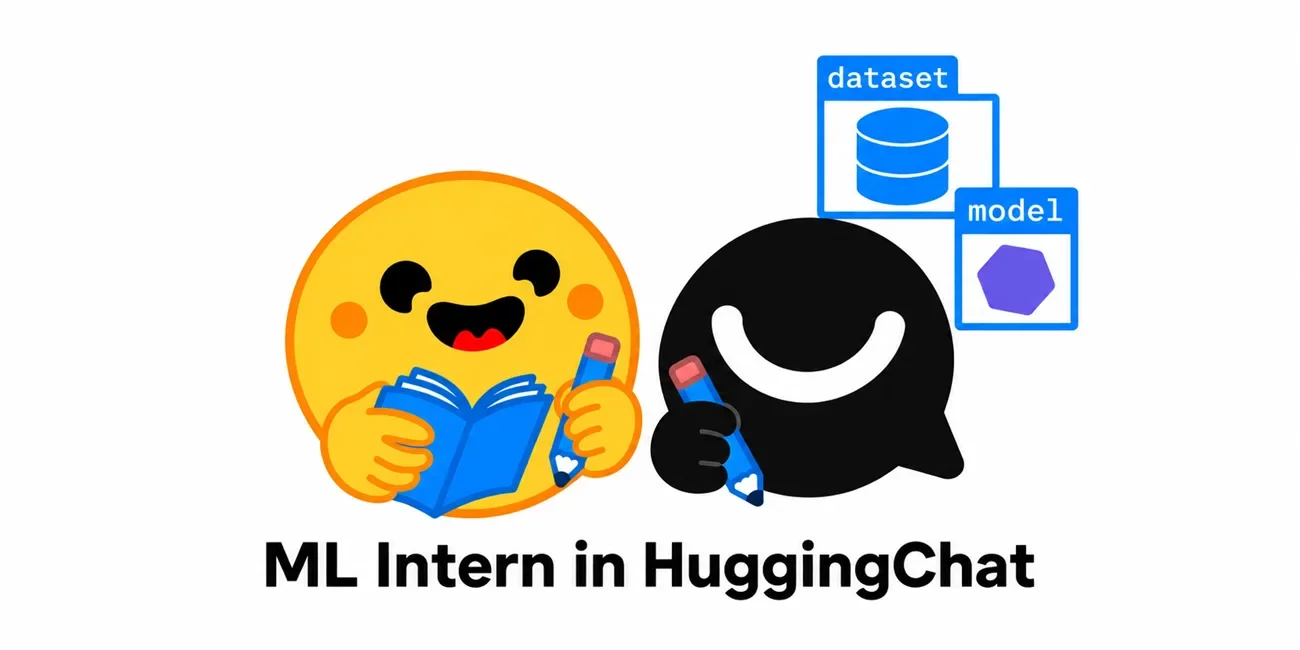
Conversational model training is most useful when the prompt acts as an experiment contract: define the gap, baseline, smoke test, budget, evaluation, and publication evidence before scaling up.
A useful model often begins with an awkward gap: a capable general model exists, but it is too large, too slow, unfamiliar with a narrow domain, or missing one specific behavior. Hugging Face's ML Intern presents a conversational route from that gap to a trained artifact. It can plan work, request a spending allowance, run jobs, evaluate results, and publish the resulting model and documentation on the Hub.
The striking part is not that training can begin from a chat. It is that the quality of the result still depends on familiar experimental discipline. A strong request defines the problem, the evidence that would count as improvement, and the point at which work should stop. Automation makes those decisions more important because an unclear goal can now consume compute quickly.
Start with a testable model gap
"Make this model better" is not an actionable specification. A useful brief identifies a concrete mismatch between the available model and the intended setting. That mismatch might be domain recognition, inference cost, a missing image-editing behavior, or latency on constrained hardware.
Translate the mismatch into three parts:
- Input and output contract. Describe what users provide and what the model must return, including formatting constraints.
- Operating boundary. State the target device, approximate resource ceiling, license constraints, and unacceptable failure modes.
- Measurable acceptance rule. Name the evaluation set and metric, then set a threshold or comparison that would justify publishing the result.
This structure prevents a visually impressive demo from becoming the only evidence. It also exposes impossible combinations early. A tiny CPU model may improve accessibility while losing rare-case quality; a specialized adapter may excel on a narrow transformation while altering unrelated prompts. Those are design tradeoffs, not cleanup details.
Make the baseline part of the deliverable
A trained score means little without a reference point. The original ML Intern report emphasizes asking for a zero-shot baseline before training. That instruction should be explicit because it changes the experiment from "produce weights" to "demonstrate an improvement under the same evaluation."
Keep the comparison symmetrical. Use the same held-out examples, preprocessing, prompt template, random-seed policy, and scoring procedure for both the base and adapted models. If the candidate changes inference steps or guidance, report those differences alongside the score. For generative tasks, combine automated metrics with a small, predeclared human-review rubric. Reviewers should judge the intended behavior as well as collateral damage such as style leakage, misplaced objects, or broken text.
A compact decision table can make the outcome legible:
| Candidate | Target metric | Resource cost | Boundary check | Decision |
|---|---|---|---|---|
| Base model | recorded first | recorded | pass/fail | reference |
| Smoke-test checkpoint | provisional | small | pass/fail | continue or stop |
| Final checkpoint | held-out score | total | pass/fail | publish or reject |
The numbers should come from the actual run. Defining the table in advance is useful even before any number exists because it forces the team to agree on what success means.
Use smoke tests as spending controls
A budget cap limits financial exposure, but a smoke test limits experimental exposure. Before launching the full job, run the shortest version that can reveal a broken pipeline: a small dataset slice, a few training steps, one saved checkpoint, and a minimal inference pass.
The check should test more than whether the process exits successfully. Confirm that training examples can be decoded, gradients or weights actually change, the checkpoint reloads, inference produces the required format, and evaluation reads the intended split. For an image adapter, generate a fixed prompt panel from the checkpoint. For a structured text model, validate syntax and required fields. A successful smoke test does not predict final quality; it only establishes that further spending is technically justified.
Budgeting should also include failed and diagnostic jobs. The source examples show that useful projects can involve many submissions, including retries caused by dependency or path errors. A realistic cap therefore needs headroom for validation rather than assigning every dollar to the longest training run. Require approval before crossing the cap, and define which evidence must be available at that decision point.
Preserve an audit trail, not just weights
The final artifact should be understandable by someone who did not watch the session. At minimum, retain dataset provenance and licenses, the exact base model revision, training configuration, compute type, evaluation split, baseline result, candidate result, known limitations, and representative failures. If synthetic labels or teacher outputs are used, document how they were generated and filtered.
Publishing a model card and evaluation beside the weights helps, but public availability is not independent verification. Treat reported scores as claims tied to a particular dataset and procedure. Users should test the model on their own distribution, especially in agricultural, medical, safety-sensitive, or multilingual settings where an apparently narrow classification error can have serious consequences.
A review gate for conversational training
Before authorizing a full run, a reviewer can ask five questions:
- Is the desired behavior precise enough to evaluate?
- Is the baseline measured with the same procedure?
- Does the smoke test verify changed, reloadable weights and valid output?
- Are cost, data rights, and publication boundaries explicit?
- Will the model card reveal failures as well as successes?
If any answer is no, improve the brief before adding compute. ML Intern can compress the distance between an idea and an experiment, but it does not remove responsibility for experiment design. The best use of that speed is to run smaller, clearer tests, stop weak directions sooner, and publish evidence that another person can inspect.
Source: The model that didn't exist, so you made it yourself ↗. How we write