Choosing Where a Quantized Model Spends Its Precision
Bartowski’s September 10 experiments explore tensor-specific precision choices. The practical lesson is to compare allocation strategies at a matched memory budget and validate on your workload.

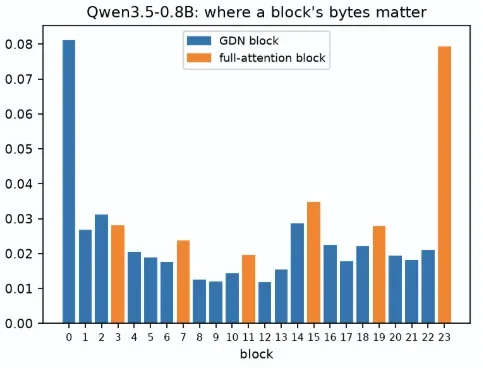
A precision map is a hypothesis about sensitivity, not a universal guarantee; test the resulting exported model at the resource budget you can afford.
Bartowski's September 10 community report explores assigning different precision levels to individual tensors during GGUF quantization. The work uses experiments that change one tensor's precision at a time to investigate sensitivity, rather than relying solely on broad architecture-independent rules. The reported measurements include divergence from an uncompressed reference on a text evaluation set. They are useful experimental evidence, but not a guarantee for every model or application.
For someone choosing a local model, the underlying idea is straightforward: a limited memory budget does not necessarily have to be distributed uniformly. Different parts of a model may respond differently to approximation. Deciding where to spend precision is an optimization problem with several constraints, and a filename rarely communicates all of them.
Think in terms of a fixed budget
Suppose two candidate model files both fit within the memory available on an illustrative laptop. One gives extra precision to a small set of components; the other spreads that budget differently. The interesting comparison is what each can do under the same constraint, not whether either beats a much smaller file.
Keep the resource definition explicit. Disk size, runtime weight memory and total application memory are related but different. Conversation state and other runtime allocations also consume capacity. A file that fits on disk is not evidence that the intended workload will run comfortably. Leave operational headroom instead of choosing a candidate that works only in a minimal demonstration.
Sensitivity depends on how it is measured
An experiment that alters one component can reveal how much a particular score changes. It does not automatically reveal the effect of changing several components together. Interactions may matter. A precision allocation built from isolated measurements still needs to be evaluated as a complete exported artifact.
Likewise, the evaluation material defines what the measurement sees. A short-context general-text test is not a complete examination of long-document extraction, programming or multilingual conversation. Treat a sensitivity map as a hypothesis worth testing on the target workload. Its value is that it provides a reasoned starting point, not that it removes the need for validation.
Compare complete candidates fairly
A useful experiment begins with a baseline that is practical to deploy. Keep the reference model revision, conversion software, runtime and prompt format fixed. Then compare a small number of precision allocations at similar resource budgets. Record the final file's checksum so later tests cannot accidentally use a different build with the same friendly name.
For an illustrative coding assistant, evaluate more than a single answer that looks plausible. Run the generated solution against relevant tests, inspect whether explanations match the code and include tasks with uncommon identifiers. For a summarizer, examine whether names, quantities and qualifications survive. The workload should determine the acceptance criteria before the results are available.
Avoid letting the average hide the failure
An overall score can improve while a critical category gets worse. Divide the evaluation into meaningful slices and retain concrete failures. A team supporting several languages might require a minimum score in each language rather than accepting whichever build has the highest overall average.
Also distinguish speed from quality. A different allocation may change the runtime's execution characteristics, or it may leave them effectively unchanged on a particular machine. Measure latency under the intended context length and concurrency instead of inferring it from the precision label. A quality improvement is useful even without a speed improvement, provided the resource cost is acceptable.
Keep selection understandable
The final output of this process should be a short decision record: which candidate was selected, its resource requirements, the evaluated tasks and the known weaknesses. Include the baseline and the conditions under which the result should be reconsidered, such as a new model revision or a different hardware target.
This approach avoids turning every new quantization method into an open-ended search. Test a bounded set of candidates, select one that meets the actual requirements and preserve a fallback. Precision allocation becomes useful when it helps a real application stay within its budget while maintaining the behaviour its users depend on.
Source: Per-tensor layout maps for GGUF quantization ↗. How we write