A Beta LLM Router Turns Model Choice Into a Testable Policy
Autobench's beta router chooses among three language models using quality, balanced, or cost policies. Its launch results are promising, but the more durable lesson is how teams should evaluate routing against simple fixed-model baselines.

Judge an LLM router against strong fixed policies using your own workload, full customer cost, routing distributions, latency, and category-level failures.
Model routing sounds straightforward: inspect a request, predict how difficult it is, and send it to the least expensive model likely to answer well. In practice, that decision is hard to validate. A router can appear economical merely because it sends nearly everything to one cheap model, or appear capable because it relies heavily on the strongest model in its pool. Either behavior may be useful, but neither demonstrates that per-request selection adds value.
Autobench's newly released beta router is an interesting attempt to make that value measurable. The service exposes three policies—Quality, Balanced, and Cost—and chooses among a small pool of models. Its creators report that all three policies outperform a fixed-model baseline on their combined quality-and-cost index. The announcement also provides decision counts, which makes it possible to see whether the system genuinely changes its choices. Those details matter more than a single headline score.
What the beta router changes
The router's pool currently contains DeepSeek V4 Flash, GPT-5.6 Luna, and GPT-5.6 Sol. Quality and Balanced can select any of the three, while Cost is restricted to DeepSeek and Luna. Users choose a policy rather than a specific underlying model. The router was trained with synthetic prompts and judge-scored responses produced through the same evaluation method used by Autobench, although the team says the training prompts and benchmark questions are separate.
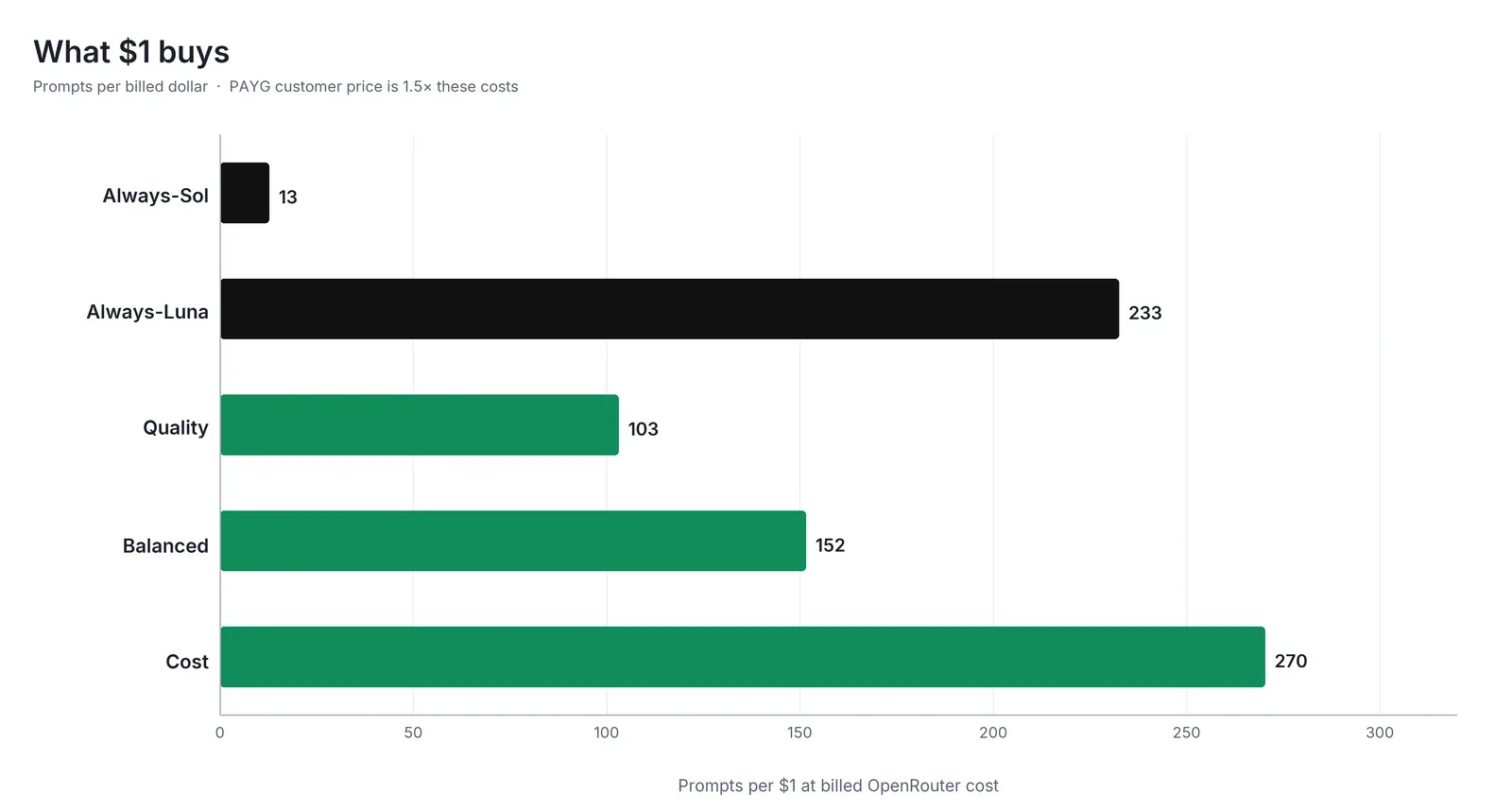
On a 242-prompt, single-turn holdout, the reported Balanced result reached an 87.8% best-answer rate at $0.0066 per question. The fixed Sol baseline was 87.5% at $0.0787. Quality reached 88.6% at $0.0097, while Cost reached 86.8% at $0.0037. For comparison, the fixed Luna baseline was reported at 85.3% and $0.0043. These figures come from the project's own evaluation and should be read as launch evidence, not a universal performance guarantee.
The routing distribution adds useful context. Balanced selected DeepSeek, Luna, and Sol for 63, 151, and 28 prompts respectively. Quality used them 42, 167, and 33 times. Cost used DeepSeek 51 times and Luna 191 times. None of those policies crossed the project's 90% threshold for “collapse” onto one model, though Cost still sent roughly four out of five prompts to Luna.
Why fixed baselines are the real competition
A production router does not need to beat every model. It needs to beat the simplest policy a team could deploy instead. That comparison should include at least three alternatives: always use the cheapest acceptable model, always use the strongest model, and use a fixed rule based on known request types. If a learned router cannot improve on those baselines after its own latency and service markup are included, its additional complexity is difficult to justify.
Consider a support workflow with password resets, account-specific troubleshooting, and policy questions. A fixed rule might send password resets to a small model and everything else to a larger one. A learned router becomes valuable only if it identifies meaningful variation within those buckets—for example, separating routine troubleshooting from ambiguous cases—without creating unacceptable failure modes. Average benchmark quality alone cannot show that. Teams also need results by task class and by severity.
The same principle applies to cost. Published per-question model charges are not the complete operating cost. A fair comparison includes the router's fee, extra network latency, retries, fallback calls, monitoring, and the engineering work needed to investigate misroutes. Autobench states that pay-as-you-go pricing is 1.5 times the billed cost of the selected model, so prospective users should calculate with the customer price rather than only the underlying benchmark bars.
A practical evaluation plan
Start with a representative, time-bounded sample of real requests, stripped of sensitive data. Define success before running the comparison: answer quality, p95 latency, total customer price, retry rate, and a small set of high-impact failure categories. Human review is especially useful for requests where a plausible but incorrect answer would be costly.
Next, replay the same sample through the router and the fixed baselines. Preserve each routing decision, selected model, response, latency, and final cost. This makes it possible to ask two separate questions: did the router select different models, and did those selections improve outcomes? Aggregate scores can hide a policy that saves money on easy requests but damages a narrow, important category.
Finally, test stability. Change the request mix, evaluate longer conversations separately, and repeat the study when model versions or prices change. A router trained around a three-model pool inherits changes in all three models as well as changes in its own decision policy. Routing is therefore an ongoing evaluation problem, not a one-time procurement choice.
Boundaries of the launch evidence
The beta results cover a frozen, single-turn holdout and a limited model pool. They do not establish performance for multi-turn agents, tool use, every domain, or future model revisions. Synthetic training data can provide broad coverage, but its scoring assumptions may differ from an organization's actual preferences. The team's use of related judges and pricing rules across training and evaluation also makes independent workload testing important, even though the prompt sets are described as separate.
Still, the launch demonstrates a useful standard for router claims: publish fixed-model comparisons, reveal selection distributions, separate quality from cost, and state the workload boundary. A router should be treated as a policy whose decisions can be audited—not as an invisible discount layer. The beta's most valuable contribution may be the invitation to evaluate model choice with that level of discipline.
Source: Try an LLM Router That Actually Routes ($1 free credit) ↗. How we write