What LFM2.5-VL-DSpark Changes in the VLM Latency Budget
Liquid AI's compact draft model accelerates token generation for LFM2.5-VL-3B, but its real value depends on how much of a vision-language workload is spent decoding rather than processing images and prompts.

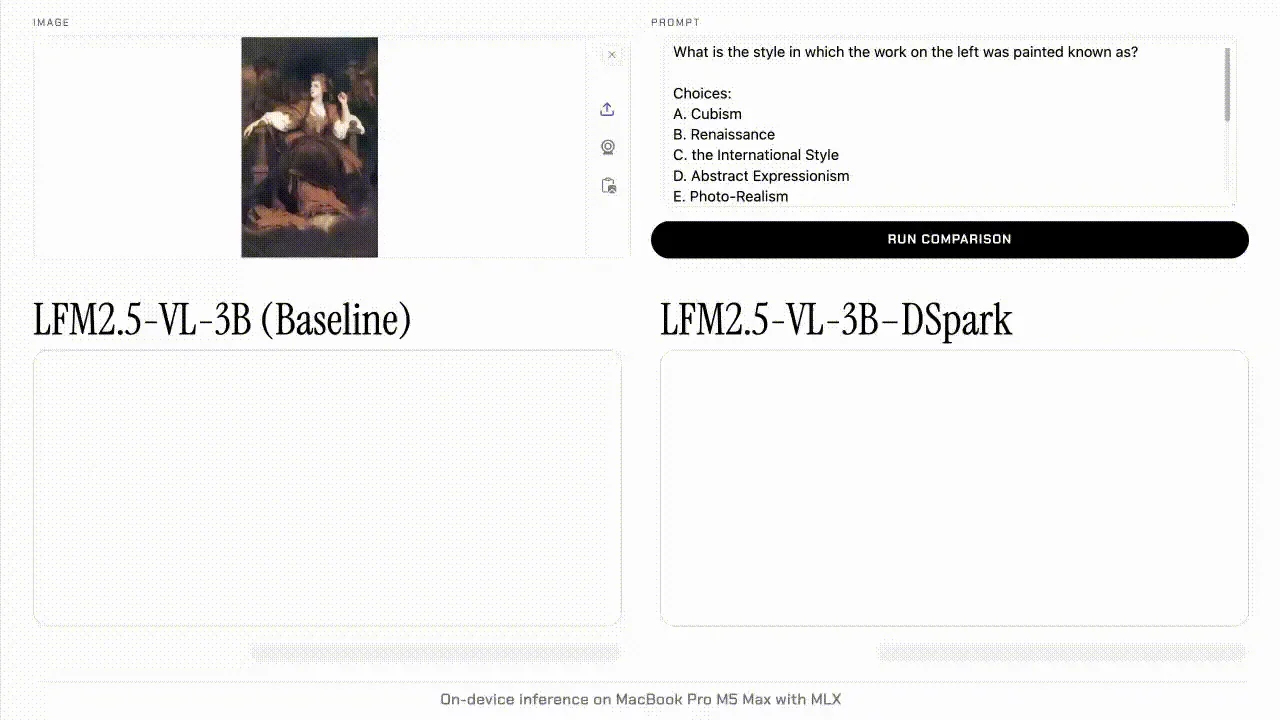
Speculative decoding can substantially accelerate VLM generation, but phase-level profiling is essential because image encoding and prefill remain untouched.
Liquid AI has released LFM2.5-VL-3B-DSpark, an experimental speculative-decoding companion for its 3B-parameter vision-language model. The drafter proposes groups of output tokens while the full model checks them, aiming to reduce generation time without approximating the target model's decisions. The release matters less as a single benchmark result than as a useful example of how to reason about acceleration in multimodal systems: a faster decoder does not automatically make image understanding equally faster.
The 279.5M-parameter drafter adds about 8.9% to the target's parameter count. Liquid AI reports decode speedups as high as 3.13x on an M5 Max and 2.66x on an H100, while its best reported end-to-end gains are lower: 2.62x and 2.27x, respectively. Integrations are available for SGLang, llama.cpp, and MLX-VLM. Those figures are vendor-reported results on six vision-oriented task types and should be treated as starting points for workload-specific evaluation.
Why exact speculation is useful
Speculative decoding separates cheap prediction from authoritative verification. A smaller draft component proposes several likely next tokens; the target model evaluates those proposals in a batch and accepts the matching prefix. When a proposed token fails verification, generation resumes from the target's result. The target therefore remains the decision-maker.
That distinction is operationally important. Teams can pursue lower latency without introducing a second, lower-quality output policy. For deterministic greedy decoding, accepted speculation should reproduce the target-only result. It does not imply that every runtime configuration, sampling mode, numerical backend, or model revision will behave identically, so regression tests should still compare the exact deployment settings that will ship.
The draft block size also creates a balance. Larger blocks offer more potential work per verification step, but wasted proposals grow when acceptance is poor. Liquid AI recommends blocks of eight or nine, yet the best value for an application depends on its prompts and output distribution. Short answers, unusual domains, structured output, and long conversational continuations can yield different acceptance patterns.
The latency budget sets the ceiling
A vision-language request has at least three major phases: encoding the image, prefilling the language model with visual and text tokens, and decoding the response. This drafter targets only the last phase. If image encoding and prefill consume most of a request, even a dramatic decode improvement has limited effect on total latency. This is the practical consequence of Amdahl's law.
Consider a hypothetical request that spends 60% of its time before decoding and 40% decoding. Making decode three times faster changes total normalized time from 1.0 to roughly 0.73: 0.60 plus 0.40 divided by three. That is about a 1.36x overall speedup, not 3x. By contrast, a long-form generation workload that spends 80% of its time decoding would benefit much more. The example is illustrative, not a measurement of LFM2.5-VL.
This also explains why time to first token and tokens per second answer different questions. Speculation primarily improves the experience after generation begins. An interactive captioning tool may care about both, while batch extraction may care about completion latency and throughput. A concise visual question-answering service may see little benefit if responses end after only a few tokens.
A practical evaluation plan
Start by recording a target-only baseline on representative images, prompt lengths, response lengths, and concurrency levels. Separate image-encoder time, prefill time, decode time, and total request time. Average throughput alone can hide a poor tail, so capture median and high-percentile latency as well.
Then enable the drafter without changing unrelated runtime settings. Track proposed and accepted draft tokens, effective tokens per second, memory use, and total latency. Acceptance rate is diagnostic rather than a goal by itself: an apparently strong rate can still deliver little user benefit when decode is a small share of the request or verification overhead is high.
Memory deserves explicit testing on edge devices. An 8.9% parameter increase sounds modest, but available headroom may already be constrained by the target model, vision encoder, KV cache, image resolution, and runtime buffers. Test the largest supported images and longest intended conversations, not just a single-turn demonstration. On servers, repeat the comparison under realistic concurrency because batching and scheduling may alter the tradeoff.
Finally, verify output equivalence for the decoding policy in use and retain a target-only fallback. The integrations referenced by the release may require particular builds or pending support, so pin known-working revisions and validate configuration metadata before rollout.
Where the release fits
LFM2.5-VL-DSpark is most compelling when generation is long enough to dominate the latency budget and the extra model fits comfortably in memory. It is less likely to transform workloads dominated by high-resolution image processing, large multimodal prefills, or very short answers.
The broader lesson is portable: evaluate an accelerator against the whole request path. Decode benchmarks show the mechanism's potential; phase-level profiling shows whether that potential reaches users. For teams already deploying LFM2.5-VL-3B through one of the supported runtimes, the drafter offers a concrete experiment with measurable success criteria rather than a universal speed guarantee.
Source: Accelerating vision-language models with LFM2.5-VL-DSpark ↗. How we write