Clover-35B-A3B Preview Puts Block-Diffusion Agents to the Test
DiffuSpace's 35B-parameter MoE preview applies block diffusion to coding and tool-use workloads. Here is what its architecture changes, what its reported results mean, and how to evaluate the model without confusing throughput with end-to-end agent quality.


Clover makes block-diffusion inference credible for agent workloads, but deployment decisions should combine reproducible throughput tests with end-to-end success, step count, context retention, and total latency.
DiffuSpace has released Clover-35B-A3B-Preview, an Apache-licensed mixture-of-experts diffusion language model aimed especially at coding and tool-using agents. The model has 35 billion total parameters but activates about 3 billion for a token, and it includes a thinking mode. Weights and code are available, with inference paths named for SGLang and llama.cpp.
The headline is not simply another parameter count. Clover generates blocks through iterative denoising rather than committing to every token strictly from left to right. DiffuSpace argues that this design can preserve competitive task quality while reducing generation latency. Its announcement reports 73.6 on SWE-bench Verified, 51.7 on Terminal-Bench 2.1, and 65.3 on τ³ Overall, alongside 680 tokens per second on an internal agent workload using one NVIDIA GB300 in BF16 at batch size one. Those are promising claims, but they are best treated as a starting point for reproduction rather than a universal deployment forecast.
Why block diffusion changes the latency discussion
An autoregressive model emits a sequence one token at a time. A block-diffusion model instead refines several positions within a block, potentially exposing more parallel work to the accelerator. That distinction matters for agents because a single user request may trigger many model turns: decide, call a tool, inspect the result, revise the plan, and repeat. Cutting generation time at each turn can compound across the full trace.
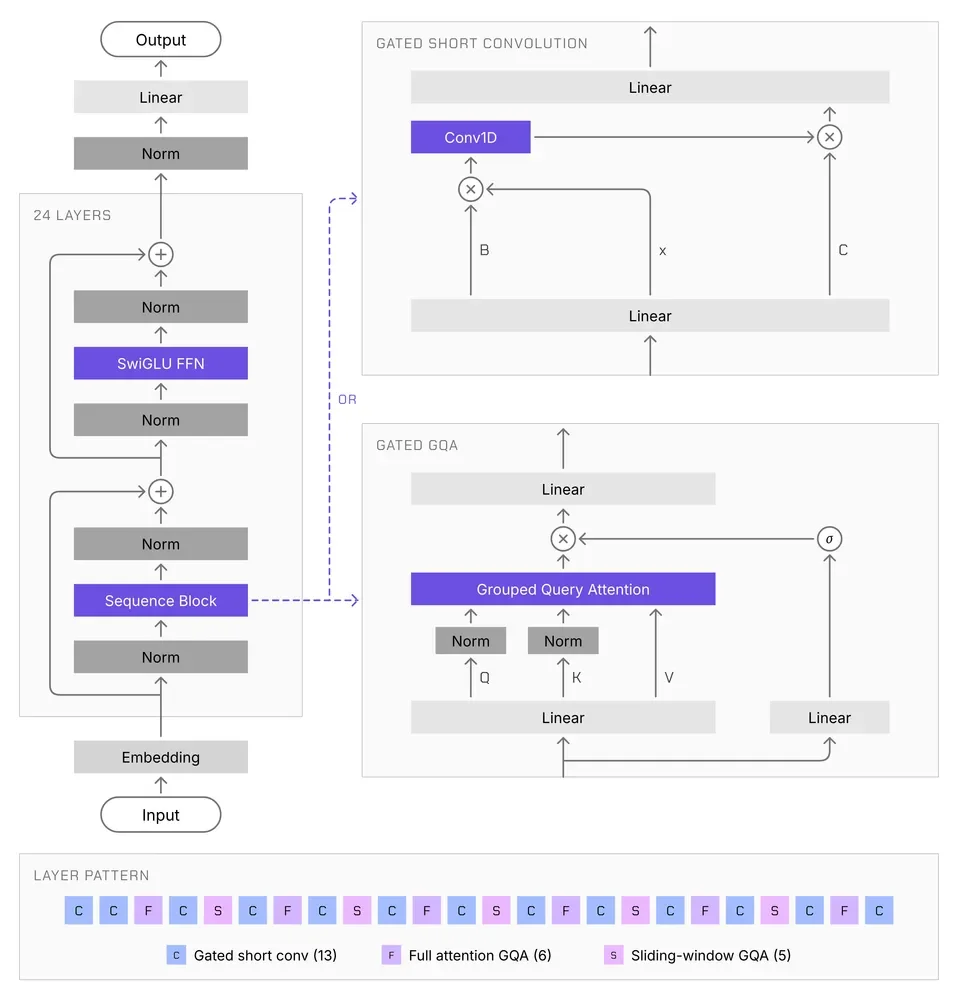
Clover's architectural description combines recurrent memory for prior context with bidirectional attention inside the block currently being denoised. Historical information is compressed into a Gated DeltaNet state. A separate memory readout competes in attention with current-block tokens, while a learned calibration is intended to prevent that history from becoming less influential merely because the block grows. A separate convolution branch adds right-context features within the block.
This is a meaningful engineering compromise. Full attention over an ever-growing sequence is expensive; aggressively compressed history can lose detail. Clover attempts to keep a compact long-range state while allowing richer interaction among the positions being generated now. Whether that balance works will depend on context length, block settings, task structure, and the inference implementation.
Throughput is only one part of agent speed
Tokens per second is useful only when its measurement conditions travel with the number. Hardware, precision, batch size, prompt length, output length, decoding configuration, and software stack can all change the result. DiffuSpace also reports 515 tokens per second on one H200 for agent tasks, compared with 365 for a Qwen setup accelerated by DFlash2. This comparison is informative within the stated setup, but it should not be generalized to every Qwen deployment or serving environment.
More importantly, an agent's wall-clock time includes tool execution, network waits, environment startup, verification, and failed branches. Faster generation helps most when model inference dominates the loop. If a browser takes five seconds to load or a test suite takes a minute, doubling model throughput will not halve completion time. Conversely, low-latency generation can be decisive for short, repeated tool decisions.
A practical evaluation should therefore record at least three layers: model generation latency, time spent outside the model, and total task completion time. Add task success and the number of steps. A fast model that needs extra recovery turns may lose its apparent advantage; a slightly slower model that chooses the right tool immediately may finish first.
A reproducible evaluation checklist
Start with tasks that resemble the intended application rather than selecting only public leaderboards. For a coding agent, include repository navigation, edits, test interpretation, and recovery from a failing command. For browser automation, include ambiguous search results, stale pages, permission boundaries, and structured form actions. Keep the agent harness, prompts, tools, timeouts, and retry policy fixed across models.
Then separate quality questions. Does the model produce valid tool arguments? Does it preserve constraints after several observations? Does it recognize an incorrect intermediate result? For block diffusion specifically, inspect formatting stability and whether revisions inside a generated block introduce contradictions. Measure cold and warm starts, multiple prompt and output lengths, and more than one run per task. Report dispersion rather than only the best attempt.
Memory is another boundary to test. A recurrent state can make long histories efficient, but application-specific facts may be buried far back in a trace. Construct tests where an early instruction remains relevant after many tool results, then check both compliance and factual recall. Vary block size if the runtime exposes it, because the fastest setting may not be the most reliable one.
Where the preview fits
Clover is most interesting as evidence that diffusion language models are moving from small demonstrations toward open, agent-oriented systems with familiar deployment integrations. Its MoE design also makes the distinction between total and active parameters important: storage, memory residency, and per-step compute are related but not interchangeable. The announcement says an INT4 version has run on a 16 GB RTX 5070 Ti, but prospective users should confirm the exact quantization, context, offload, and quality tradeoffs for their own machine.
The preview label deserves attention. Integration maturity, long-horizon stability, quantized quality, and performance outside the authors' workloads remain empirical questions. The responsible next step is not to assume that one throughput figure settles the architecture debate. It is to reproduce the model under controlled conditions, publish complete configurations, and judge whether lower generation latency produces more successful work per unit of time and cost.
Source: Clover-35B-A3B-Preview: A New Way for Intelligence ↗. How we write