LFM3 Turns One Compact Backbone Into a Multimodal Model Toolkit
Liquid AI’s LFM3 family spans text, vision, audio, omni, and decision workloads around a shared compact backbone. Here is how to choose a variant and evaluate whether specialization really pays off.

Select the LFM3 variant by its input-output contract, then validate adaptation, calibration, latency, and memory on the complete target workflow.
Liquid AI has introduced LFM3 as a family of compact models built from a common 1.7-billion-parameter base. The lineup covers text, vision, audio, combined multimodal input, and structured decision tasks, with the released variants staying around the two-billion-parameter class. The proposition is less about finding one model that does everything and more about selecting a small branch that matches the application, adapting it, and running it close to where the data is produced.
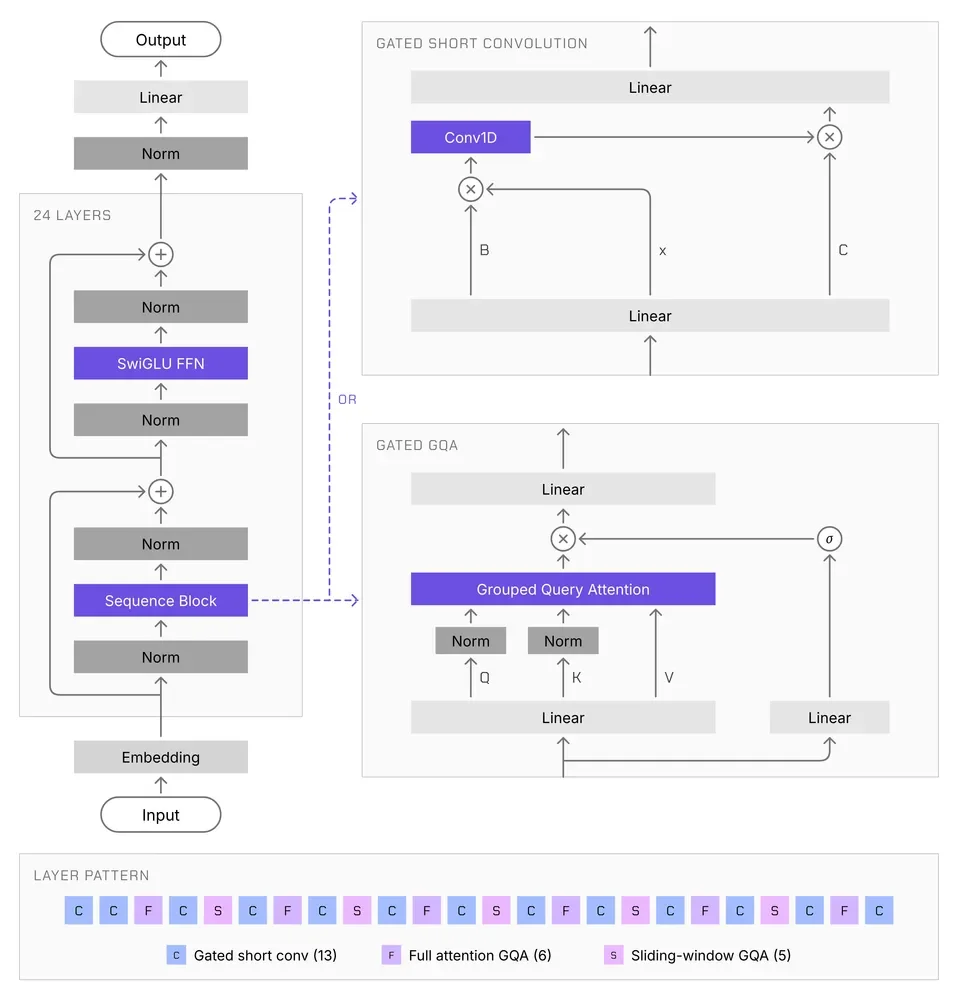
The underlying model uses a mix of short convolutions, sliding-window attention, and global attention. Liquid AI says the text model supports a 256K-token context window, while the family’s vision and audio branches use purpose-built encoders. All six models derive from the same base, but their interfaces and outputs differ enough that teams should treat them as a toolkit rather than interchangeable checkpoints.
Choose by interface, not by headline capability
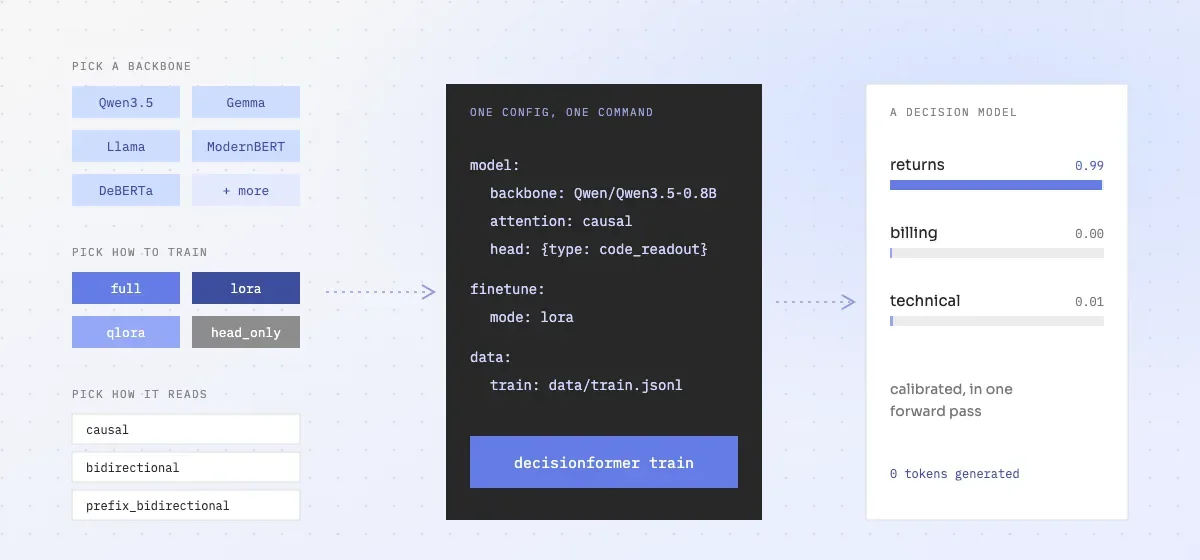
The first useful filter is the application’s actual input-output contract. LFM3-1.7B suits text generation, structured output, and tool-oriented agents. LFM3-VL-2B adds images and video while returning text. LFM3-Audio-2B accepts speech and can return text or speech, and LFM3-Omni-2B combines text, visual, and audio inputs with text or spoken output. The d1 variants take a different path: they produce calibrated answers for questions such as classification, scoring, or multi-choice selection.
That distinction matters operationally. A support-routing system that needs a category and confidence value may benefit more from a decision model than from parsing prose generated by a chat model. A visual inspection workflow may need the vision model but not the memory and latency costs of audio components. An assistant that must interpret a video’s soundtrack and frames together is where the omni variant becomes relevant.
Start by writing the contract as a table: accepted media, required response type, latency budget, hardware target, and failure behavior. Only then pick a checkpoint. This prevents “multimodal” from becoming a vague requirement that adds dependencies without helping the product.
A shared backbone does not erase deployment differences
A common base can simplify experimentation because concepts learned with one modality may fit into a broader family strategy. It does not make every variant equally easy to ship. Text inference primarily involves tokenization and generation. Vision adds image preprocessing and potentially long visual sequences. Audio introduces sample rates, streaming buffers, codecs, and playback. Omni systems must coordinate those paths and decide how media is aligned in time.
The release reports that the text model occupies about one gigabyte at 4-bit precision and that each model can be fine-tuned on a single GPU. Those are useful starting claims, not a substitute for measuring the intended stack. Quantization support, runtime kernels, processor code, and peak memory can change the practical footprint. A model that fits in storage may still miss an interactive latency target after media preprocessing is included.
For edge evaluation, measure the complete request. Record cold start, input preparation, time to first useful output, sustained generation, peak memory, and energy use where possible. Repeat with realistic context lengths and media sizes. The slowest stage may be an encoder, codec, or data transfer rather than the language backbone.
Test specialization against a strong baseline
LFM3 is positioned for domain adaptation, with examples spanning supervised fine-tuning, preference optimization, reinforcement learning, and continued pretraining. Small checkpoints make iteration more accessible, but a successful fine-tune depends more on task definition and evaluation quality than on the training method’s name.
Build a frozen test set before training. Include common requests, difficult edge cases, malformed inputs, and examples where the system should abstain. For tool use, verify argument validity and downstream outcome rather than checking whether a tool name appears. For document extraction, compare fields and types, not textual similarity. For speech, separate recognition quality from response quality and generated-audio quality. For visual tasks, include changes in lighting, framing, resolution, and irrelevant content.
Compare three systems: the untouched LFM3 variant, the adapted version, and the current production baseline. A fine-tune earns its place only if its improvement survives representative data without causing unacceptable regressions elsewhere. Keep the same prompt, decoding policy, runtime, and hardware where possible so the comparison isolates the model change.
Treat long context and calibrated outputs as testable features
A large advertised context window is capacity, not proof of reliable retrieval across the entire window. Evaluate the positions and document mixtures that matter: relevant evidence near the beginning, middle, and end; multiple plausible distractors; and conflicting updates. Check whether answer quality declines as the prompt grows and whether latency remains acceptable. Often, retrieval that sends a smaller set of relevant passages is still the more predictable design.
Decision models also deserve calibration checks on local data. A probability is useful only when similar scores correspond to similar observed frequencies. Plot reliability by score bucket, inspect results by class and input source, and choose thresholds based on the cost of false positives and false negatives. Distribution shifts can invalidate a threshold even when aggregate accuracy looks stable.
A practical adoption path
Begin with one narrow workflow and the smallest variant whose interface covers it. Establish an end-to-end baseline, then test quantization and adaptation separately. Add modalities only when the evaluation shows that they improve the user outcome. Finally, package preprocessing, model revision, runtime version, and decision thresholds together so results can be reproduced.
LFM3’s most interesting idea is architectural and product-level modularity: one compact foundation branching into specialized tools. The payoff will not come from using every branch. It will come from choosing the right one, measuring the full system, and proving that specialization beats a simpler baseline under the constraints that matter.
Source: Build specialized multimodal models with LFM3 ↗. How we write