DecisionFormer Turns Language Models Into Structured Decision Engines
DecisionFormer packages language-model backbones as one-pass classifiers that return constrained choices and probabilities. Here is what that design changes, where calibration matters, and how teams can evaluate it responsibly.

DecisionFormer makes bounded language-model decisions easier to integrate, but deployment quality depends on held-out calibration, task-specific thresholds, and strong system-level evaluation.
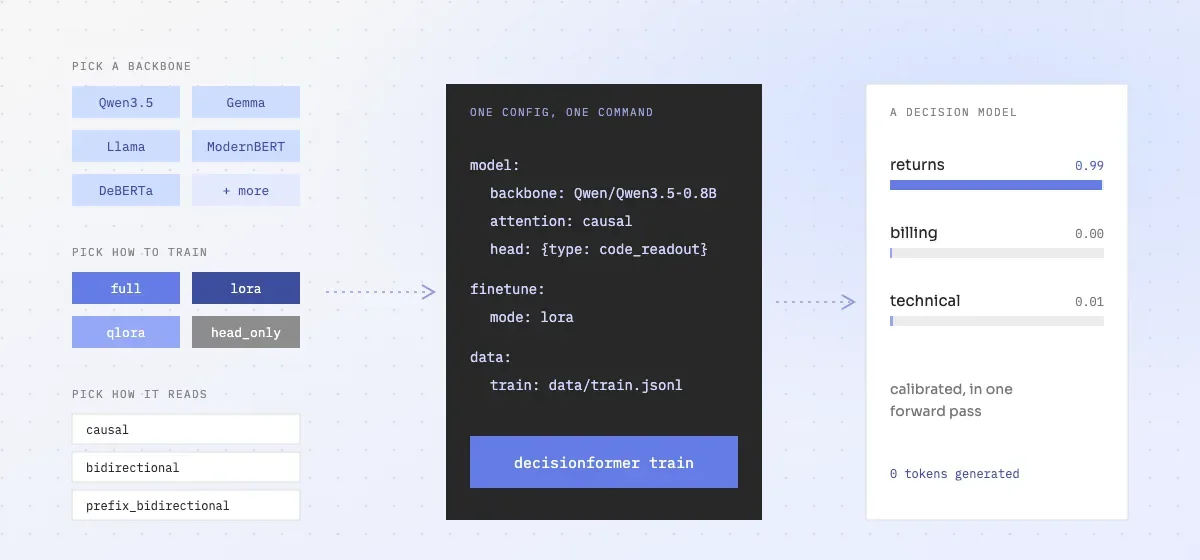
DecisionFormer reframes a familiar language-model task: instead of asking a model to generate a label and then parsing the text, it reads a probability distribution over valid options at a designated answer position. FrontiersMind released the Apache-2.0 library on October 26 alongside the deciformer-15k dataset mix. The project supports Hugging Face model backbones, several fine-tuning strategies, and a common interface for typed decisions.
That approach is useful because many production problems are not really writing problems. Routing a support request, applying a policy gate, or assigning an ordinal risk level requires a bounded decision with a measurable degree of uncertainty. A constrained classifier can make that contract explicit.
A decision API, not a text protocol
DecisionFormer accepts a state plus one or more questions. A question can request a choice among named options, a yes-or-no probability, or an ordered score. The model returns probabilities and a derived answer without running an autoregressive generation loop. For decoder models, short option codes define the valid outputs; encoders can instead score option representations or use fixed task heads.
This distinction removes a surprisingly large integration burden. A generative classifier may return extra prose, misspell a label, or choose an unexpected format. Applications then need parsers, retries, and fallback rules. A constrained head only scores options that the caller supplied. The schema becomes part of the model interface rather than a convention embedded in a prompt.
The result is still a prediction, not a proof. Restricting the output space prevents malformed answers, but it does not make the selected answer correct or the underlying policy appropriate. Teams should keep input validation, authorization, and consequential business rules outside the model.
Probabilities need evidence
A probability is more actionable than an unsupported confidence phrase, but only when it behaves reliably on relevant data. DecisionFormer fits temperatures on a calibration split and reports metrics including expected calibration error, Brier score, and negative log likelihood. It also distinguishes the top probability from a separate confidence measure based on how concentrated the full distribution is.
Consider a three-way routing model that assigns 0.55, 0.40, and 0.05. The top class wins, yet the runner-up is plausible. A workflow might accept a prediction automatically above a validated threshold, request human review in an uncertain band, and reject inputs that fall outside the supported domain. Those thresholds should come from held-out examples and the cost of each error, not from a universal number.
Calibration must also be monitored after release. A new product line, a changed policy, or shifts in user language can invalidate the relationship between predicted probability and observed accuracy. Segment results by task and meaningful cohorts, and track both accuracy and calibration over time.
Choose the smallest training change that works
The library exposes full fine-tuning, LoRA, QLoRA, and head-only training through configuration. These modes trade flexibility against memory, compute, and operational complexity. Head-only training provides a useful low-cost baseline. LoRA limits the number of trainable parameters, while QLoRA reduces base-model memory further through quantization. Full fine-tuning offers the most freedom but demands more resources and produces a complete new weight set.
A sensible comparison holds the data split, prompt contract, and evaluation procedure constant. Start with a simple baseline, then add adaptation only when the measured gain justifies it. Report results by decision family as well as in aggregate; a strong overall score can hide a weak high-cost category. Keep related examples together across splits so near-duplicates do not create an optimistic estimate.
DecisionFormer also offers causal, bidirectional, and prefix-bidirectional attention choices. Opening attention on a decoder is not automatically beneficial because it changes the information pattern used during pretraining. The project documentation itself recommends comparing against a causal baseline. Treat attention mode as an experiment for each backbone, not as a general upgrade.
An evaluation checklist for deployment
Before serving a checkpoint, verify four layers separately:
- Contract tests: confirm every question type returns the expected schema, valid options, and stable handling of empty or oversized inputs.
- Predictive tests: measure task accuracy, class-specific error rates, and confusion patterns on untouched examples.
- Probability tests: evaluate calibration before and after temperature fitting, then test the operational thresholds used for automation and review.
- System tests: measure latency, memory use, batching behavior, and failure handling on the actual serving stack.
Also test adversarial and ambiguous states. Because state text is data rather than trusted instruction, examples should include prompt-like content, conflicting evidence, missing fields, and options with similar meanings. A constrained output prevents arbitrary generated text, but the input can still mislead the model.
Where the pattern fits
DecisionFormer is best viewed as infrastructure for bounded probabilistic decisions built on pretrained representations. It is a plausible fit when labels are known at request time, reproducible outputs matter, and downstream systems can use probability distributions. It is less suitable when the task requires open-ended synthesis, retrieval of new facts, or explanations that must themselves be generated and checked.
The important contribution is the separation of concerns: the language model represents the state, a constrained readout produces valid alternatives, calibration makes uncertainty testable, and the application decides what to automate. That architecture does not eliminate model risk, but it gives teams clearer surfaces on which to measure and manage it.
Source: DecisionFormer ↗. How we write