What It Really Takes to Run a 180B MoE Model on Personal Hardware
POCKET-Darwin-180B packages a 180-billion-parameter mixture-of-experts model as a 111 GB GGUF. Its laptop story depends on SSD streaming, selective expert activation, and clear tradeoffs between capacity, memory, and latency.

Sparse activation and SSD streaming can make a 111 GB model usable on a laptop, but workload-level testing is essential before treating technical compatibility as practical deployment readiness.
A model with 180 billion parameters sounds incompatible with a laptop. POCKET-Darwin-180B shows why that conclusion is too simple for mixture-of-experts (MoE) systems—but also why model size alone is a poor guide to the experience users should expect.
FINAL-Bench has released a four-file, 4-bit GGUF build of Darwin-180B-RSI. The publisher reports a total size of 111 GB, down from 360 GB in BF16, and says it can generate on a laptop equipped with 32 GB of system memory, an 8 GB GPU, and fast NVMe storage. This is an interesting packaging and systems result, not evidence that a laptop has suddenly acquired data-center throughput.
Active parameters are not stored parameters
The key distinction is between the model's total capacity and the subset used for each token. Darwin-180B is an MoE model with 512 routed experts, of which ten are selected per token. According to the release, roughly 3 billion parameters participate at any one time. That limits the compute required for a token, but it does not make the other weights disappear.
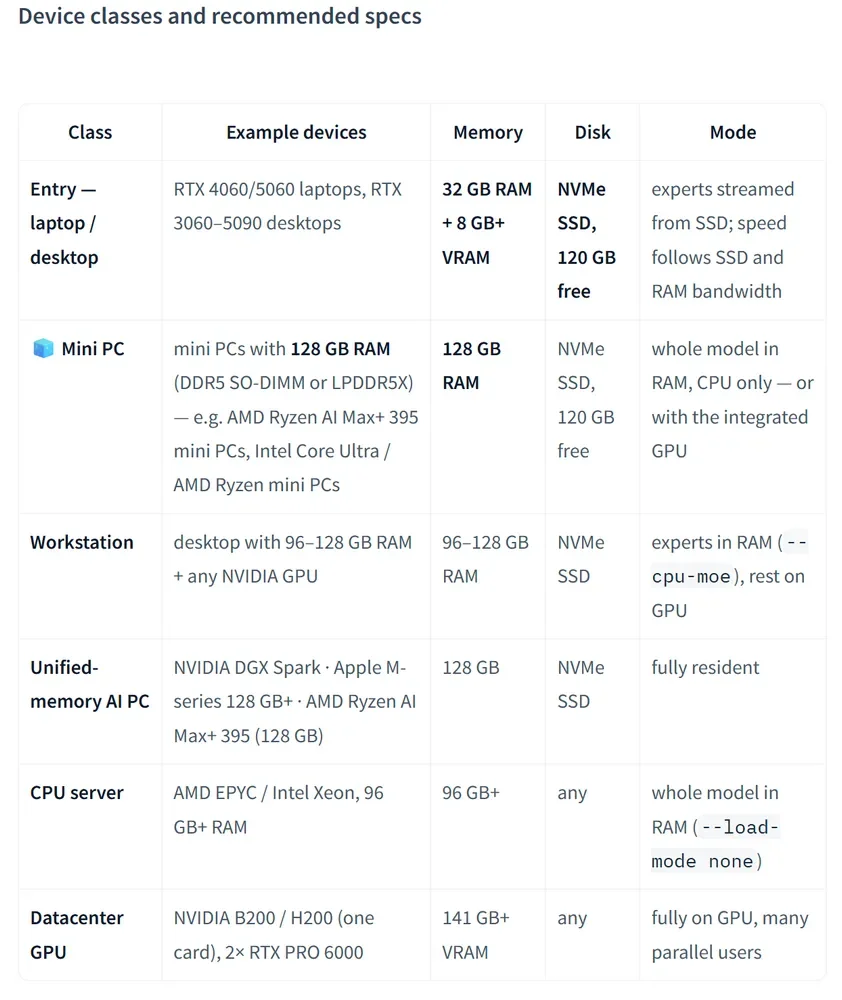
The full quantized checkpoint still occupies 111 GB. A machine with 32 GB of RAM and 8 GB of VRAM cannot keep all of it resident, so llama.cpp memory-maps the files and retrieves needed experts from the SSD. In effect, storage joins CPU, GPU, and memory as part of the inference pipeline. The model may fit operationally even when it does not fit physically in RAM, but latency becomes sensitive to storage performance and expert-access patterns.
That distinction matters when evaluating any claim that a very large model “runs” on modest hardware. Ask whether weights are fully resident, partially cached, or streamed; whether the quoted rate covers generation rather than prompt processing; and how long or concurrent requests affect the result.
What the published measurements establish
FINAL-Bench reports 4.17 tokens per second on an RTX 5060 laptop with 8 GB VRAM, 32 GB RAM, and NVMe storage. It also reports 18.4–21.0 tokens per second on a 16-thread AMD EPYC CPU setup where the model is resident in memory, with peak usage of 78.8 GB. These figures describe different memory arrangements and should not be read as a simple laptop-versus-server processor comparison.
The release also reports identical 87.65% accuracy for the BF16 and 4-bit variants on a fixed, stratified sample of 2,000 MMLU-Pro questions. That paired result is useful evidence that this conversion preserved performance on that particular evaluation. It does not establish equivalent quality across all tasks, prompt formats, context lengths, or languages. The broader leaderboard rankings in the announcement are explicitly self-reported and should be treated separately from independently reproduced evaluation.
The quantization method is unusually targeted. Rather than quantizing the fine-tuned model entirely from scratch, the authors used an existing 4-bit base-model build as a template and replaced the 300 tensors changed during their self-improvement training, using Q8_0 for those replacements. They report verifying all 300 tensors after writing them. This approach is plausible because routed experts and several other components were reportedly left unchanged during training, but downstream users should still validate behavior on their own workloads.
Choosing hardware by workload, not headline size
There are three practical deployment profiles. A 32 GB laptop can prioritize accessibility and privacy, accepting SSD traffic and a single-digit token rate. A system with roughly 96–128 GB of available memory can keep far more—or all—of the quantized weights resident, reducing storage pressure. A larger unified-memory or server platform can pursue higher throughput while retaining local execution.
For interactive use, 4.17 tokens per second may be acceptable for short answers but slow for long reasoning traces. For batch processing or multiple users, aggregate throughput, prompt-evaluation speed, queueing, and cache memory become as important as single-stream generation. The 111 GB download and at least 120 GB of recommended free NVMe space also make distribution and updates meaningful operational costs.
Local execution can help when data cannot be sent to a hosted service, but it does not automatically solve security or governance. Teams still need controls for model provenance, file integrity, access, logs, generated outputs, and updates to the inference runtime. The checkpoint uses the Qwen Community License 1.0, so prospective adopters should review its terms for their intended use.
A sensible evaluation plan
Before committing hardware, begin with representative prompts and define acceptable time-to-first-token, generation rate, answer quality, and maximum response time. Test both short and long contexts, because memory use and prompt-processing cost can change the experience substantially. Record storage type, RAM, VRAM, llama.cpp version, context size, and offload settings so results can be reproduced.
Then compare the model with a smaller dense or MoE alternative on the same machine. A smaller model that remains fully resident may answer faster and serve more concurrent requests, even if its benchmark ceiling is lower. Conversely, the larger checkpoint may justify slower delivery when a task benefits from its capacity and must remain offline.
POCKET-Darwin-180B is best understood as a demonstration of a wider deployment envelope. Sparse activation and memory mapping allow a huge checkpoint to cross a hardware boundary that dense-model intuition would rule out. The achievement is real, but the useful question is not merely whether the model launches. It is whether its quality, latency, storage demands, and operating constraints fit the work that needs to be done.
Source: Data-center AI, now on a laptop — POCKET-Darwin-180B ↗. How we write