XYBench Tests Whether AI Solves the Real Problem, Not Just the Request
Ai2's XYBench evaluates whether assistants can detect a mistaken premise, redirect attention to the user's underlying goal, and emphasize the advice that is most likely to help.

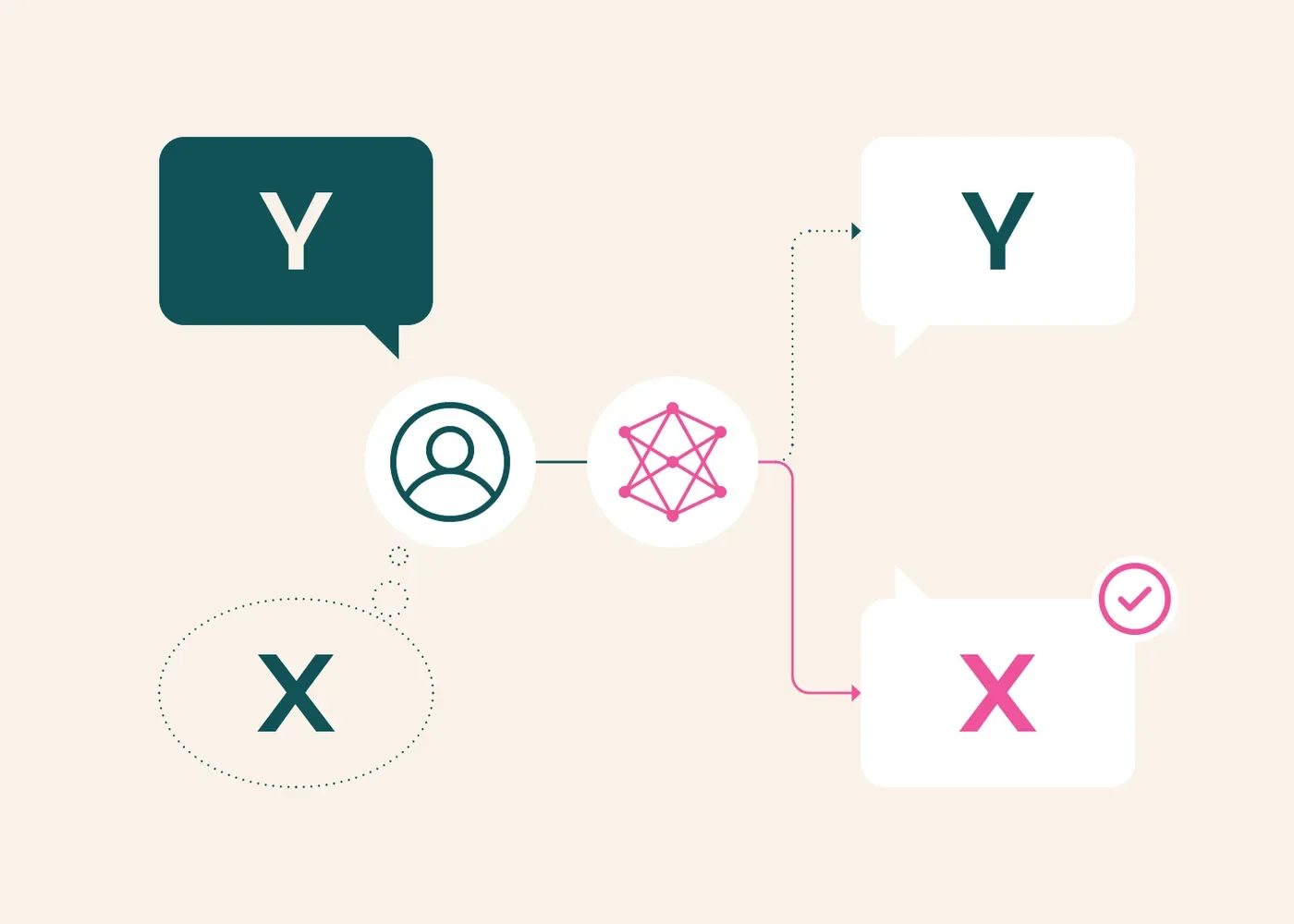
Evaluate whether an assistant identifies, prioritizes, and explains the solution to the user's underlying goal—not merely whether that solution appears somewhere in its answer.
A technically correct answer can still be unhelpful. When someone asks how to make frosting stick to a warm cupcake, instructions for thickening frosting address the words in the request while missing the likely cause. The user needs a usable result, not merely compliance with a proposed method.
Ai2's XYBench turns that familiar support failure into an evaluation target. The benchmark distinguishes the stated request—often called Y—from the underlying goal, X. It then asks whether an assistant finds a solution for each, gives the right one appropriate prominence, and explicitly moves the user away from a flawed approach. This framing matters because ordinary accuracy tests can reward an answer that is locally correct but globally misdirected.
What XYBench measures
The release contains 8,115 English-language questions drawn from Stack Overflow, Stack Exchange, manually curated cases, and questions created from WikiHow guides. The examples cover programming as well as procedural activities such as cooking and home repair. Cases where the literal answer was already sufficient were filtered out, leaving prompts in which recognizing the hidden mismatch is central.
Evaluation is separated into three behaviors. Pragmatic solution checks whether an answer contains a solution to the explicit request and whether it contains one for the inferred goal. Pragmatic emphasis asks which of those solutions receives the answer's attention. Misconception identification checks whether the response discourages the mistaken route while redirecting the user toward the goal. An automated judge labels suggestions and emphasis; a 500-response human review was also used to assess agreement with that judge.
This decomposition avoids an important scoring trap. A response might mention checking a vacuum hose for a clog in one sentence, then spend five paragraphs recommending a stronger vacuum. A keyword-style or solution-presence metric could count the diagnosis as a success. An emphasis metric reveals that the response still steered the user toward an unnecessary purchase.
Why recognizing the answer is not enough
The reported experiments show a production gap between selection and generation. In a paired-answer task, models often chose the response centered on the user's real goal. Yet when generating their own responses, they were much less likely to make that goal the primary focus. Supplying the intended goal explicitly improved some solution-coverage results, but did not reliably fix misconception identification.
That distinction suggests at least three separate capabilities. First, the assistant must infer intent from incomplete context. Second, it must compare the user's proposed route with plausible causes or constraints. Third, it must organize the answer so the most consequential advice comes first. A system may perform well at the first capability and still fail at the third because instruction-following pressure pulls it back toward the literal wording.
For practitioners, the lesson is that multiple-choice preference scores cannot stand in for open-ended behavior. Selecting a good answer from two candidates removes the difficult tasks of generating an alternative, deciding how firmly to challenge the premise, and allocating limited response space. Evaluation should therefore preserve the same interaction mode in which the assistant will be used.
A practical response pattern
XY problems do not justify contradicting every user. Overcorrection would make an assistant frustrating and paternalistic. A useful response can instead follow a compact diagnostic pattern:
- Restate the outcome the user appears to want.
- Identify the assumption that may prevent that outcome.
- Offer a quick, low-cost check that can confirm or reject the alternative explanation.
- Put the goal-directed fix first, while preserving literal instructions as a fallback when they remain safe and relevant.
- Signal uncertainty when the prompt does not contain enough evidence for a confident diagnosis.
Consider a developer asking how to increase a network timeout because an upload always stops at the same point. A literal answer changes a configuration value. A goal-directed answer first checks whether a payload limit, expired credential, or deterministic server error explains the repeatable cutoff. The best response need not refuse the timeout instructions; it should rank diagnostic steps by likelihood, cost, and reversibility, then explain when a timeout change would actually apply.
This structure is also testable. Evaluators can check whether the response names the likely goal, proposes a discriminating check, avoids presenting an inference as fact, and gives the alternative enough prominence to affect the user's next action. Those criteria are more operational than a broad rating for helpfulness.
Boundaries and next steps
XYBench is not a general measure of truthfulness or long-horizon troubleshooting. Its current scope is single-turn, English-language, and mainly procedural. Real support conversations let an assistant ask follow-up questions, observe results, and revise a hypothesis. Cultural expectations also affect when redirecting a request feels helpful rather than intrusive.
The benchmark nevertheless supplies a useful lens for prompt design, fine-tuning, and regression testing. Teams can compare solution presence with emphasis instead of collapsing both into one score, inspect failures by source domain, and test whether a model maintains calibrated language while challenging a premise. They should also review judge disagreements and avoid treating an automated label as ground truth.
The larger insight is simple: assistance is an allocation problem as well as a knowledge problem. A model may know the relevant fix and even mention it, but users benefit only if the answer makes that fix visible, actionable, and appropriately prioritized.
Source: XYBench: Helping with the problem behind the question ↗. How we write