A Formal Yang–Mills Result Is a Milestone, Not the Mass-Gap Finish Line
A reported Lean-checked construction advances the existence side of four-dimensional Yang–Mills theory, while leaving universality, uniqueness, and the celebrated mass-gap question unresolved.

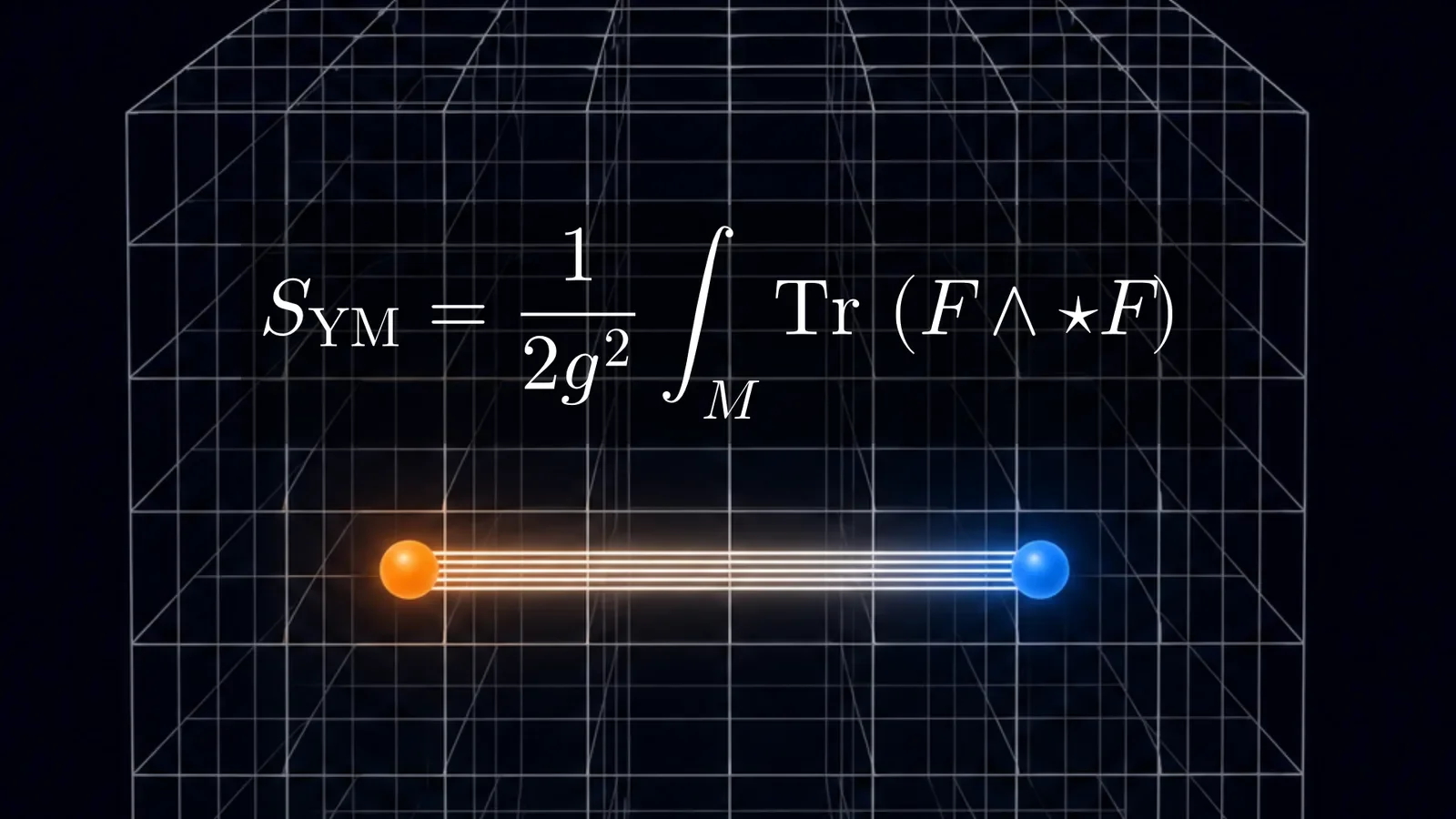
Formal verification strengthens confidence in a stated construction, but existence, uniqueness, universality, and a mass gap must be evaluated as separate claims.
A new formal construction has put an unusually technical question in quantum field theory into the AI conversation: can four-dimensional Yang–Mills theory be defined as a rigorous mathematical object? The reported result is substantial, but its scope matters. It addresses much of the existence side of the problem, not the mass gap itself, and reviewers still identify important unresolved limits.
That distinction is more than mathematical fine print. It is a useful case study in how to read machine-checked research claims: separate verification of logical steps from validation of definitions, assumptions, and correspondence with the intended scientific problem.
The problem has two different finish lines
Yang–Mills theory supplies the gauge-field framework behind the strong and weak interactions. For the strong interaction, the relevant non-abelian structure allows gauge bosons to interact with one another. At short distances the coupling weakens, a property called asymptotic freedom; at longer distances it becomes strong, where ordinary perturbative expansions are no longer enough.
Physicists handle that regime effectively with lattice calculations. Space-time is replaced by a finite grid, turning an informal continuum path integral into a very large but well-defined finite-dimensional calculation. Predictions can then be estimated while the lattice spacing is reduced and the simulated box is enlarged.
The mathematical challenge is to prove that these limiting operations produce a nontrivial continuum quantum field theory satisfying accepted axioms. That is the first finish line: existence. The second is to prove a mass gap—a strictly positive minimum energy above the vacuum. The two claims are related, but one does not imply the other. A construction can establish a legitimate theory without proving its lightest excitation has positive mass.
What the reported construction establishes
According to the community article’s account of the review group’s preliminary assessment, the construction starts from lattice Yang–Mills theory for compact simple gauge groups. It establishes a continuum limit as the lattice spacing approaches zero and recovers the short-distance behavior expected from asymptotic freedom. It also produces nontrivial quantum field theories satisfying the relevant axiomatic requirements.
The infinite-volume step is more qualified. The box can be taken to infinity along a convergent subsequence, but the result does not yet show that every valid sequence leads to one unique limit. Nor does it establish universality: independence from choices such as lattice formulation or the route used to approach the continuum. The assessment also does not claim a mass-gap proof or evidence deciding that question.
These boundaries suggest a precise headline: a large part of an existence construction has reportedly been formalized and checked, while uniqueness, universality, and the mass gap remain open. Calling it a complete solution would collapse several independent obligations into one.
What Lean verification does—and does not—settle
A proof assistant checks whether each encoded inference follows from declared definitions and earlier results. For a manuscript of exceptional length and complexity, that changes the review surface. Reviewers can inspect explicit dependency chains rather than relying only on prose and hand calculations, and the checker can catch gaps that are easy to overlook.
But formal verification is conditional. A verified theorem has the form “given these definitions and assumptions, this conclusion follows.” Human experts must still decide whether the formal objects faithfully represent continuum Yang–Mills theory and whether the theorem matches the target problem. They also need to audit the trusted computing base, imported libraries, axioms, and any bridge between informal physics language and formal statements.
A practical review can therefore be organized into three layers:
- Kernel correctness: Did the proof checker accept the terms without hidden placeholders or disallowed assumptions?
- Semantic alignment: Do the encoded fields, observables, limits, and axioms express the intended theory?
- Problem coverage: Does the theorem prove existence, uniqueness, universality, a mass gap, or only a specified subset?
Passing the first layer is powerful evidence, but it cannot substitute for the latter two. This is especially important when a familiar label such as “Yang–Mills” covers several formulations and limiting procedures.
A useful way to evaluate the next updates
Future assessments should be read as a matrix of claims rather than a single yes-or-no verdict. For each update, ask which gauge groups are covered, what continuum and infinite-volume limits are proved, whether convergence holds outright or only for subsequences, and whether different regularizations are shown to agree. Then ask separately whether the construction is nontrivial and whether it has a positive spectral gap.
The difference between subsequence convergence and unique convergence is easy to visualize. A bounded sequence may contain convergent selections even when the full sequence oscillates. Finding one convergent route establishes that a limit object can be extracted; proving all admissible routes agree establishes a much stronger form of uniqueness. In field theory, that stronger result helps show the answer is intrinsic rather than an artifact of the regulator or limiting path.
Why the result matters without changing collider predictions
This work does not replace perturbative calculations, lattice simulations, or experimental measurements. Those methods already support remarkably successful particle-physics predictions. A rigorous construction instead addresses the foundations beneath those practices: whether the continuum theory exists with the required consistency properties and retains genuine interaction.
That makes the reported advance meaningful even under a cautious reading. It also demonstrates a productive role for formal methods in research: not an automated stamp of scientific truth, but a precise ledger of what follows from what. The appropriate response is neither dismissal nor premature celebration. It is to credit the verified scope, keep the unresolved obligations visible, and let expert semantic review proceed alongside formal checking.
Source: Yang-Mills, OpenAI proof, and the mass gap problem ↗. How we write