An In-Model Kill Switch Is a Security Claim, Not Just a Control
ViKernel proposes packaging policy, integrity checks, audit state, and an asymmetric stop mechanism with a model. The useful question is not whether the controls are described as weight-native, but which threats the complete deployment can resist and how operators can verify that resistance.

Treat weight-native controls as part of an end-to-end security architecture: verify runtime enforcement, external roots of trust, recovery behavior, and every path to a real-world side effect.
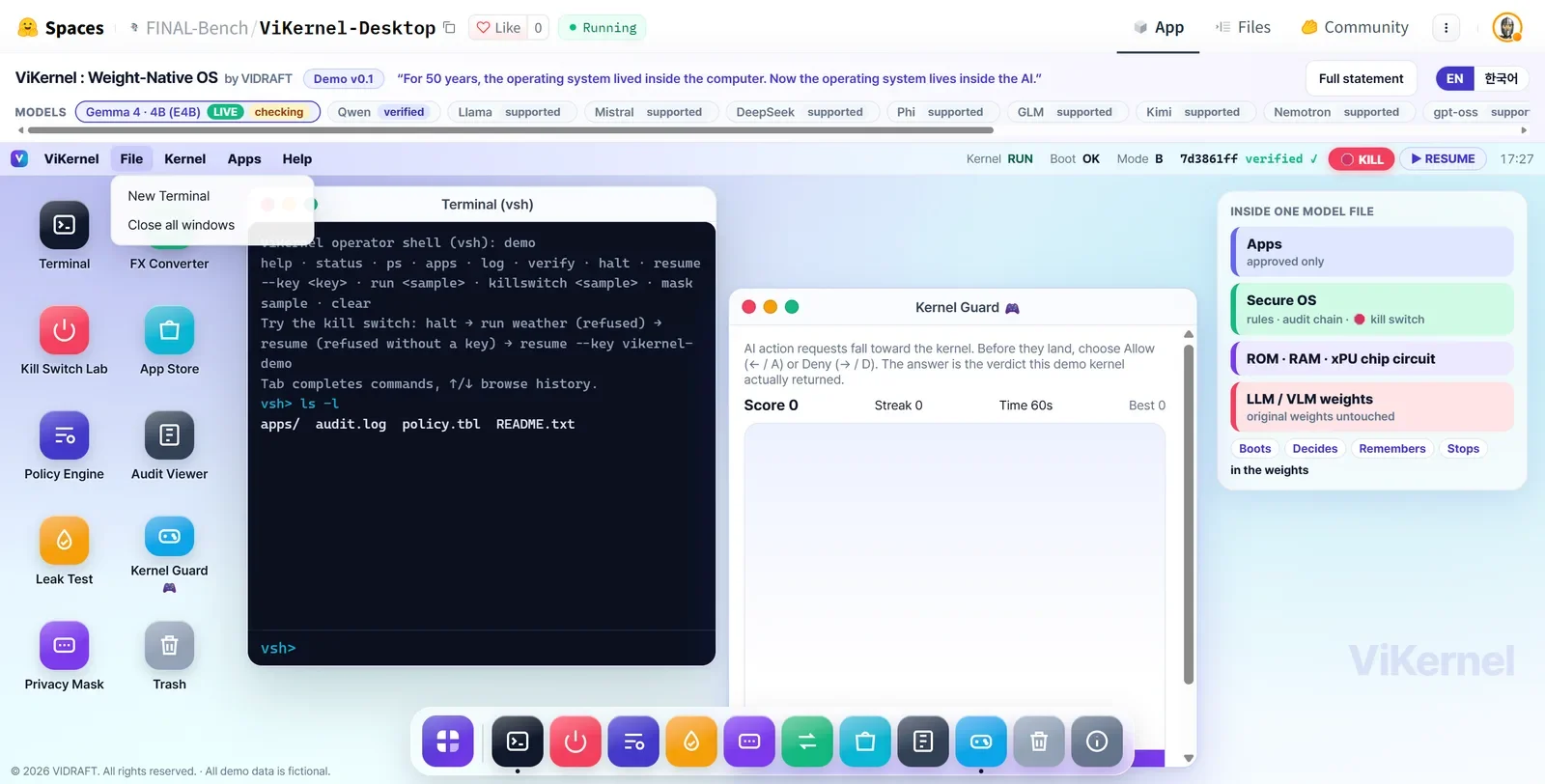
Agentic models create a control problem that ordinary chat interfaces largely avoid. Once a model can request tools, modify files, or initiate network actions, operators need a dependable place to decide which actions are permitted. ViKernel proposes moving several controls closer to the model artifact: a policy mechanism, boot-integrity checks, an audit chain, and a stop state that is easy to enter but requires an operator key to leave. Its public desktop demo exposes these concepts through terminal commands and interactive panels.
That proposal is best understood as an architectural direction, not a completed proof that external controls are obsolete. A control can travel with a model while still depending on a runtime, keys, tool adapters, and hardware that enforce its decisions. Evaluating the idea therefore requires asking where every trust boundary actually sits.
What “inside the model” needs to mean
A model file normally contains tensors and metadata; an inference engine interprets them. If additional weights encode a policy circuit or persistent state, the runtime must still execute that mechanism and route every consequential action through it. The phrase “in the weights” can describe artifact packaging, but packaging alone does not establish enforcement.
Consider an agent with permission to call a payment API. A useful policy might represent an action as structured fields such as tool name, amount, destination, and approval state. The policy engine can then reject payments above a limit without interpreting persuasive natural language. This is a meaningful improvement over asking a second language model whether a request seems safe. Yet the guarantee holds only if the payment adapter cannot be reached through another path and the action fields cannot be ambiguously encoded.
The same distinction applies to the stop function. Persisting a halted state with the model can make that state portable. But an evaluator should test whether a different loader can ignore it, whether a copied base model remains usable without the attached mechanism, and whether tool credentials are revoked or merely hidden from one execution path. The security property belongs to the whole system, not to a file label.
Why asymmetric recovery is valuable
ViKernel’s most practical design idea is asymmetric control: halting is available without a privileged recovery credential, while resuming requires a signed operator key. This resembles emergency controls in other engineered systems. It reduces the chance that an autonomous process can immediately undo a human stop command.
The asymmetry also introduces operational questions. Who may trigger a halt, how is denial-of-service abuse handled, where are recovery keys stored, and what happens when those keys are unavailable? A production design needs key rotation, revocation, multi-party recovery where appropriate, and a documented fail-safe state. It should also define whether halting blocks model inference, tool execution, network access, or all three. “Stopped” is only testable when its scope is precise.
A strong exercise is to enumerate every side effect the agent can cause, then issue a halt between authorization and execution. If an already queued tool call still completes, the system has identified a race that the stop protocol must address. Similar tests should cover restarts, crashes, snapshots, replicas, and concurrent workers.
Integrity and audit require external anchors
The project describes boot verification and a hash-chained audit log. Both are useful primitives. A signed reference can detect an altered artifact, while chained records make retrospective edits evident because later hashes no longer match. Neither primitive, by itself, prevents an attacker from replacing the reference, truncating the log, or presenting an entirely different valid chain.
Production evaluation should identify the root of trust. Verification keys may need protection outside the model artifact, and audit heads may need periodic publication to an independent store. Monotonic counters, trusted hardware, or a remote transparency service can help distinguish an old but internally consistent state from the latest approved one. The right mechanism depends on the threat model; the important point is that tamper evidence needs an observer that an attacker cannot rewrite at the same time.
The demo’s recorded responses and fictional data make it suitable for exploring the interface, not for validating resistance to a hostile runtime. Likewise, the source reports an internal audit with mock tools and fake honeypot data. That result is a project-reported observation, not enough information to infer performance against new models, adapters, or adversaries. Reproducible test definitions and independent replication would make such evidence more informative.
A practical evaluation checklist
Teams considering a weight-coupled control layer can turn the proposal into concrete acceptance tests:
- Define the protected boundary. List model files, runtimes, adapters, credentials, queues, and replicas, then mark which components enforce the halt and policy decisions.
- Attempt bypasses. Load the artifact with an unmodified inference stack, call tools through alternate routes, replay pre-authorized actions, and restore old snapshots.
- Exercise policy determinism. Encode semantically identical actions in different valid forms and confirm that normalization produces the same decision. Test malformed and missing fields as fail-closed cases.
- Challenge recovery. Rotate and revoke resume keys, simulate lost keys, and verify that unauthorized recovery fails without making legitimate disaster recovery impossible.
- Verify audit continuity. Edit, remove, reorder, and truncate entries; roll back the complete state; and check whether an independent verifier detects each case.
- Measure compatibility. Compare model quality, latency, memory use, and tool reliability before and after integration across the actual deployment stack.
The broader lesson
ViKernel highlights a real weakness in agent deployments: controls implemented only as prompts or optional wrappers are easy to separate from the capability they govern. Binding policy state and shutdown semantics to a portable artifact could make safe configuration harder to forget and easier to inspect.
But proximity is not the same as invulnerability. The decisive advance would be a verifiable chain from an approved artifact through an enforcing runtime to every external side effect, backed by keys and logs outside the attacker’s control. The project’s demo offers a vocabulary for that discussion. The next step is to express each promise as a falsifiable system property and invite independent attempts to break it.
Source: ViKernel: Why the Kill Switch Must Live Inside the Model ↗. How we write