Harness-Specific RL Makes the Agent Loop Part of the Model
New harness adapters for Qwen3.8-27B show that reinforcement learning can improve both task success and tool efficiency when training matches the deployed agent loop. The harder question is how much of that gain survives a different harness, task mix, or reasoning mode.

Treat a harness adapter as a versioned model-harness-task policy, and validate success and efficiency together across the exact production loop and meaningful transfer tests.
An agentic model never works alone. A harness decides how messages are formatted, which tools are exposed, when results return, how context is compacted, and when the run stops. Those choices shape the trajectories that a model sees. Training for the exact loop used at deployment therefore targets something more specific than general coding ability: it targets the interaction between model, tools, and control software.
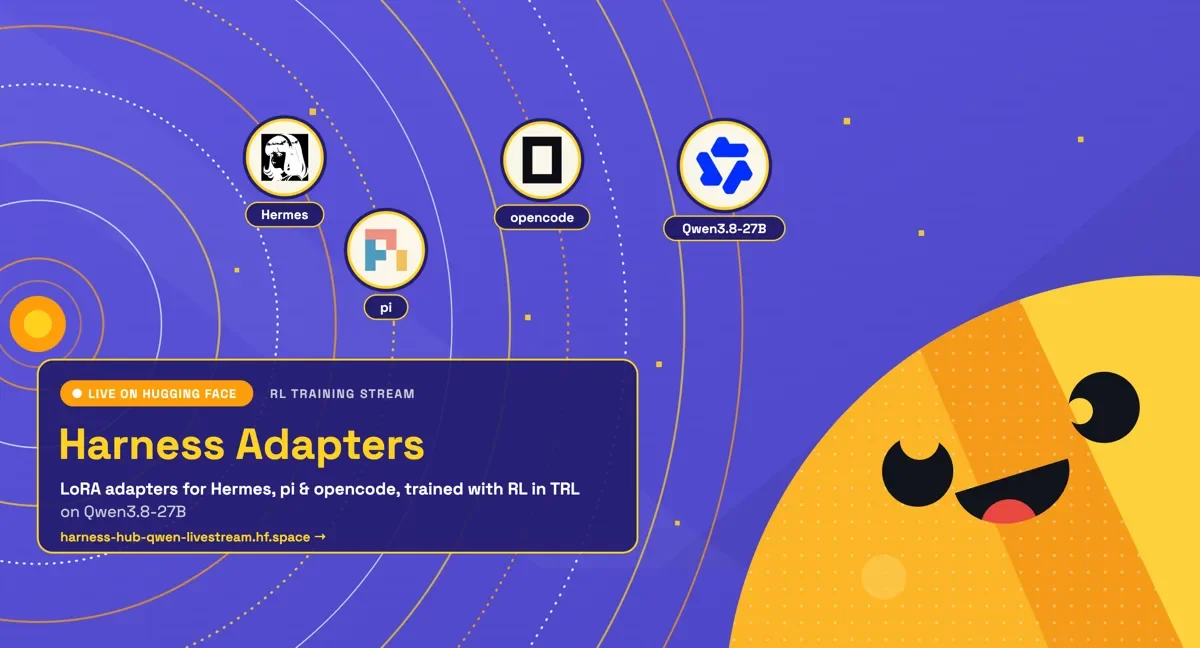
A Hugging Face experiment applies this idea to Qwen3.8-27B. The team froze the base weights and trained separate LoRA adapters with reinforcement learning inside Pi, Hermes Agent, and OpenCode. Rollouts used the released harnesses rather than trainer-specific approximations. On Terminal-Bench 2.1 and a hard SWE-bench Pro subset, each specialist beat the base model under its own harness while using fewer tool calls. The team also concatenated the three LoRA updates into a rank-96 adapter, scaling each update by one half.
The results make a strong case for treating the harness as part of the optimization target. They also suggest a more careful evaluation discipline for anyone deciding whether the approach belongs in production.
The unit of optimization is a complete trajectory
A conventional model evaluation can make the harness look like neutral plumbing. For agents, it changes the problem. One harness may encourage short tool calls, another may inject different observations, and another may compact long histories. Identical model weights can consequently receive different token sequences and have different opportunities to recover from mistakes.
Reinforcement learning inside the deployed loop lets the reward act on those actual trajectories. If a run succeeds after four precise calls while another succeeds after forty exploratory calls, an efficiency component can distinguish them. The adapter may learn when to stop searching, how to format a call correctly, or how to use the particular feedback that the harness returns.
That specificity is useful but creates a boundary: an adapter is not merely a universally better version of its base model. It is a policy tuned for a model-harness-task distribution. A deployment claim should name all three. Changing the tool schema, context policy, system prompt, or stopping rule can move the application away from the conditions that produced the gain.
Validate the verifier before trusting the reward
Agentic RL is only as reliable as its tasks and reward functions. A broken test can reward an incomplete patch; an impossible task produces uniformly bad attempts; a trivial task produces uniformly good ones. Neither extreme gives group-relative training much useful contrast.
The reported pipeline illustrates a practical screening sequence. Candidate tasks were checked for licensing, duplication, benchmark overlap, deterministic replay, a successful reference solution, and rejection of known-wrong controls. The base model then attempted tasks several times, and the training set favored tasks it solved sometimes but not always. This is a broadly reusable pattern even when the exact infrastructure differs.
Teams should preserve rejected cases and reasons rather than silently deleting them. Failure clusters can reveal flaky containers, permissive tests, repository-specific shortcuts, or capabilities outside the model's current reach. A small manually audited sample is also valuable: automated validation can establish that a verifier behaves consistently without proving that the task specification represents a useful real-world requirement.
Separate capability gains from shorter behavior
An efficiency reward can improve a policy, but it can also teach premature stopping. Fewer tokens and calls are valuable only when correctness holds. Evaluation should therefore report success and resource use together, preferably with paired results for the same tasks.
A useful scorecard includes pass rate, calls and tokens for all attempts, calls and tokens among jointly solved tasks, timeout frequency, invalid tool calls, and regressions where the base succeeds but the adapter fails. The jointly solved slice asks whether the adapter completes comparable successful work more efficiently. The regression list checks whether aggregate gains hide newly abandoned task types.
The merged adapter demonstrates another tradeoff. Combining specialized updates can produce one artifact that works across several harnesses, but shared packaging does not guarantee that it retains every specialist's advantage. An organization using only one stable harness should compare its specialist directly with the merged option. A platform serving several harnesses may accept a smaller peak gain to reduce routing, storage, and lifecycle complexity.
Test transfer across every production boundary
Before release, build an evaluation matrix rather than relying on one benchmark column. Rows can represent the target harness, a changed harness version, and at least one unrelated agent loop. Columns can represent in-domain tasks, held-out repositories, and tasks outside the training family. Add reasoning mode as a separate condition when the chat template supports it.
This matrix answers different questions. In-harness, in-domain tests measure the intended specialization. A new repository tests whether the adapter learned reusable coding behavior instead of repository cues. A foreign harness tests sensitivity to the control loop. An unrelated task family looks for collateral regressions. None alone proves generality.
Version pinning matters as much as the matrix. Record harness releases, prompts, tool definitions, model and adapter revisions, sampling settings, context limits, and container images. When the harness changes, rerun a canary set before assuming the adapter remains aligned. The adapter and harness should be promoted as a tested pair, with rollback possible for either component.
Decide from application economics, not benchmark rank
A higher pass rate can justify adaptation when failed attempts are expensive, but training and operating specialized artifacts add their own costs. Count task construction, verifier audits, rollout compute, evaluation, model storage, serving complexity, and the work needed to repeat training after a harness change. Compare that total with simpler interventions such as improved tool descriptions, deterministic preprocessing, or better stopping rules.
The best first deployment is narrow: one stable harness, a well-defined task distribution, trustworthy automated checks, and enough repeated volume for saved calls to matter. Start with shadow evaluation, then route a limited slice while monitoring task success and resource use. Expand only if paired production evidence matches the offline result.
Harness-aware RL reframes agent optimization in a productive way. The agent is the whole execution loop, not just the model checkpoint. That can unlock meaningful accuracy and efficiency gains, provided the same systems perspective governs task validation, evaluation, versioning, and deployment.
Source: Introducing harness adapters: adapt your favorite model to your harness to improve performance and cost ↗. How we write