Putting a Time-Series Model Beside a Stream Changes the Engineering Problem
IBM and Confluent’s September announcement connects time-series inference with streaming infrastructure. Useful deployment still depends on timestamps, windowing and the decisions made downstream.

Evaluate the streaming system from incoming measurement to downstream action, including late data, recovery and the cost of false alarms.
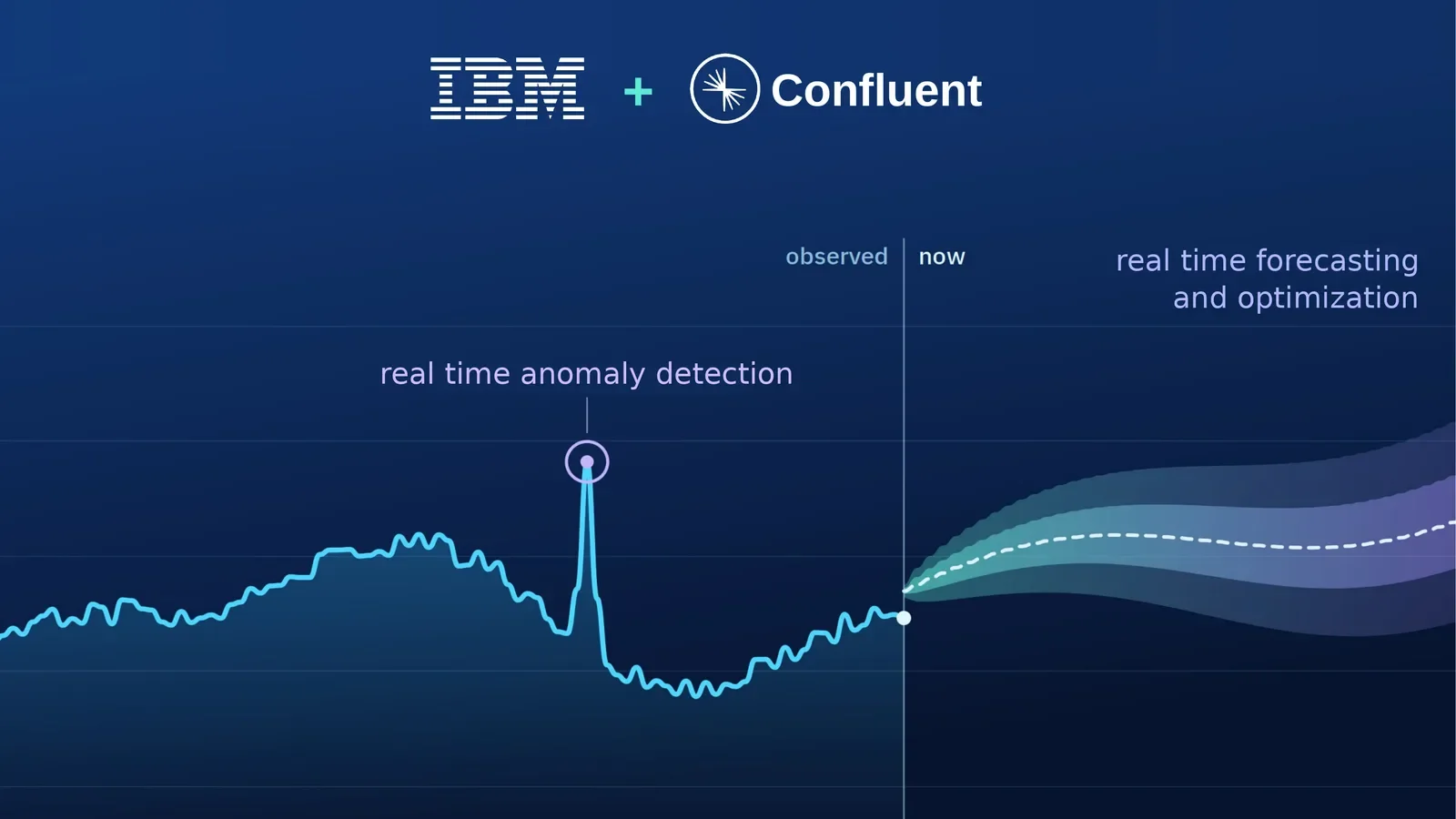
IBM and Confluent's September 2 announcement describes early access to IBM time-series models on Confluent Cloud, with inference integrated into streaming workflows using Apache Flink. The stated use cases include forecasting and anomaly detection, with broader time-series capabilities also discussed. The announcement presents a product direction and vendor claims; it does not establish results for every customer's data or workload.
Placing inference near a data stream can reduce integration work, but it does not eliminate the need to define what a prediction means. A stream contains events arriving over time. A model usually expects an organized representation of recent history. The transformation between those two is part of the application, not a neutral transport detail.
Begin with the decision and its deadline
Consider an illustrative refrigeration system monitoring temperature readings. Predicting a future threshold crossing may be useful only if maintenance staff have time to respond. A forecast delivered after the equipment has already failed has little operational value, regardless of its offline accuracy.
Specify when a decision must be made, how far ahead the prediction should look and what action follows. Distinguish a dashboard observation from an automated control command. The latter requires much stronger rules about acceptable behaviour when data is incomplete or the model is unavailable. A clear decision deadline also provides a meaningful end-to-end latency target.
Keep event time distinct from arrival time
A measurement may describe an event that occurred before it reached the streaming platform. Network delays and device buffering can change arrival order. Building a model input simply from the latest arrivals can therefore produce a different history from the one the physical process actually experienced.
Choose how to handle late and out-of-order measurements, and document the tradeoff. Waiting longer can improve completeness while making the prediction less timely. Acting immediately can be faster while relying on a partial window. There is no single setting that solves this for every system. Evaluate the chosen policy under realistic delay patterns rather than only perfectly ordered test data.
Give missingness an explicit meaning
A missing reading is not automatically a zero value. It may mean a disconnected device, a delayed message or a sensor that reports only when conditions change. These possibilities carry different information. Filling every gap with the same constant can manufacture patterns that the underlying process never produced.
Track data quality alongside the prediction. Useful fields include the age of the newest reading, the proportion of expected observations present and the number of values repaired by preprocessing. Downstream consumers can then distinguish a forecast based on a complete window from one produced under degraded conditions.
Evaluate the alert, not only the model
An anomaly score does not decide whether to wake someone at night. An application needs a threshold, a persistence rule and a response policy. Many small deviations may be harmless; one rare deviation may be expensive. The operational objective should reflect the relative costs of unnecessary interventions and missed incidents.
Replay historical streams through the full workflow, including delays and missing values where possible. Count alerts per device and per operating period, not just pointwise prediction errors. Review cases where an alert was technically correct but arrived too late to support action. Those failures belong to the system evaluation even if the model component behaved as designed.
Make recovery predictable
Streaming systems must decide what happens after interruption. If recent history is reconstructed differently after a restart, identical measurements can produce different inputs and therefore different predictions. Version the preprocessing rules and retain the identifiers needed to trace a result back to its data window and model.
For a first rollout, begin in an observational mode where predictions are recorded without automatically changing the controlled process. Compare proposed actions with established procedures, investigate disagreements and define a fallback. Moving inference closer to the stream can be valuable, but the durable benefit comes from making the complete path to a decision timely, explainable and recoverable.
Source: Real-Time Intelligence with IBM Time Series Models on Confluent ↗. How we write