What a Small Image-Generation Experiment Can Teach About Data Quality
A community account of training TinyDiT highlights the choices that matter before a long run begins: image-caption agreement, evaluation prompts and honest boundaries around pretrained components.

Inspect training examples in the form the model actually receives, and use a fixed visual evaluation set alongside numerical loss.
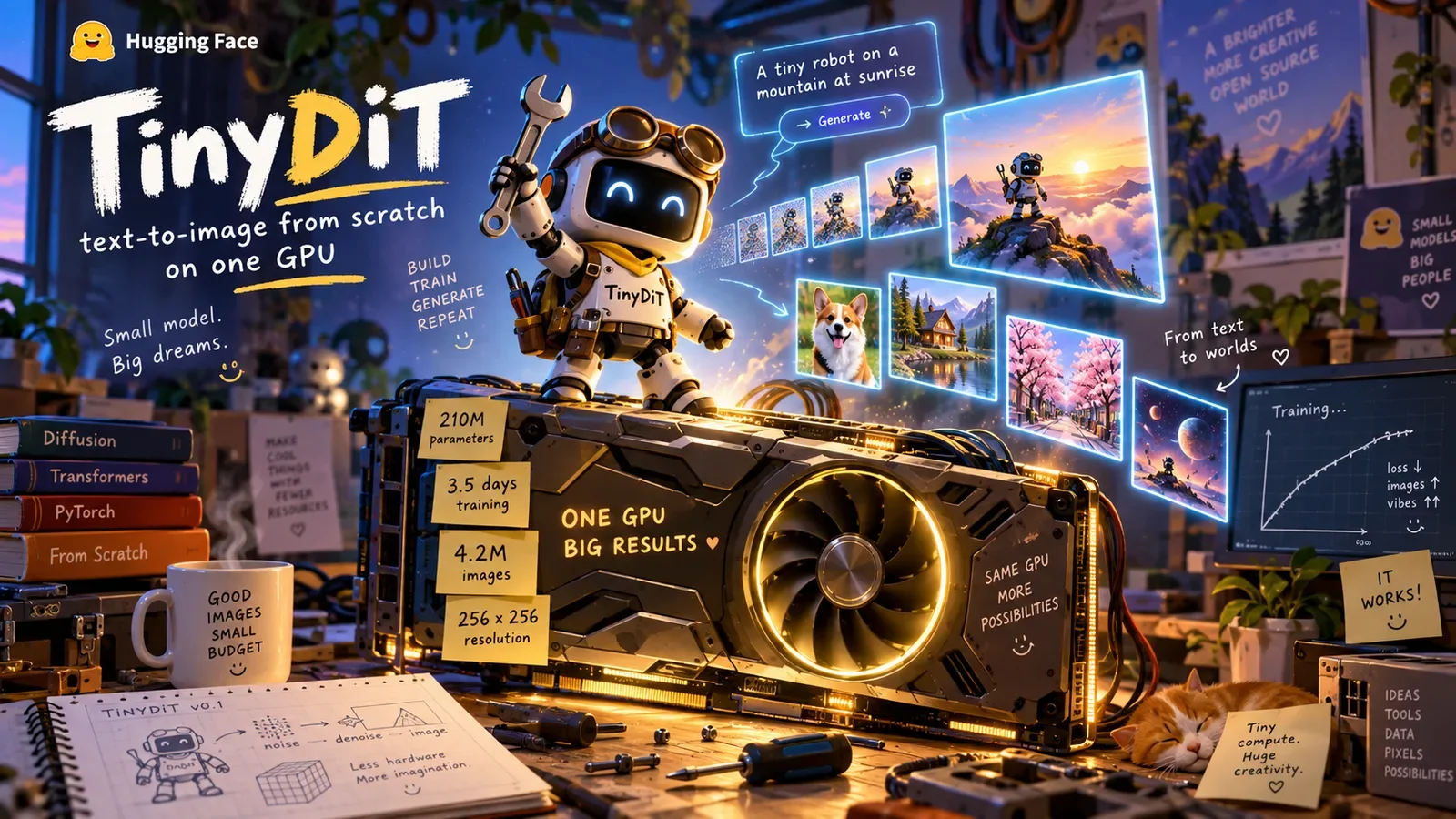
Ivan Mikhnenkov's September 9 community article describes TinyDiT, a 210-million-parameter image-generation transformer trained on a single GPU. The author reports using frozen pretrained text and image-encoding components while training the transformer itself, and emphasizes dataset inspection, caption choices and varied image shapes. This is a documented individual experiment, not evidence that a small project can reproduce every capability of a large production image model.
Its value for a reader is the opportunity to examine decisions usually hidden behind a finished demo. A successful training run is not merely one that reaches the final step. It should teach something about the relationship between data, architecture, computation and the images people actually want to generate.
Clarify what is being learned
When a project is described as trained from scratch, ask which components start without learned weights. A system may train its image transformer while depending on an existing text encoder or autoencoder. That is a legitimate design, but it changes both the cost and the interpretation of the result.
Draw a small component map before comparing projects. Mark which parts are frozen, which are updated and what data each has previously encountered if that information is available. This prevents a training-duration claim from being mistaken for the total effort needed to build every part of the system. It also identifies dependencies that must accompany a reproducible release.
Inspect the data after preprocessing
An attractive full-resolution photograph can become a poor training example after resizing or cropping. A caption that accurately describes the original might refer to an object no longer visible in the processed image. The model then receives contradictory supervision even though both source files look reasonable separately.
For an illustrative product-photo dataset, inspect examples with tall bottles, wide furniture and several objects in one frame. Apply the actual preprocessing first, then compare the resulting image with its caption. A systematic mismatch is more important than a few unusually beautiful samples. Record the frequency of problems so data selection is based on more than a memorable example.
Design prompts that reveal different failures
A fixed evaluation set makes checkpoints comparable. Include simple objects, attributes, spatial relationships and scenes with several requested elements. Keep the prompts stable while the training recipe changes. If prompts are rewritten to flatter each new checkpoint, the comparison no longer measures consistent progress.
Consider an illustrative prompt requesting a blue cup beside a red notebook. An output may contain both objects but reverse the colours, omit the notebook or place the objects incorrectly. Those are distinct failures. A single aesthetic score can miss them, so use a small rubric that separates appearance from instruction adherence. Label examples selected for publication and avoid presenting a lucky sample as typical behaviour.
Use loss as a diagnostic, not a verdict
Numerical loss is important for detecting instability and comparing controlled changes. It is not identical to perceived image quality or correct composition. A model can improve its training objective while still failing on a practical prompt category that is poorly represented in the data.
Review checkpoints at predetermined intervals using the same settings and, where appropriate, comparable random seeds. Save failed generations as well as successful ones. When a change appears to help, ask which categories improved and whether others regressed. This creates a more useful experiment history than a folder containing only the latest attractive outputs.
Spend a small budget deliberately
Before committing to a long run, verify that a small batch can pass through the entire pipeline, that checkpoints can be loaded and that the evaluation script uses the intended model. A short end-to-end rehearsal catches mistakes that a large compute budget merely makes more expensive.
Choose a limited number of questions for the experiment. For example, does a particular data-cleaning rule reduce missing objects, or does a caption policy improve short-prompt adherence? Change one major factor at a time when practical. The goal is not to produce a universal recipe from a single machine, but to create evidence about which choices help under the conditions actually tested. Clear limits make a small experiment more informative, not less impressive.
Source: Trained 210M text-to-image model from scratch on one GPU: what actually mattered ↗. How we write