A5 Reframes Personal Agents Around Memory, Change Detection, and Restraint
A5 presents a personal-agent harness built for work that spans conversations. Its design connects persistent context, memory maintenance, workspace change detection, and user-approved proposals—but also highlights why provenance, permission boundaries, and silence are core product requirements.

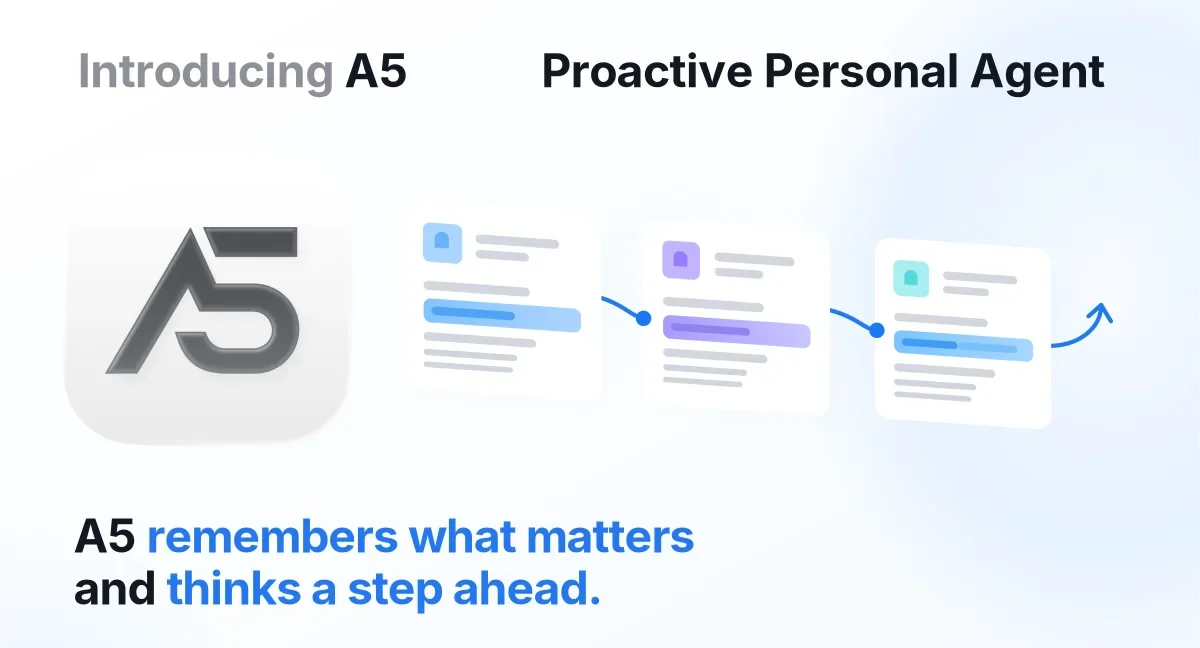
Personal agents need scoped, traceable memory and selective change handling; useful proactivity depends as much on restraint and user control as on recall.
A useful personal agent cannot treat every conversation as a blank page. It must carry forward relevant decisions, notice when the underlying evidence changes, and still avoid turning every update into an interruption. A5, introduced as a technical preview, approaches that problem as a harness around an agent rather than as a single model feature.
The project combines persistent workspace context, layered memory, change detection, background maintenance, and a proposal inbox. Its authors describe a ReAct-based core in which tools and services can bring previous understanding and new developments into the current task. Source code is planned for a later release, so the current announcement should be read as an architecture and product-direction description rather than a fully inspectable implementation.
The important shift is from recall to continuity
Long-term memory is often presented as a retrieval problem: store old messages, search them, and add matching fragments to a prompt. A5 points toward a broader requirement. Continuity means preserving not only a fact, but also its scope, supporting evidence, and the conditions under which it remains valid.
Consider a project note saying that a resource library is for personal use. That statement could be remembered perfectly and still become harmful after the requirements change to team use. The agent needs to associate the decision with its source, detect the source update, and reconsider permissions and ownership. Recall without revision can make an assistant confidently stale.
A5 separates source material from memory. A Context index represents files and saved pages and groups them semantically, while Memory retains goals, preferences, decisions, and background. A stable overview can enter a conversation immediately; more detailed notes remain available for targeted retrieval. The described design also divides workspace-specific knowledge from user-level preferences that may apply across projects. That boundary matters: a constraint from one client engagement should not quietly become a universal preference.
Proactivity is a ranking problem, not a notification feature
Watching a workspace for changes is straightforward compared with deciding which changes deserve attention. A5 assigns two different jobs to that process. Its Diff Engine can feed relevant updates into work already in progress. Its Proposal Engine can assess whether new evidence justifies a separate follow-up and place a suggestion in an inbox for user approval.
This separation offers a practical control point. A changed delivery date might require an active schedule calculation to be revisited, while a newly added background document may merely deserve indexing. The system also describes screening suggestions against completed, active, rejected, or duplicate work. Reintroducing a rejected proposal should require materially new evidence.
The most valuable behavior may be silence. If every file edit becomes a proposal, the user inherits a second inbox and must supervise the assistant continuously. A proactive system therefore needs thresholds, frequency limits, deduplication, and an explicit no-action outcome. Success is not the number of suggestions produced; it is the proportion that arrive with sufficient evidence, at an appropriate time, and with a clear decision for the user.
Maintenance work becomes part of the agent architecture
Persistent context degrades unless something maintains it. A5 describes an idle-time process called Autodream that reorganizes the context hierarchy, reconciles memory records, archives low-use material, and preserves unresolved conflicts for later confirmation. Candidate index changes are prepared separately and checked before publication, according to the announcement.
That design surfaces an underappreciated engineering issue: memory maintenance is itself a state-changing agent task. Merging two notes can erase an important exception. Promoting a project lesson into user memory can leak a local assumption into unrelated work. Summarizing an overview can remove provenance that was needed to challenge a conclusion later. Version history, source links, scoped records, and read-back checks are therefore operational safeguards, not just organization features.
The proposed Workspace Wiki offers another useful layer. Instead of leaving accumulated knowledge hidden inside retrieval machinery, it renders linked pages with citations and history that people can inspect and correct. This creates a visible interface for evaluating what the agent believes, distinct from evaluating its latest answer.
A practical evaluation should test failure modes
A demo can show that an agent remembers a travel interest or reacts to a supplier delay. A stronger evaluation asks when it should not generalize or intervene. Teams assessing systems in this category can use scenario pairs that differ by one important condition:
- A preference is repeated across trips, versus selected once because of a temporary constraint.
- A requirement changes in an authoritative document, versus an informal note that conflicts with it.
- A delay affects the critical path, versus a component with adequate schedule slack.
- A user rejects a proposal permanently, versus rejects it until new evidence appears.
- A memory is useful across workspaces, versus contains project-confidential context.
For each pair, measure more than answer quality. Check whether the system retrieved the right evidence, preserved its source, respected scope, identified conflicts, requested confirmation when needed, and avoided unauthorized action. Track false interventions and missed important changes alongside successful proposals. Memory correction and deletion should also be tested, because a system that learns continuously must provide a dependable way to unlearn.
The preview sets expectations, not guarantees
The announcement says the technical preview supports macOS and Linux packages and connects to model APIs compatible with Anthropic Messages or OpenAI Chat Completions, with streaming and tool calling required. It also notes that the Linux package had not been thoroughly tested at announcement time. Those are release-specific constraints, not assurances about every provider or workload.
More broadly, the architecture does not remove the familiar risks of personal agents. Background processing expands the period during which permissions matter. Cross-session memory raises privacy and retention questions. Proactive proposals can manipulate attention even when execution awaits approval. Recursive improvement is presented as a longer-term research direction, not a delivered capability.
A5 is most useful as a concrete decomposition of the personal-agent problem: evidence lives in context, durable judgments live in scoped memory, changes are evaluated for relevance, proposals remain user decisions, and maintenance keeps the whole structure usable. Whether the preview delivers that reliably will require hands-on inspection and longitudinal testing. The design nevertheless makes one principle clear: an agent that works over time must manage not only what it knows, but why it knows it, when that knowledge expires, and when doing nothing is the correct action.
Source: Introducing A5: Proactive Personal Agent in Your Life-Long Context ↗. How we write