Why Answer Verifiers Need Workflow Tests, Not Just Leaderboards
A shared comparison of typed decision models shows why answer-verification systems should be evaluated against simple baselines, deployment thresholds, and the downstream cost of unnecessary retries.

Judge answer verifiers by whether they beat simple baselines and improve the complete escalation workflow at a realistic threshold—not by AUC alone.
Answer verification sounds like a simple classification task: given a question and a candidate answer, estimate whether the answer is correct. In an agent pipeline, however, that score is rarely the final product. It normally controls a decision—accept the answer, retry it, route it to a stronger model, or ask a human. That makes the quality of a verifier inseparable from the workflow around it.
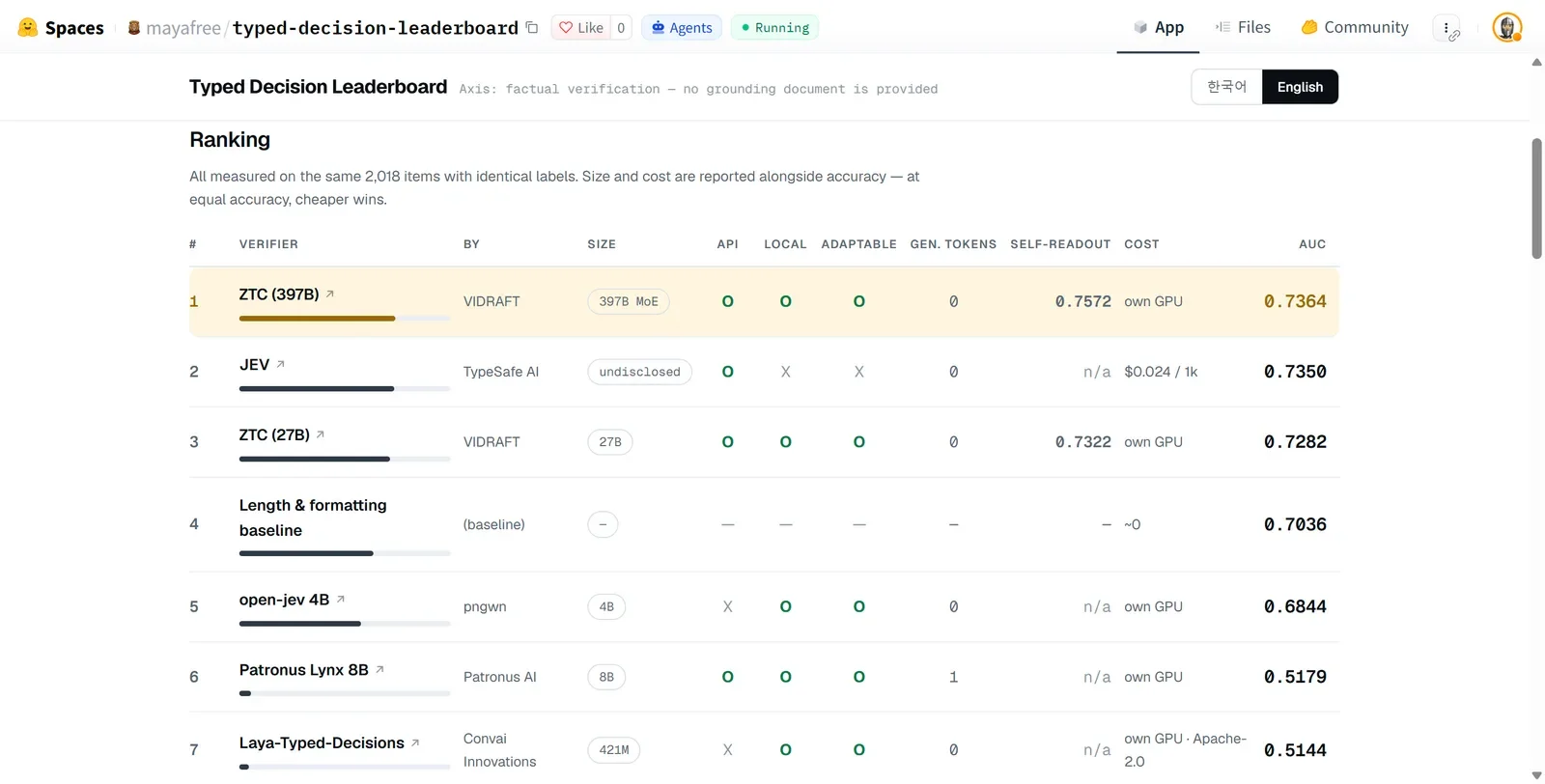
A new community comparison puts several typed decision systems on one 2,018-item test set spanning five domains. Its most useful contribution is not a single winner. It is the evidence that ranking quality, threshold behavior, and operational value can point in different directions. For teams building gates around model outputs, that distinction should shape both evaluation and deployment.
Start with the cheapest plausible baseline
The comparison reports a size-weighted, per-domain AUC and includes a logistic baseline built from ten surface features such as answer length, digit count, and formatting. That baseline reaches 0.7036, while eight measured systems fall below it. The two highest scores—0.7364 and 0.7350—are statistically indistinguishable under the study's paired-bootstrap rule.
A surface baseline is important because answer datasets often contain accidental shortcuts. Incorrect answers may be shorter, less structured, more hesitant, or formatted differently from correct ones. A sophisticated model can appear to recognize truth while mainly exploiting those correlations. If it cannot outperform an inexpensive feature model, its extra latency and complexity have not yet purchased convincing evidence of semantic verification.
This suggests a practical benchmark ladder. Begin with random ranking, then test surface features, the answering model's own confidence, a small local classifier, and only then larger or hosted judges. Keep every baseline on the same split and aggregation rule. The goal is to identify where additional capability begins to add signal, not merely to fill a table with model names.
AUC describes ordering, not the operating point
AUC asks whether incorrect answers tend to receive worse scores than correct ones across all possible thresholds. That is useful for comparing general ranking ability, but a deployed gate uses one threshold at a specific budget. Two systems with nearly identical AUC can place very different examples in the bottom 20 percent.
The downstream cost matrix matters. Suppose a retry sometimes repairs a wrong answer but can also replace a correct answer with a wrong one. Sending more cases for reconsideration is therefore not automatically beneficial. At a fixed retry budget, the gate should concentrate errors strongly enough that the expected repairs exceed the correct answers damaged by re-answering. Precision among routed items becomes more actionable than global ranking alone.
A useful evaluation should consequently report threshold-specific quantities: the fraction of routed answers that are actually wrong, the number repaired after retry, the number broken after retry, final task accuracy, latency, and cost. Teams should calculate these values at several realistic budgets rather than selecting a threshold from AUC. A high-quality ranking may still be a poor production gate if its useful region falls outside the permitted traffic or cost envelope.
Evaluate the entire decision loop
Verifier tests often freeze the candidate answers and stop after classification. Production systems add another model call or human action, introducing a second source of uncertainty. The retry model may be stronger on average yet unreliable on particular domains. It may also repeat the original mistake, introduce a new one, or respond differently when prompted with critique.
A controlled loop test should reuse the same candidate-answer pool and the same retry policy for every verifier. At each routing budget, record which examples were selected and what happened after escalation. Random routing is a necessary control: if a verifier cannot beat random selection end to end, its score is not translating into useful decisions. The ungated workflow is another control because even random retries can sometimes move aggregate accuracy.
Domain slices deserve equal attention. A single pooled metric can hide shifts in score scale between domains, making cross-domain separation look like correctness discrimination. Computing within each domain before aggregation reduces that risk. It also reveals where one global threshold may be inappropriate. A science question and a short factual lookup can have different error rates, score distributions, and retry economics.
Reproducibility includes failures and boundaries
A leaderboard is most trustworthy when it states what it could not establish. The source comparison distinguishes factual verification without a grounding document from entailment against supplied evidence. Those are adjacent tasks, but they are not interchangeable. A system optimized to check whether text follows from a document should not be interpreted as a general correctness judge when no document is provided.
The study also lists systems whose published artifacts did not execute and flags a disputed re-measurement rather than silently substituting a new value. This is useful scientific hygiene. Executability, tokenizer compatibility, missing classifier heads, and access constraints are part of the real adoption surface, even though they do not fit neatly into an accuracy column.
For an internal evaluation, preserve the same discipline: pin artifact versions, publish the scoring transformation, retain per-example outputs, document excluded systems, and separate reproduced numbers from vendor claims. If source data cannot be redistributed, release the harness and a schema so others can run the protocol on data they are licensed to use.
A deployment checklist for verifier gates
Before adding an answer verifier, teams can ask five questions. Does it beat a surface-only baseline on the target distribution? Is the metric aggregated in a way that prevents domain leakage? At the intended threshold, what proportion of routed cases are genuine errors? Does the complete retry or escalation loop improve the final task outcome? And do the improvement, latency, privacy, and API costs remain acceptable under expected traffic?
The best verifier is therefore not necessarily the largest model or the first row of a general leaderboard. It is the system whose scores remain informative at the chosen operating point and whose downstream actions create net value. Shared benchmarks narrow the search. Workflow-specific tests decide what should ship.
Source: Inside the JEV Ecosystem: 13 Answer Verifiers on One Test Set ↗. How we write