OhanASR Makes Armenian Speech Recognition a Testable Engineering Choice
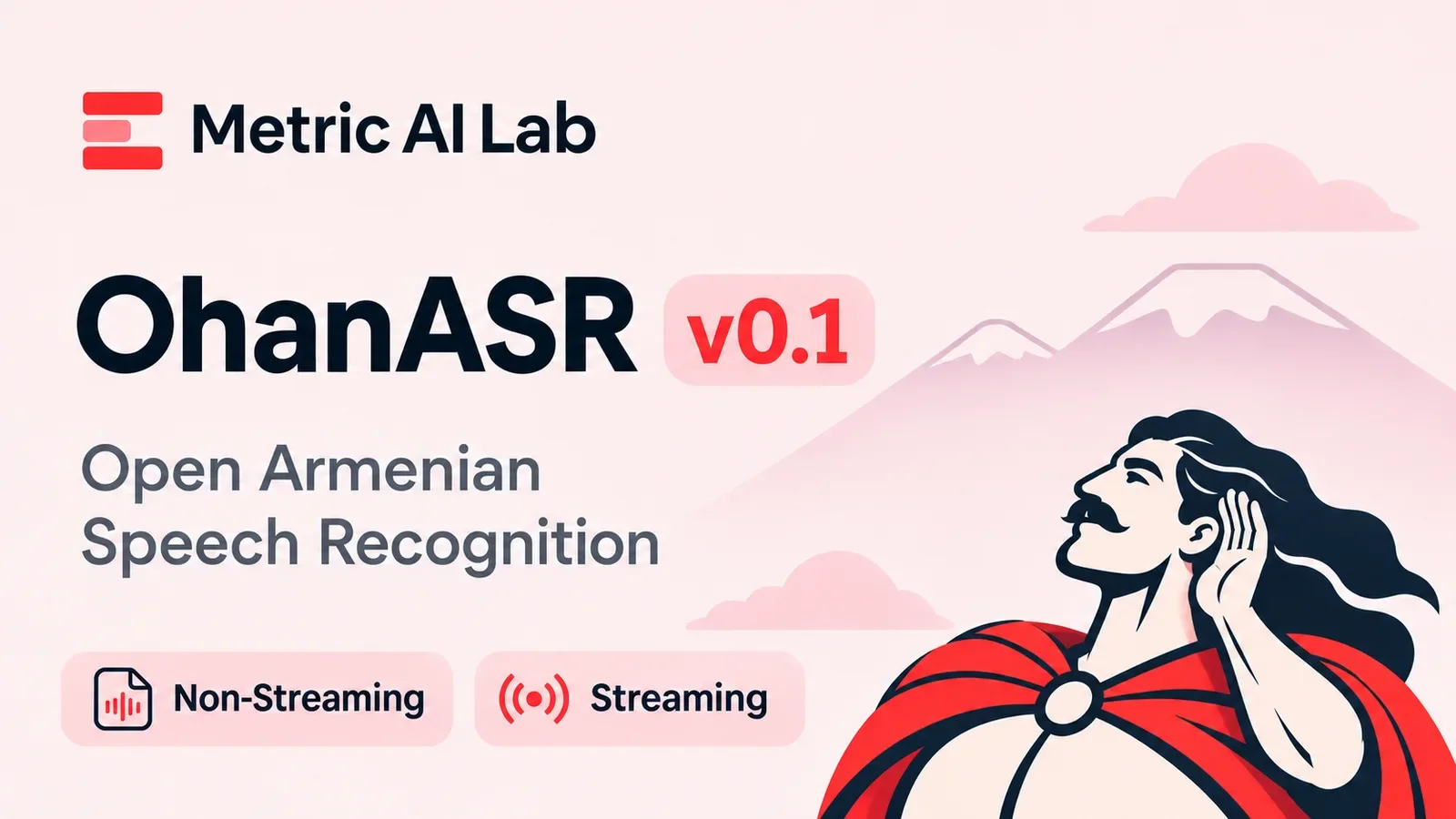
OhanASR provides separate offline and streaming models for Armenian speech recognition. Its benchmark breakdown and stated limitations offer a practical starting point for choosing a model and designing an evaluation that reflects real audio.

Choose between offline and streaming recognition by workflow, then evaluate OhanASR on representative Armenian audio with separate slices for noise, code-switching, critical terms, and transcript stability.
Speech recognition for a lower-resource language is not one problem with one score. A recorded interview, a live captioning feed, a poetry reading, and a film soundtrack impose different constraints. A useful release therefore needs more than a model file: it needs enough evidence for developers to decide which variant to try, where it may fail, and how to test it on the speech they actually handle.
Metric AI's OhanASR release, published on November 20, 2026, offers that starting point for Armenian. OhanASR-v0.1 targets recorded audio, while OhanASR-Streaming-v0.1 processes speech incrementally. The team says the offline model was fine-tuned from a two-billion-parameter multilingual model on 820 hours of Armenian speech, with additional training used to adapt the streaming version. Both are open-weight and licensed under CC BY-NC 4.0, which permits non-commercial use with attribution but is not a general commercial deployment license.
Read the benchmark by audio condition
On ArmBench-ASR, the authors report combined word error rates of 16.12% for the offline model and 19.07% for the streaming model. Those aggregate numbers are useful for orientation, but the per-dataset results are more informative. The offline model's reported WER ranges from 9.62% on Common Voice 26 to 42.61% on movies; the streaming variant ranges from 11.91% to 45.00% on the same slices. Lower is better.
This spread is a warning against turning a leaderboard rank into a product expectation. Movie audio may contain music, overlapping speakers, accents, compression, and dialogue recorded at varying distances. Read speech recorded under cleaner conditions is a different task. A team transcribing classroom lectures should not infer its likely accuracy from either slice without checking how closely its microphones, speakers, and background noise resemble the benchmark material.
Word error rate also treats every word equally, while applications do not. A missed filler word may have little consequence; a wrong surname, dosage, date, or account number can invalidate an otherwise readable transcript. Character error rate can add context for a morphologically rich language or spelling variation, but it still does not express business impact. The right evaluation combines standard metrics with a list of terms and fields that must be preserved.
Choose offline or streaming by workflow
The offline model has access to a completed recording, while streaming recognition must produce partial output before future audio arrives. That makes the choice an operational tradeoff, not simply a contest between two accuracy scores. Batch transcription can tolerate waiting until an upload finishes and may suit archives, interviews, or subtitle preparation. Streaming is relevant when people need text during a meeting, broadcast, classroom session, or live accessibility workflow.
For a streaming system, measure more than final WER. Track time to the first usable text, the delay between speech and stable text, and how often partial words are revised. A transcript that eventually becomes correct can still be distracting if captions repeatedly rewrite earlier phrases. Conversely, a modest accuracy reduction may be acceptable when low delay is the central requirement. These measurements depend on the complete pipeline—including audio capture, chunking, networking, decoding, and display—not just the model.
A fair comparison should use the same audio and the same text normalization rules. Preserve raw hypotheses as well as normalized scoring output. Punctuation removal, number formatting, or spelling normalization can make a metric easier to compare, but users see the rendered transcript. Keeping both views prevents a cleaned score from hiding an awkward experience.
Build a small Armenian evaluation set
Start with recordings that represent the intended users rather than assembling a large generic test set. Include different speakers, devices, room acoustics, speaking rates, and the formal or colloquial forms expected in the application. The release specifically notes potential confusion between formal and colloquial Armenian, unreliable code-switching, phonetic rendering of foreign words in Armenian script, and omissions in unclear audio. Each limitation can become an explicit test slice.
For example, a technology event may contain Armenian sentences with English company names and product terms. Create a dedicated code-switching slice and score named entities separately. A media archive can group clean studio speech, field reporting, movies, and literary readings. A live-captioning pilot should include interruptions and variable microphone distance. Report every slice alongside the aggregate so improvement in a large easy category cannot conceal regression in a smaller critical one.
Human review remains important. Ask Armenian-speaking reviewers to label whether an error changes meaning, affects a protected name or number, or merely reflects an acceptable written variant. Define the policy before comparing models. Otherwise reviewers may unconsciously forgive the preferred system or disagree about normalization after seeing results.
Treat the release as a baseline, not a promise
A reproducible trial should record the exact model revision, decoding settings, audio preprocessing, hardware, and evaluation script. Pinning these details matters because changes in segmentation or normalization can move the score without changing the underlying recognizer. For streaming, record chunk size and any buffering policy as well.
The non-commercial license is another early decision point. Research, education, and internal experimentation may fit the stated terms, but a commercial product team should resolve licensing before investing in integration. Open weights improve inspectability and experimentation; they do not automatically remove use restrictions or establish fitness for sensitive domains.
OhanASR expands the set of concrete options for Armenian ASR and, importantly, publishes separate evidence for recorded and incremental recognition. The productive next step is not to repeat its headline ranking. It is to turn the published slices and limitations into a local acceptance test, choose the latency–accuracy tradeoff that matches the workflow, and keep the results specific to the people and audio conditions the system is meant to serve.
Source: Introducing OhanASR: Open Armenian Speech Recognition Models ↗. How we write