OhanTTS Brings Streaming Speech Generation to Armenian
Metric AI's OhanTTS-v0.1 focuses on Armenian while offering multilingual synthesis, short-sample voice cloning, and streamed audio for latency-sensitive applications.

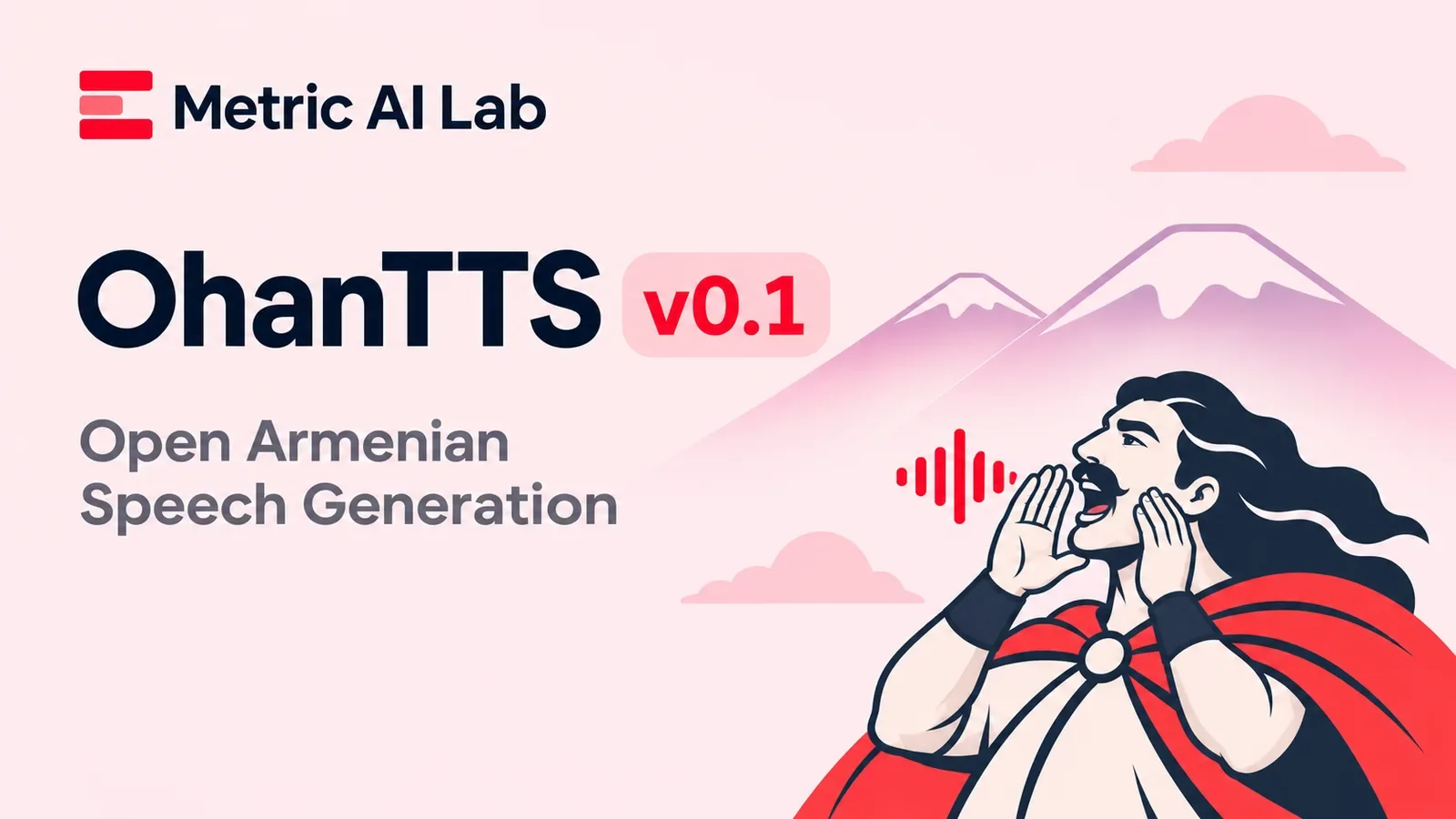
OhanTTS expands Armenian speech tooling with streamed synthesis, but adopters should validate language quality, latency under load, consent practices, and non-commercial licensing against their own use case.
Armenian speech technology has often had fewer open options than higher-resource languages. Metric AI's new OhanTTS-v0.1 release targets that gap with an Armenian-focused text-to-speech model that can return audio incrementally rather than waiting for an entire utterance to finish. That distinction matters for conversational interfaces, accessibility tools, and any product where silence between a request and a spoken response makes the experience feel slow.
The release is also a useful reminder that a speech model should be judged as a system, not just by a polished audio sample. Language coverage, latency, reference-audio requirements, licensing, pronunciation behavior, and deployment constraints all determine whether a model fits a real use case.
What the release includes
OhanTTS-v0.1 generates Armenian and seven additional languages: English, Spanish, Arabic, Russian, Mandarin Chinese, Japanese, and French. According to Metric AI, it was further trained on roughly 160 hours of recordings, including 61 hours of Armenian speech. It supports voice cloning from a reference clip of three to ten seconds paired with an exact transcript, as well as voice creation from a short textual description.
The model streams generated audio, but the current interface still expects the complete input text before synthesis begins. Metric AI reports 331 milliseconds to first audio for one client on its tested NVIDIA GB10 setup. At 16 concurrent clients, the reported time rises to 2,169 milliseconds while generation remains faster than real time. These figures describe one local serving configuration, not a universal service-level guarantee; hardware, workload, request length, and concurrency can materially change the result.
For Armenian evaluation on held-out, unseen speakers and texts, the authors report 14.70% word error rate, 6.15% character error rate, and 0.693 speaker similarity. Each metric captures only part of the experience. Transcription-based error rates emphasize intelligibility, while similarity estimates how closely the output resembles the reference voice. Neither directly measures whether phrasing, emotion, stress, or pauses sound appropriate to a listener.
Streaming changes the product experience
A non-streaming synthesizer can produce good audio yet still feel unresponsive because playback starts only after the whole result is ready. Incremental output lets an application buffer a small amount of audio and begin playback while later segments are generated. The benefit grows with longer responses, provided the generation rate stays ahead of playback.
Consider a spoken assistant answering with a 15-second response. The important user-facing measurement is not only total generation time. Teams should separately track time to first playable audio, interruptions caused by buffer underruns, and end-to-end completion time. A model can excel on one dimension and struggle on another. Concurrency tests are equally important: the single-user result says little about a service handling bursts of simultaneous requests.
OhanTTS does not yet accept text progressively. An application connected to a language model must first receive or assemble the full text, then submit it for streamed speech generation. Metric AI identifies bidirectional streaming—accepting text chunks while producing audio—as a future goal. Until that arrives, upstream text-generation latency remains outside the benefit of audio streaming.
A practical evaluation checklist
Teams considering the model should build a test set from the language and content they actually serve. For Armenian, that should include punctuation patterns, dates, numbers, abbreviations, proper names, borrowed words, and sentences of different lengths. Human reviewers can score intelligibility, naturalness, stress, pacing, and whether the voice remains stable across an utterance. Automated transcription metrics are useful for regression testing, but they should complement rather than replace listening tests.
Voice-cloning evaluation needs additional controls. Use clean reference audio, verify that its transcript matches exactly, and test multiple speakers rather than selecting one favorable example. Compare results across microphones, background-noise levels, speaking styles, and reference durations within the supported range. Most importantly, obtain the speaker's permission and define how reference recordings and generated audio will be stored, accessed, and removed.
Latency testing should mirror the intended deployment. Measure cold and warm requests, several text lengths, realistic concurrent-user levels, and the network path between client and server. Record both median behavior and slow-tail behavior. A fast median can conceal occasional delays that are disruptive in conversation. Because the release limits a request to approximately 20 seconds of generated audio, applications also need a splitting strategy and should listen for awkward joins between segments.
Boundaries to account for
Metric AI describes v0.1 as an early release. The documented limitations include imperfect handling of Armenian punctuation, possible mispronunciation of unfamiliar names and foreign words, errors during within-utterance language switching, and sensitivity to reference quality. Those are especially relevant for news reading, customer support, and educational content, where names and mixed-language phrases are common.
Licensing is another firm boundary. The model is released under CC BY-NC 4.0, which permits research, educational, and other non-commercial use with attribution but is not a general commercial-production license. Organizations should review whether their intended use qualifies before integration. The release is served through SGLang-Omni with an OpenAI-compatible audio endpoint, but interface compatibility alone does not remove the need to validate operational behavior and license terms.
Why this release matters
OhanTTS expands the set of tools available for Armenian speech while foregrounding responsiveness as a first-class feature. Its strongest immediate fit is experimentation and non-commercial prototyping where teams can evaluate Armenian quality, streaming behavior, and consent-aware voice cloning against their own requirements.
The broader lesson is transferable: responsible adoption depends on more than hearing one convincing demo. A useful assessment combines language-specific listening, intelligibility metrics, load testing, clear voice-consent practices, and a careful reading of deployment and licensing limits. OhanTTS-v0.1 offers a concrete foundation for that work, with its early-release boundaries plainly visible.
Source: Introducing OhanTTS: Armenian Text-to-Speech ↗. How we write