Simulation-Ready Assets Turn 3D Libraries Into Testable Robotics Infrastructure
SimReady Central packages OpenUSD models with simulation metadata. The useful shift is not simply a larger asset catalog, but a more disciplined way to select, validate, version, and reuse components across robotics and digital-twin experiments.

Treat simulation-ready profiles as explicit capability contracts, then verify each chosen asset in a minimal, versioned acceptance scene before building a larger robotics or digital-twin workflow.
A visually convincing 3D model is not automatically a useful simulation object. A robot can appear to touch a crate while its physics representation passes through the surface; a gripper can look articulated while lacking usable joint limits; and a factory rack can have the right silhouette but no metadata for the analysis a digital twin is meant to perform. The expensive part is often the preparation between obtaining geometry and running a credible experiment.
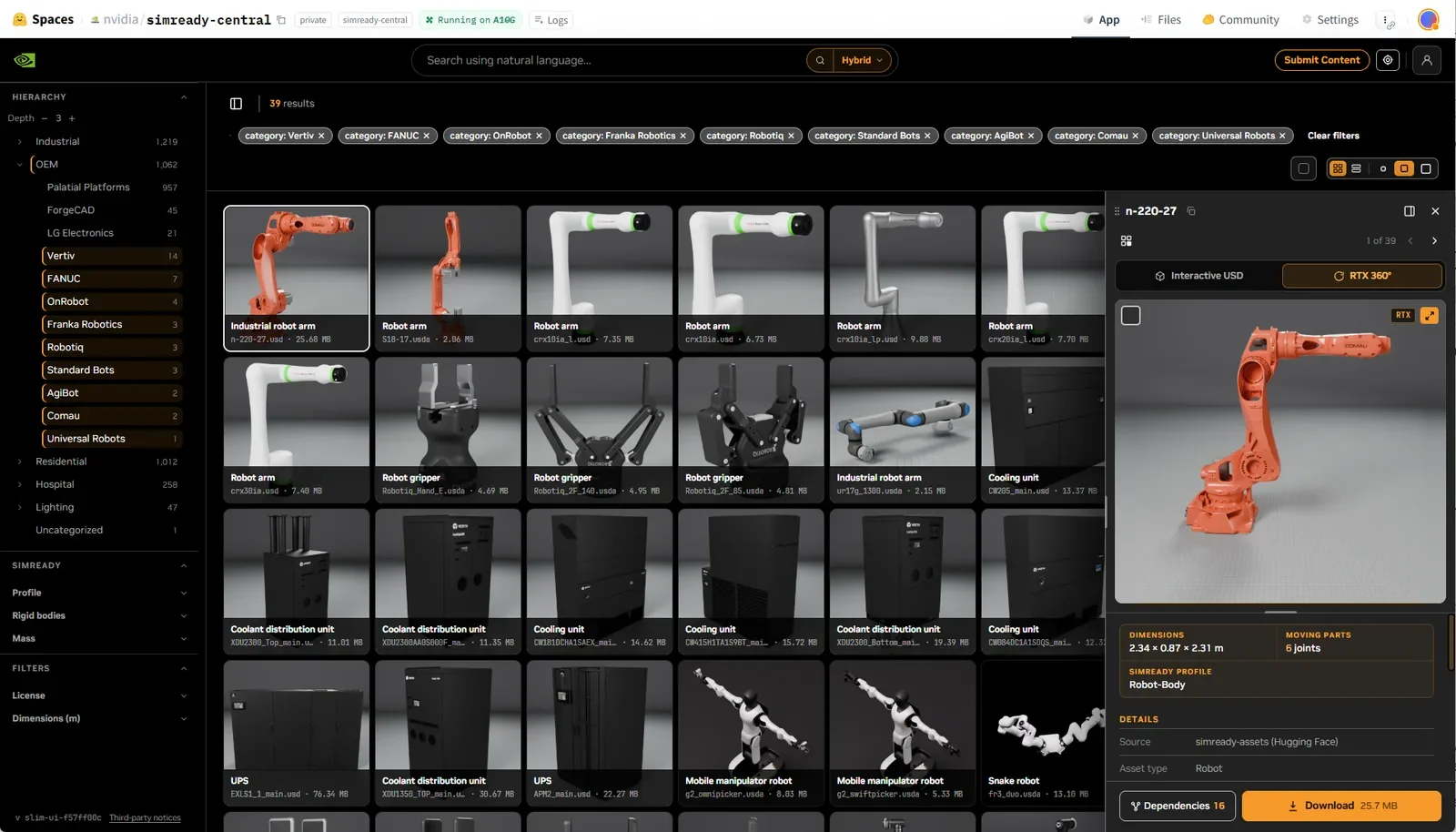
NVIDIA’s SimReady Central Library, announced on October 21, 2026, addresses that preparation layer. Hosted on Hugging Face, it brings together more than 2,000 OpenUSD assets described as ready for simulation workflows. The collection spans robot arms, grippers, warehouse equipment, racks, cooling infrastructure, and other components. Its importance is less about the raw item count than about making readiness requirements visible and searchable.
Readiness is a contract, not a visual label
A simulation-ready asset should be treated as a contract between its producer and the runtime consuming it. Geometry answers what an object looks like. The contract must also describe what the runtime may assume about its structure and behavior. Depending on the task, that can include collision shapes, mass, friction, joint topology and limits, semantic labels, materials, or sensor-related attributes.
SimReady Foundation organizes requirements into profiles for different uses. That matters because readiness is contextual: an asset suitable for a perception dataset may still be incomplete for contact-rich manipulation. Likewise, a rack that supports spatial planning does not necessarily include the electrical or thermal information needed for facility analysis. A profile should therefore be read as a capability declaration, not as a universal quality badge.
Before adopting an asset, teams can turn the profile into a short acceptance checklist: Which properties are present? Which units and coordinate conventions apply? Which runtime interprets them? Which behaviors remain outside scope? This prevents a polished preview from becoming an accidental substitute for technical validation.
Build a small acceptance scene first
The safest first step is not a full warehouse or factory. It is a minimal scene designed to expose integration problems quickly. For a pick-and-place setup, load the chosen arm, gripper, target object, support surface, and one obstacle. Confirm that joints move in the expected directions, limits are respected, collision shapes align with visible geometry, and grasp contact behaves plausibly. Check scale, origin placement, and axis orientation before tuning a controller.
For a facility-layout asset, use an equally narrow test: place two pieces of equipment at known coordinates, calculate their bounds, and run a clearance check with a deliberately valid and deliberately invalid arrangement. If the workflow depends on thermal, power, or connectivity metadata, verify those fields independently. OpenUSD composition can keep this acceptance scene in its own layer, leaving vendor assets unchanged and making the test repeatable when an asset version changes.
This small-scene method separates three possible failures. The asset may lack required information; the importer may interpret valid information incorrectly; or the application logic may make a wrong assumption. Diagnosing those categories in a complete environment is much harder because many assets, extensions, and scripts change at once.
Search should filter by capability
SimReady Central includes natural-language discovery through NVIDIA USD Search, while Hugging Face search indexes USD properties and simulation metadata. Natural-language search can accelerate exploration, but the final selection should rely on explicit constraints. A request for a ‘warehouse gripper’ is incomplete without payload needs, mounting compatibility, articulation requirements, runtime support, licensing, and the profile needed for the task.
A useful agent-assisted workflow therefore has two stages. First, search broadly to assemble candidates. Second, apply deterministic filters and produce a selection record containing asset identifiers, versions, relevant profiles, and rejected alternatives. The agent may help write scene-assembly code, but executable output still needs review and sandboxed validation. Search relevance does not establish physical compatibility, and generated code does not prove that a scenario is correctly configured.
That distinction becomes especially important when combining equipment from different manufacturers. Shared OpenUSD representation makes composition easier, but it does not guarantee matching mounts, realistic reach, collision-free motion, or equivalent conventions. Those are integration questions that the assembled scene must answer.
Reproducibility needs more than the scene file
A saved stage is only one part of a reproducible experiment. Record immutable asset revisions where possible, the simulator and extension versions, physics settings, unit conventions, generated or handwritten assembly scripts, random seeds, and any local overrides. Keep task configuration separate from the environment layer so the same workcell can support multiple evaluations without silently altering its source assets.
For AI factory layouts, geometry checks such as overlap and aisle clearance are valuable early filters. They are not substitutes for engineering analysis. Cooling performance, power distribution, structural constraints, safety rules, and live building-management data require domain-specific tools and authoritative inputs. A digital twin assembled from reusable assets can organize those analyses, but it cannot create missing operational truth.
A practical adoption sequence
Start with one task whose success criteria can be measured. Choose assets by required profile, inspect their metadata, and pin their versions. Create the minimal acceptance scene and store its checks alongside the scene-building script. Only after that test passes should the team expand the environment, introduce variations, or generate synthetic data.
The library model also creates a useful feedback loop for equipment makers. When requirements are explicit, an integration failure can be reported as a missing capability or validation issue rather than a vague complaint that a model ‘does not work.’ For developers, the payoff is similarly concrete: less one-off asset repair, clearer experiment provenance, and faster comparison of alternatives.
SimReady Central does not remove the need to validate simulations. It makes validation more tractable by attaching declared capabilities to reusable assets. The strongest use of the library will be to treat those declarations as the beginning of an evidence trail—from discovery, through acceptance testing, to a versioned experiment—not as the end of one.
Source: Announcing SimReady Central: An Open Library of Simulation-Ready 3D Assets for Robotics and AI Factories ↗. How we write