Decision Models Could Simplify Document AI—If Their Probabilities Hold Up
IVE-4B and Ivonnet-0.8B turn document tasks into scored choices rather than generated text. The design can simplify routing, extraction, and reranking, but deployment still requires threshold, calibration, and domain-shift tests.

IVE's constrained, probability-based interface can unify several document decisions, but its real value depends on candidate quality, calibrated thresholds, and domain-specific fallback tests.
Document systems often look more complicated than the decisions they make. A pipeline may use separate components to classify a page, identify a relevant field, choose a navigation action, and rerank search results. IVE proposes a different abstraction: express each task as a question with a finite set of options, then score every option in one forward pass.
Illuin has released IVE-4B and its distilled 0.8B counterpart, Ivonnet, under Apache 2.0. Both accept text or page images and support as many as 255 choices. Instead of producing free-form prose that another component must parse, they return probabilities that an application can rank, threshold, or combine. That interface is potentially more important than any single benchmark result because it changes how document workflows can be assembled.
A shared interface for unlike tasks
Classification, page relevance, key-value extraction, and web actions appear different at the product level. At the decision layer, each can become a constrained choice. An invoice workflow might ask which candidate date is the issue date. A retrieval system might ask whether a page can answer a query. An agent might choose among named interface controls. The same service contract can cover all three.
This reduces integration work: applications receive bounded outputs with explicit scores rather than strings whose wording may vary. It can also make fallbacks easier. A system can accept a high-confidence selection, route an uncertain case to a larger model, or send a narrow set of candidates to a human reviewer.
The abstraction has limits. Candidate generation still has to put the correct answer among the options. A confident choice cannot recover a missing field candidate, an unseen page, or an action omitted from the menu. Open-ended synthesis and explanations also remain generative tasks. Decision models are therefore best treated as control-plane components, not universal replacements for OCR, retrieval, or language models.
Why visual input changes the pipeline
IVE reads screenshots, scanned pages, charts, and photographs directly. This matters when spatial structure carries meaning: a table header may determine which value belongs to a row, nearby labels may disambiguate a number, and visual grouping may disappear in linearized OCR. Direct image input can preserve those relationships.
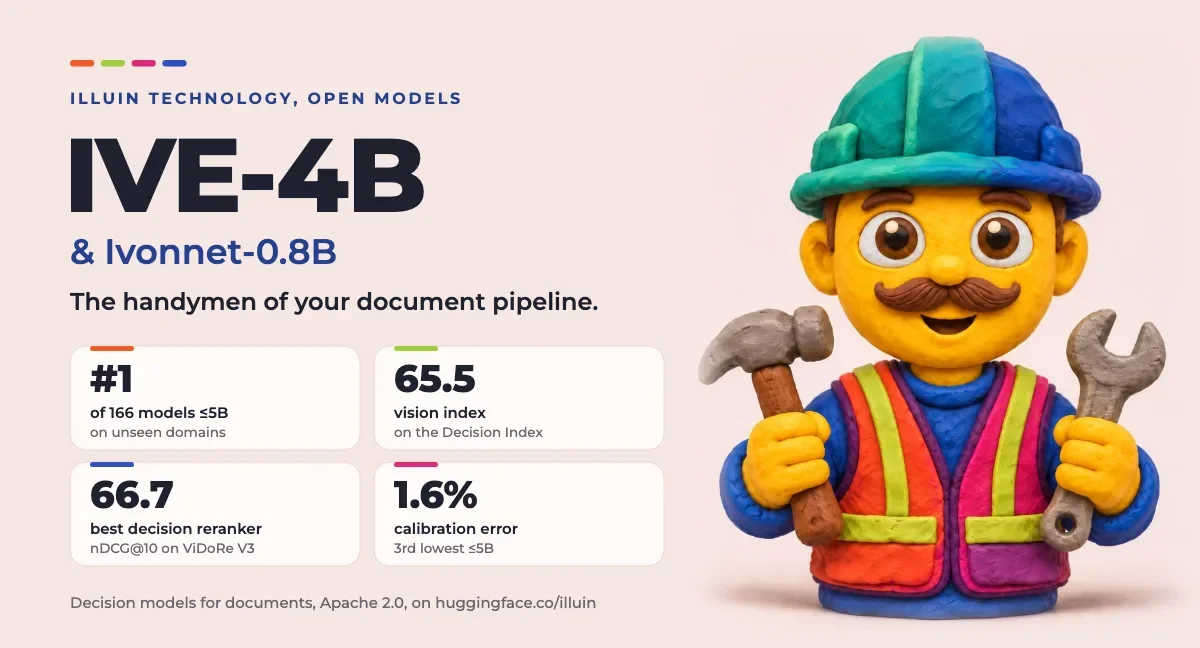
The release reports a 65.5 vision index for IVE-4B on Decision Index 0.4.1 and places Ivonnet second among models up to 1B in that evaluation. For text tasks from private new domains, IVE-4B reportedly scores 40.3, the highest result among 166 evaluated models up to 5B, although its overall text index trails the strongest listed alternatives. These are promising results, but adopters should reproduce the relevant slice rather than generalize from a composite ranking.
A practical architecture may keep both image and text paths. OCR remains useful for search, accessibility, audit logs, and cheap filtering. The visual decision model can operate on a shortlist where layout or chart interpretation matters. This staged design limits expensive image processing while retaining access to information that OCR may flatten.
Calibration is an operational requirement
Probabilities are useful only when their meaning survives the deployment environment. The authors report 1.6% expected calibration error for IVE-4B after temperature scaling. That is encouraging, but calibration is not permanent. A score learned across benchmark mixtures may shift with a new document template, language, scanner, option count, or class balance.
Teams should evaluate both ranking and reliability. Ranking asks whether the correct option tends to score above alternatives. Reliability asks whether selections assigned 80% confidence are correct about 80% of the time. The latter determines whether a threshold can safely automate work. Calibration plots, selective accuracy at several coverage levels, and per-document-family slices are more informative than one average score.
Thresholds should also reflect asymmetric costs. Missing a relevant compliance page may be worse than reviewing an extra page, while an incorrect payment field may be much worse than escalating it. One global cutoff across tasks is unlikely to express those differences. The application should own the policy even if one model supplies all the scores.
Training choices suggest useful evaluation tests
IVE uses a frozen vision encoder while training the language-side components and connector. The authors say updating the visual tower damaged out-of-domain chart and document performance, while freezing it shortened the 4B training run to 12.8 hours on four H100 GPUs. Their dataset also randomizes option order, varies label wording, paraphrases common questions, adds hard negatives, and balances numeric distractors.
Those choices point directly to robustness tests. Shuffle options and verify that answers do not follow positions. Rename labels without changing their meaning. Add plausible negative pages rather than obvious mismatches. Change a question's wording while holding its intent constant. For numeric extraction, include distractors above, below, and near the target. A model that succeeds across these perturbations is more likely to have learned the decision rather than a dataset shortcut.
Known boundaries should be tested explicitly. The release describes weaker behavior on multiple-answer questions and long multi-step reasoning, a 16,384-token input limit, and training data that is mostly English. Applications needing multilingual documents, select-all answers, or long chains of reasoning should not infer support from single-choice document results.
A deployment trial that measures the whole system
Begin with one bounded workflow and a labeled shadow set. Preserve the current pipeline as a baseline, then compare task accuracy, abstention rate, latency, memory use, and downstream correction cost. Evaluate image and OCR inputs separately, because the cheaper path may be sufficient for some document families.
Next, choose thresholds on validation data and freeze them before the final test. Record performance by template, scan quality, language, option count, and time period. Include cases where the correct answer is absent so the surrounding system can detect candidate-generation failures rather than forcing a misleading selection.
Finally, monitor confidence drift after launch and retain a review path. A unified decision model can remove a zoo of specialist classifiers, but it also concentrates risk in one component. The best outcome is not merely fewer models. It is a simpler pipeline whose boundaries, probabilities, and fallback behavior remain visible and testable.
Source: Meet IVE, the handyman of your document pipeline ↗. How we write