Multi-Teacher Distillation Comes to TRL: What Teams Should Measure Before Scaling
TRL now supports multi-teacher on-policy distillation through its asynchronous trainer, giving teams a practical route for combining domain specialists while exposing a crucial balancing problem: prompts are not the same thing as training tokens.

Multi-teacher distillation becomes practical only when teams measure effective token weight and capability retention per teacher, not merely the nominal prompt mix.
Multi-Teacher On-Policy Distillation (MOPD) offers an appealing answer to a stubborn post-training problem: how can one general model absorb the strengths of several specialists without forcing every capability to compete inside one reinforcement-learning run? A newly documented TRL workflow makes that recipe more accessible through AsyncDistillationTrainer. The important news is not simply that another training method has gained library support. It is that teams can now examine the routing, weighting, and measurement choices that determine whether specialist knowledge is actually transferred evenly.
From separate specialists to one deployable model
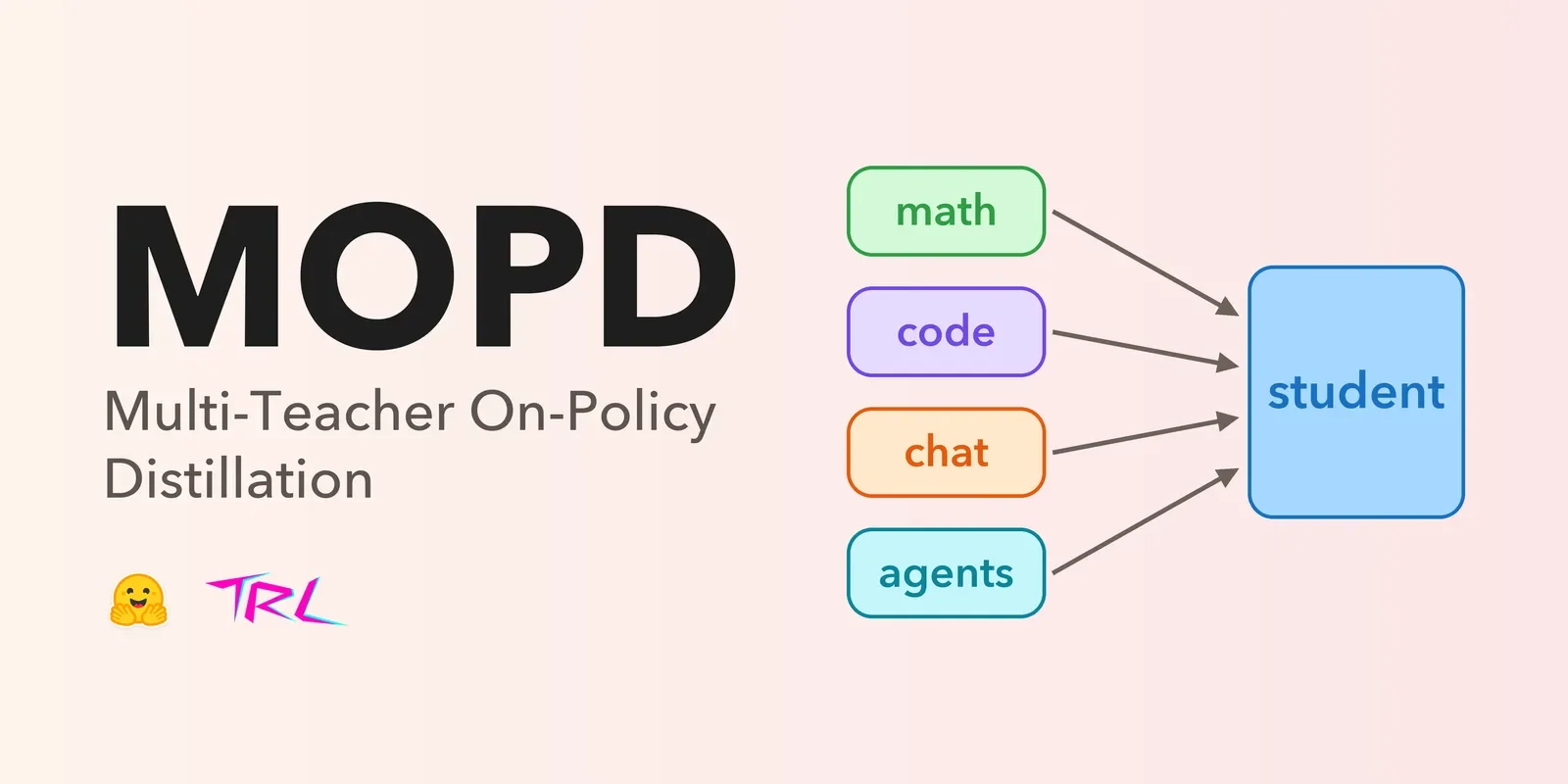
The basic recipe has three parts. First, a shared model learns across domains through supervised fine-tuning. Next, separate copies are optimized as specialists—for example in mathematics, code, or instruction following. Finally, a student generates answers to mixed-domain prompts, and each answer is scored token by token by the relevant specialist teacher.
That final stage differs from collecting a fixed set of polished teacher answers. Because the student learns from continuations it produced itself, the teacher evaluates the states the student is likely to encounter at inference time. The resulting token-level signal can identify where the student diverges from a specialist throughout an answer, rather than reducing an entire completion to one terminal score.
The attraction is operational as well as methodological. A single resulting model is easier to serve than a router plus several domain models. But fusion is not automatic model averaging. The teachers must be compatible with the student, the prompt-to-teacher labels must be dependable, and the training mixture must represent the capabilities the final model is expected to retain.
What TRL makes concrete
TRL's asynchronous implementation routes examples using a teacher_id field and maps each identifier to a teacher server. Generation, teacher scoring, and optimization can overlap, avoiding a strictly sequential loop in which accelerators repeatedly wait for one another. The published example uses a shared SmolLM3-3B supervised checkpoint plus math, code, and instruction-following experts released by Open-MOPD.
That example also clarifies a hard compatibility boundary: the student and teachers need the same tokenizer. Token-level comparisons lose their meaning if a teacher and student divide text differently. Teams should therefore treat expert provenance as part of the training interface, not merely as a checkpoint-selection detail. Specialists derived from the same starting checkpoint are the cleanest candidates.
The loss configuration deserves equal attention. Reverse-KL training can use the teacher probability assigned to the token sampled by the student, limiting response size and communication overhead. Other comparisons may retain more of the teacher distribution, potentially supplying richer information at greater cost. This is not a cosmetic hyperparameter choice; it changes what information crosses the boundary between teacher servers and the trainer.
Prompt balance can hide token imbalance
A dataset can look balanced when counted by prompts and still be sharply unbalanced when counted by generated tokens. A long mathematical derivation or code solution may contribute thousands of training tokens, while a constrained instruction-following response may contribute only a few hundred. If the loss is averaged over tokens, the long-answer domain receives more influence even when its prompt share appears fair.
This is the most transferable lesson in the release. Before scaling, teams should build a small diagnostic run and inspect at least four views of the mixture:
- Prompt share by teacher. This verifies the intended sampling policy and catches routing mistakes.
- Token share by teacher. This reveals the effective optimization weight after generation lengths are considered.
- Divergence by teacher. Per-teacher distance metrics show whether the student is moving toward every specialist or only the verbose ones.
- Held-out capability scores. A falling training divergence does not prove useful retention, so each domain still needs an evaluation set and appropriate scorer.
TRL exposes per-teacher token fractions and divergence metrics, making the mismatch visible during training. If one capability gets too little signal, simply increasing its prompt percentage may help, but the adjustment should be based on observed token contribution rather than intuition. Length-aware sampling, domain-specific weights, or controlled completion limits may also be candidates, each with tradeoffs that should be checked against downstream quality.
A practical evaluation sequence
A responsible pilot begins with a compatibility audit: confirm shared tokenization, aligned chat formatting, valid teacher identifiers, and domain labels that match the teachers' actual specialties. Then run a deliberately short job to validate server health and metric reporting. This stage is for detecting structural failures, not for claiming final quality.
Next, compare the student with its pre-distillation checkpoint on every target domain. Include cross-domain and general instruction tests, because improvement toward specialists can still introduce regressions outside their narrow evaluations. Inspect answer length alongside quality so that a model is not rewarded merely for becoming more verbose. Finally, repeat critical evaluations across enough samples or seeds to avoid reading random variation as a capability gain.
Infrastructure planning matters too. Multi-teacher distillation adds concurrent model servers, communication, and memory pressure. Asynchrony can improve utilization, but it also makes queueing, stale work, and uneven teacher latency part of the system design. A configuration that functions on one accelerator layout may need different batching or placement on another.
The real value is observable specialization transfer
MOPD is useful because it separates two difficult tasks: building strong specialists and consolidating them into one general model. TRL's support turns that consolidation step into a workflow teams can inspect and adapt. Yet the central risk remains easy to miss: the mixture specified in a dataset is not necessarily the mixture optimized by the model.
The right question is therefore not only whether every prompt reached the correct teacher. It is whether every desired capability received enough effective training signal and survived evaluation after fusion. Teams that measure routing, token contribution, per-teacher convergence, and held-out behavior together will learn far more from a modest pilot than from an expensive run guided only by aggregate loss.
Source: MOPD: how frontier labs merge RL experts into one model and how to do it using TRL ↗. How we write