Designing Reliable Decision Pipelines with Jev
Jev turns bounded questions about text or structured state into typed signals. The harder engineering work is defining answer spaces, evaluation sets, escalation rules, and application-owned safeguards around those signals.

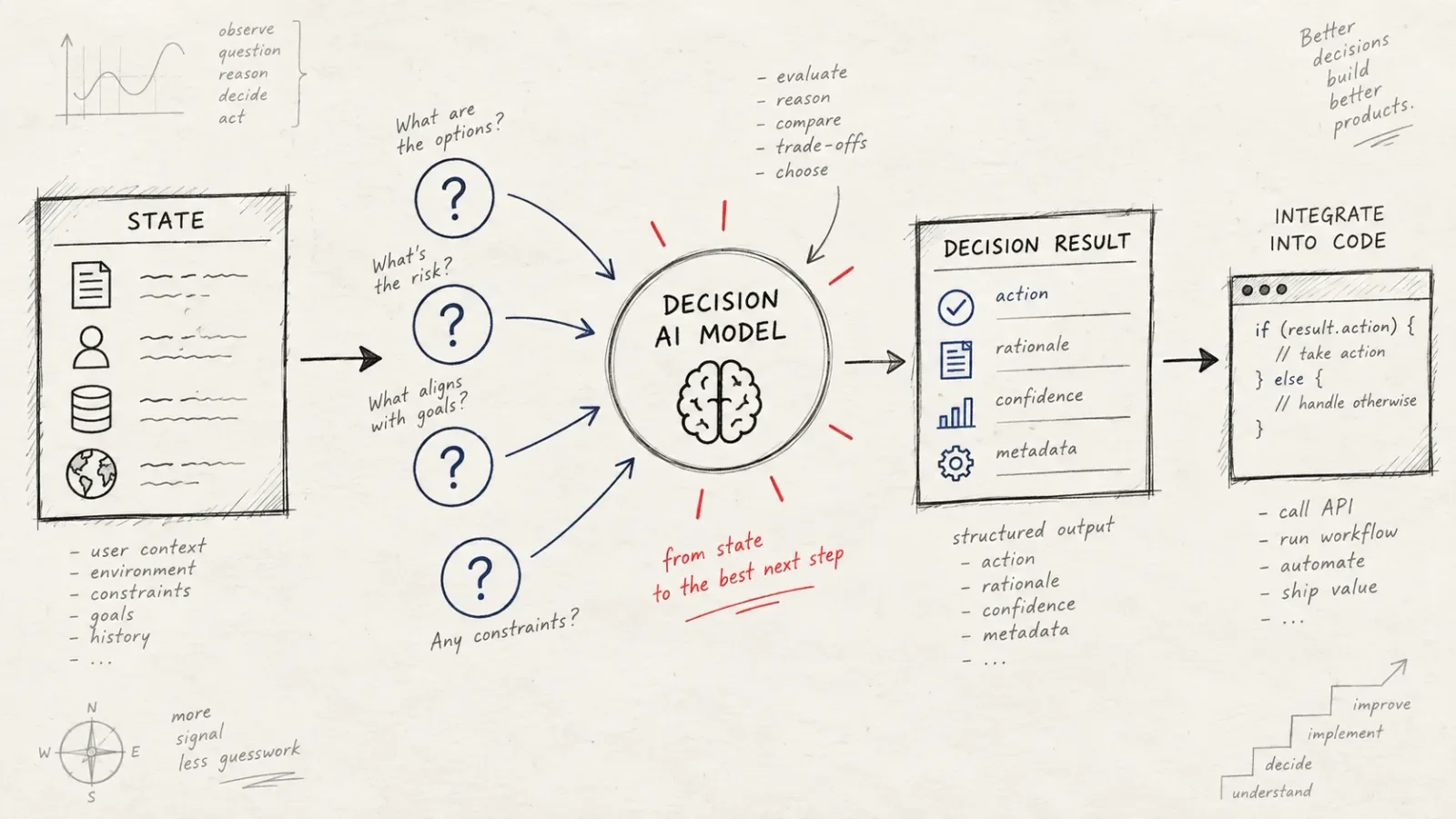
Treat Jev as a source of typed decision signals; keep thresholds, fallbacks, permissions, and consequential actions under explicit application policy.
A community guide published on September 22 introduces Jev as a decision-focused model interface: an application submits state, asks typed questions, and receives structured answers rather than open-ended prose. It describes three question forms—Choice for a fixed set of options, Score for an ordered scale, and Noul for a proposition expressed as a probability. The documented state inputs are text, JSON objects, or arrays of text, and several questions can share the same state.
That interface is simple, but a dependable decision feature needs more than a successful API call. The crucial design work sits around the model: turning a business need into a testable question, deciding what uncertainty means, and ensuring that software—not a model score alone—controls consequential actions.
Start with an action, not a prompt
A useful decision has an identifiable consumer. “Understand this ticket” does not specify what the result changes. “Choose one of the approved support queues” does. The second version provides a finite answer space and lets a team determine whether the result was operationally correct.
Before writing instructions, define four items:
- Available actions. List the routes the application is actually allowed to take. Include a review or abstention path when the evidence may be insufficient.
- Required evidence. Identify which fields are necessary to distinguish those routes. A message may be enough for topic classification, while an escalation decision could also require account state or elapsed time.
- Error costs. A wrong label on an internal dashboard is different from a wrong decision about access, money, or deletion. Higher-impact workflows need stricter controls.
- Decision owner. Name the code path or person responsible for the final action. A model output is an input to that owner, not a transfer of responsibility.
This framing also makes the choice of question type clearer. Use a finite classification when the downstream system has named destinations, an ordered score when the levels have a meaningful progression, and a proposition when one specific condition needs assessment. Avoid combining several hidden judgments in one question; separate them so each can be evaluated.
Make the state inspectable
Structured state is valuable because reviewers can see which facts were supplied. Prefer explicit fields over a large narrative assembled from an entire record. For a support-routing example, a compact object might contain the customer message, product area, failure count, and time waiting. Irrelevant profile data adds privacy exposure and can introduce accidental correlations without improving the decision.
Version the state schema and the question definitions together. If a field changes meaning, or a classification option is renamed, old and new results should remain distinguishable in logs. Stable question keys help connect an answer to the rule that consumed it. They also make replay tests possible when instructions or models change.
Treat missing data as a designed state rather than an exceptional surprise. The application can request more context, route to review, or use a conservative default. It should not silently invent a value simply because the question expects one. Schema validation before inference can catch malformed objects, unexpected arrays, and absent required fields cheaply.
Evaluate decisions as a policy
A handful of convincing playground examples does not establish reliability. Build a small labelled set from representative, privacy-appropriate cases. Include easy examples, ambiguous boundaries, unusual wording, missing fields, and inputs where no automatic action should occur. Keep a held-out portion for comparing later changes.
Measure the outcome that matters to the workflow. Overall accuracy can hide an expensive failure mode. A triage system may need per-route error rates; a review detector may care more about missed risky cases than extra reviews. Examine a confusion matrix and inspect errors near policy thresholds.
Probability-like outputs and confidence values should be calibrated against observed outcomes before they become automation thresholds. A value such as 0.8 is not inherently a safe cutoff. One practical arrangement is to create three bands: automatic handling for well-supported, low-impact cases; a clarification band for incomplete evidence; and mandatory review for uncertain or high-impact cases. The exact boundaries should come from evaluation data and the cost of each error.
Re-run the evaluation whenever the model, question wording, criteria, state schema, or traffic mix changes. Record both the returned signal and the action ultimately taken, while excluding secrets and minimizing sensitive content. This separates model behavior from application-policy behavior during incident review.
Keep execution outside the model
The source guide lists a server-side API endpoint and recommends keeping its credential away from browser code. The larger architectural point is separation: one component obtains a decision signal, while a policy layer validates it and authorizes any effect.
That policy layer should reject unknown labels, enforce timeouts, cap retries, and define a safe fallback for unavailable inference. It should also apply ordinary permissions independently of the model response. A high score must never grant an account privilege, release a payment, publish content, or invoke a destructive tool by itself. For sensitive operations, retain explicit human approval or another independently checked authorization step.
Parallel questions can reduce repeated context submission, but their outputs may not be logically independent. If one request asks for department, urgency, and human review, the application still needs rules for contradictions—for example, a routine label paired with a strong review signal. Resolve such combinations in deterministic policy code and test them as complete scenarios.
A disciplined first deployment
The safest starting point is a shadow or advisory workflow: generate decisions, compare them with existing outcomes, and take no automatic action. After reviewing errors, enable automation only for a narrow, low-impact band and monitor the remainder. Expand coverage when evidence supports it, not merely because the interface permits more questions.
Jev’s typed outputs can make model results easier for software to consume. Their usefulness, however, depends on the surrounding contract. Clear answer spaces, minimal state, representative evaluation, conservative fallbacks, and application-owned permissions turn a structured prediction into a maintainable decision pipeline.
Source: How to Use the Jev AI Model: A Step-by-Step Developer Guide ↗. How we write