Falcon-Emirati-7B Tests What Dialect Specialization Really Requires
TII's Falcon-Emirati-7B pairs targeted dialect data with native-speaker review and Emirati-specific benchmarks, offering a useful case study in why regional language adaptation is more than vocabulary replacement.

Dialect adaptation works best when teams evaluate generated register, cultural fit, and factual reliability separately instead of treating broad language support as sufficient.
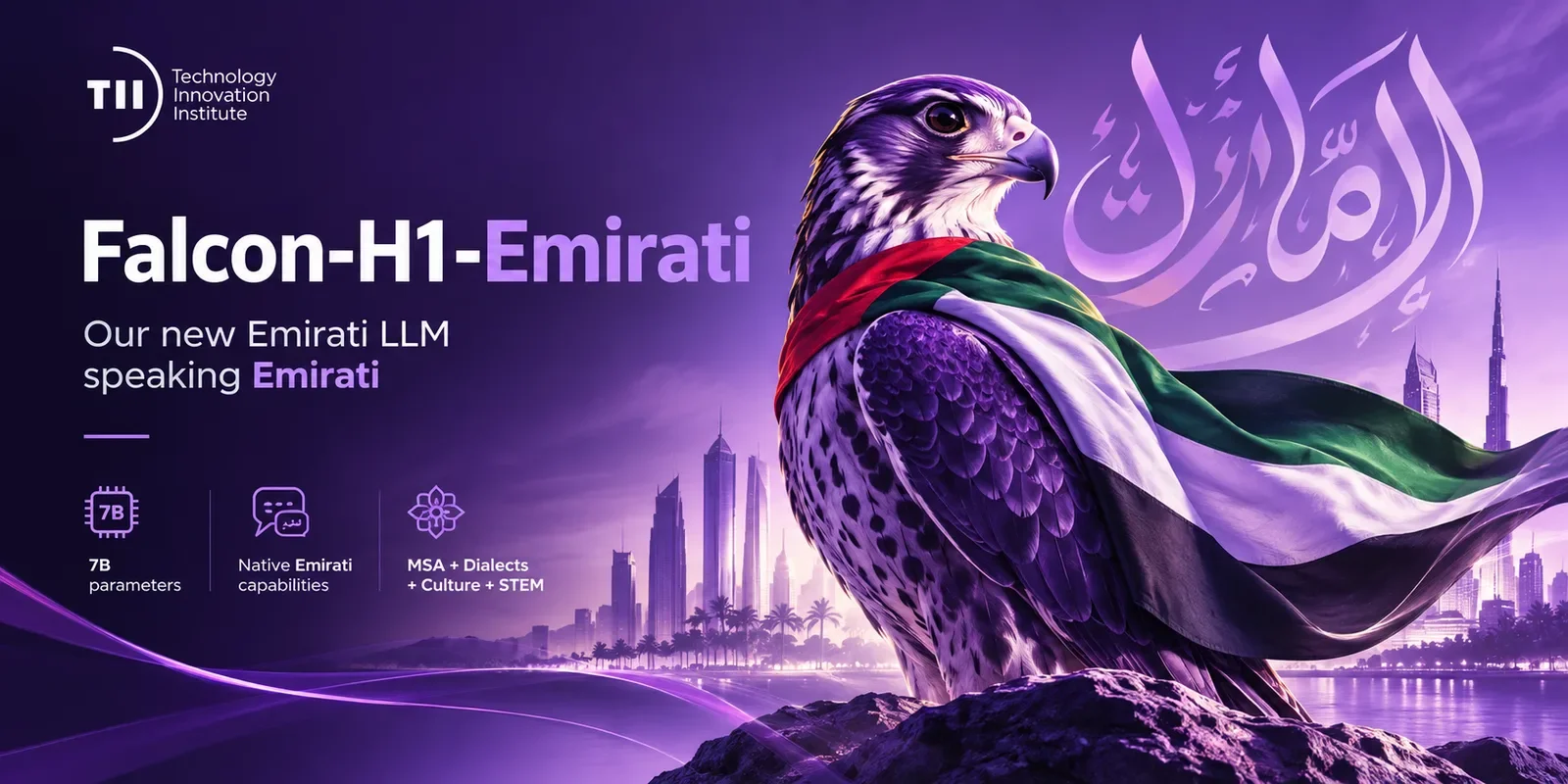
A language model can be broadly capable in Arabic and still answer an Emirati speaker in the wrong register. That distinction sits at the center of Falcon-Emirati-7B, a dialect-specialized model developed by the Technology Innovation Institute on top of Falcon-H1-Arabic. The release is interesting not simply because it adds another regional model, but because it exposes the separate engineering problems hidden inside the phrase language support: vocabulary, grammar, conversational register, cultural knowledge, and the ability to produce rather than merely recognize a dialect.
The team's reported results suggest that deliberate adaptation can let a 7-billion-parameter model compete with larger general systems on a narrow linguistic target. They also show why a single benchmark score cannot establish that a model is ready for real conversations.
Dialect competence is not just translation
Modern Standard Arabic is widely used in formal writing, education, and media, while everyday speech varies substantially by region. An assistant that understands the literal words in an Emirati prompt may still respond in MSA, mishandle an idiom, or miss the social meaning of a proverb. Those failures are different from basic translation errors: the answer can be grammatical and factually plausible while sounding unnatural to the intended audience.
Falcon-Emirati-7B addresses this through three reported data streams. Authentic dialect material provides examples of natural usage. MSA material about Emirati culture supplies background knowledge that may not appear often in casual dialogue. Synthetic conversations broaden coverage, with vocabulary and style constraints intended to prevent generic Gulf Arabic from being mislabeled as specifically Emirati. This division is useful because it maps each source to a different objective rather than assuming that more text solves every weakness.
The tradeoff is quality control. Web text can be noisy and unrepresentative; cultural reference material can flatten contested or evolving practices; synthetic text can reproduce the generator's habits. A strong adaptation pipeline therefore needs provenance checks, deduplication, demographic and topical coverage reviews, and native-speaker inspection of samples—not only a larger token count.
The evaluation separates recognition from generation
TII reports 84.83% accuracy on Alyah, its 1,173-item native Emirati multiple-choice benchmark. Alyah covers areas such as etiquette, figurative language, heritage, and poetry. This measures whether a model can select an appropriate answer, but selection offers clues that an open-ended response does not. A model might recognize Emirati wording among four choices yet default to formal Arabic when asked to answer freely.
To probe that gap, the team also generated answers to the same questions and used Gemini 3.7 Flash as a judge for correctness and dialect fidelity. Falcon-Emirati-7B received a reported dialect-fidelity partial-credit score of 0.52; the four comparison models ranged from 0.00 to 0.05. The large separation supports the claim that targeted adaptation changed the model's output register, not just its test-taking behavior. On 283 UAE scenarios from ArabCulture-Dialogue, the model also achieved a reported 85.57% multiple-choice accuracy, compared with 83.39% for the next-best system in the four-model evaluation.
Those figures should be read within their stated setup. Alyah was released by the same organization that built the model, and an automated judge can have language or style preferences of its own. Multiple-choice items also simplify ambiguity, while category averages can hide weak subtopics. The evaluations are evidence of progress, not proof of universal Emirati fluency. Independent reproduction, additional human raters, and adversarial prompts would make the picture stronger.
A practical test plan for adopters
Teams considering a dialect model should start from actual user interactions rather than a generic leaderboard. A useful evaluation set might divide prompts into four groups: routine service questions, code-switching between dialect and MSA or English, culturally sensitive situations, and rare local expressions. Each prompt should be scored separately for factual correctness, dialect naturalness, tone, safety, and whether the model admits uncertainty when appropriate.
Human review matters most where acceptable answers vary. Recruit speakers from different ages and regions, record disagreement instead of forcing artificial consensus, and compare blind outputs from the specialized and base models. For example, a customer-support answer may need a warm local register but must not invent a policy; a heritage question may require careful sourcing even when the phrasing sounds native. Fluency should never be allowed to conceal factual weakness.
Deployment tests should also include fallback behavior. If the model encounters an unfamiliar expression, does it ask for clarification, switch registers without warning, or confidently guess? Product teams can define when MSA is an acceptable fallback and when a human handoff is safer. Monitoring should track shifts in vocabulary and user feedback because dialect usage evolves and no static training set represents every Emirati speaker.
What this release demonstrates
Falcon-Emirati-7B offers a concrete blueprint for regional adaptation: begin with a capable language-specific base, combine authentic usage with cultural context and constrained synthetic coverage, then evaluate both knowledge and produced register. Its 7B scale also makes the project relevant to teams that must balance specialization against serving cost.
The broader lesson is methodological. Dialect support should be treated as a set of measurable behaviors, not a checkbox inherited from general Arabic capability. TII's results make a credible case that focused data and evaluation can alter those behaviors. Whether that improvement transfers to a particular service, community, or sensitive application remains a question for representative human testing.
Source: Falcon-Emirati: When an LLM Learns the Dialect, the Culture, and the Nuance ↗. How we write