Training Agent Teams Means Measuring Communication, Not Just Wins
A new four-agent reinforcement-learning experiment shows how a shared small model can learn to exchange private information. The larger lesson is methodological: compare coordination against retries at equal budgets, and track messages, tokens, and success together.

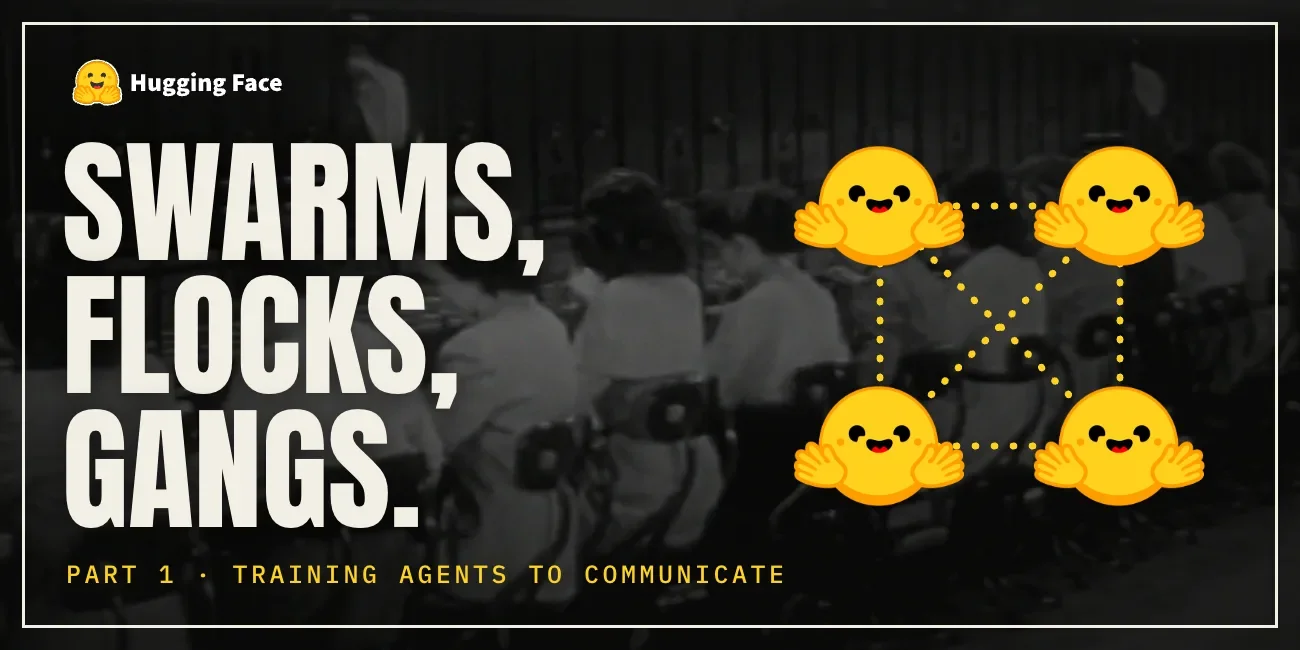
Agent-team experiments are credible when they isolate communication from extra sampling and measure success, total cost, and observable coordination behavior together.
Multi-agent systems are often described as if adding more agents automatically adds intelligence. In practice, another agent also adds another context, another stream of generated tokens, and another opportunity for useful information to be lost. A new Hugging Face experiment offers a deliberately small setting for studying that problem: four logical agents, one shared language-model policy, private observations, and a result that can be checked exactly.
The setup matters less as a benchmark leaderboard than as a clean lesson in experimental design. If a team improves, researchers need to know whether communication created the gain, whether extra attempts did, and what the gain cost. Those questions require more than a final success percentage.
A task where communication is necessary
Each of four agents receives one integer between 1 and 99. An agent initially knows only its own value and the names of its teammates. The team succeeds if at least one member submits the complete sorted list, including duplicates. Because the missing values cannot be inferred, exchanging information is essential rather than optional.
All four agents use separate contexts backed by the same Qwen3-0.6B policy. They can send direct messages, broadcast, and inspect an inbox. Training assigns one reward to the whole team, discounted according to generated-token use. Eight independent team attempts are collected for each problem, and their rewards are compared within the group. The same team-level advantage is then applied to every agent trajectory from an attempt.
This arrangement makes communication part of the learned policy. A message is not merely text appended after inference; it changes what another agent observes and therefore can change later actions. At the same time, shared reward creates a credit-assignment limitation: an unhelpful trajectory may receive positive reinforcement when a teammate succeeds. The experiment accepts that ambiguity to study whether a shared policy can discover a workable protocol.
Why the baseline must include retries
Suppose four independent agents each answer an ordinary question. The group may outperform one attempt simply because it bought four chances. That is useful operationally, but it is not evidence of cooperation. A fair comparison should hold the token or compute budget constant and compare communicating agents with independent attempts.
The number-ordering task is a special case because a solitary agent lacks required information. Its closest baseline is therefore an untrained four-agent team given repeated attempts. In the reported training data, the early policy with eight attempts solved fewer problems while consuming far more tokens than one later trained attempt. That comparison supports the value of learning a protocol in this environment, but it should not be generalized into a claim that agent teams beat single models on tasks a single model can solve.
A practical evaluation matrix should separate at least four conditions: one agent with the full budget, several independent agents sharing that budget, communicating agents sharing it, and repeated attempts with a verifier selecting the result. Use identical task sets and count every generated token, including coordination and tool calls. Without those controls, “multi-agent improvement” can conceal a simple increase in sampling.
Read success, cost, and behavior together
The reported run improved training success from 6.6% over its first five updates to 82.3% over its final five. A held-out check at update 75 solved 26 of 32 problems. Over the same training windows, generated tokens per team fell by 37.4%, while broadcasts increased. These are encouraging measurements for this task: the shared policy became both more successful and less verbose even as information sharing became more active.
Yet each metric has a boundary. Message count does not measure message quality. Fewer tokens can reflect a concise protocol, premature answers, or both. Training-batch efficiency is not automatically held-out efficiency, and a 32-problem check leaves substantial uncertainty. The source explicitly distinguishes its training measurements from held-out token measurements that were not retained.
For a stronger evaluation, record exact-match success, total generated tokens, wall-clock latency, failed or redundant messages, and results across several random seeds. Inspect transcripts for protocol failures: agents that never send, broadcasts that omit the private value, duplicated work, and answers produced before unread messages are consumed. Plotting these behaviors alongside reward can reveal whether the policy learned coordination or merely exploited a narrow scoring path.
What builders can take from the experiment
The most reusable idea is to start with an environment where information flow is observable and correctness is deterministic. A small team and a verifiable task make it possible to debug prompts, messaging tools, reward calculation, and trajectory assembly before moving to open-ended research or software work.
Builders should also decide what is actually being trained. This experiment updates one policy shared by all team members. Other systems may train only an orchestrator while freezing workers, or use different specialist models. Those choices change the credit-assignment problem, serving architecture, and evaluation target; “training a swarm” does not identify a single technique.
Finally, efficient coordination should be treated as an empirical result, not a property of the architecture. The useful question is not how many agents participated. It is whether communication improved outcomes under a controlled budget, whether that result survives held-out evaluation, and whether the learned behavior remains understandable enough to monitor.
Source: Swarms, Flocks, Gangs: How to build, train, and evaluate multi-agent systems ↗. How we write