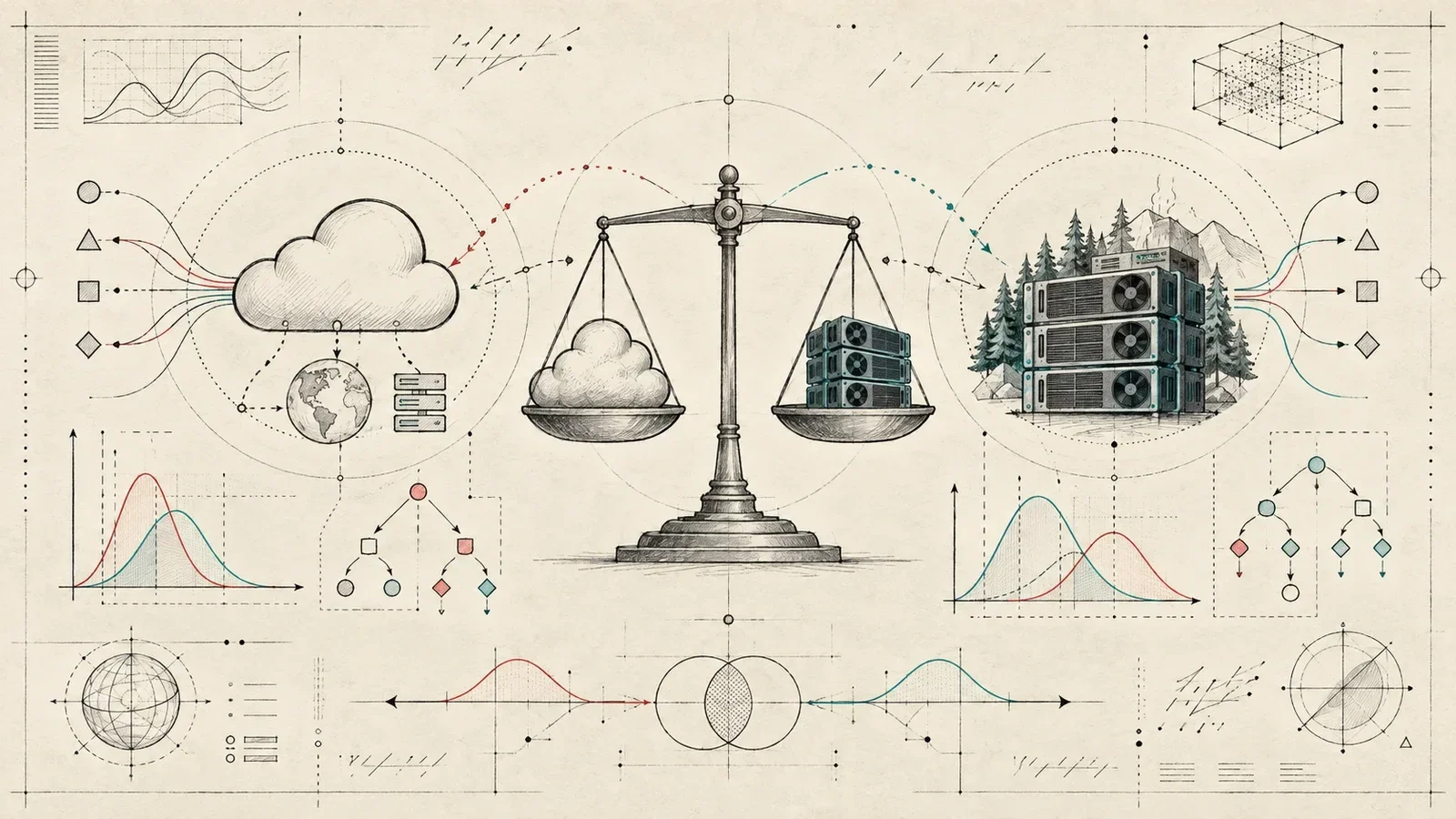
AstaBrief Shows Why Scientific Report Models Need Narrower Claims, Not Just Better Citations
Ai2's open-weight AstaBrief turns retrieved research excerpts into cited reports. Its training recipe highlights a practical lesson for scientific AI: attribution quality depends as much on data selection and claim scope as on model size.

For scientific report generation, teams should evaluate coverage, citation attribution, and preservation of evidentiary scope as separate requirements.
Scientific report generation is a deceptively demanding language-model task. A useful system must do more than assemble fluent paragraphs and attach references. It has to answer the actual research question, distinguish evidence from interpretation, and preserve the limits of each cited result. A citation can be relevant while the sentence around it still overreaches.
Ai2's newly open-sourced AstaBrief offers a useful case study in designing for those constraints. The 8-billion-parameter model takes a research question plus retrieved literature excerpts and produces a cited report. It is deployed as the Fast mode in Asta and is also available for local use. The most instructive part of the release is not simply that a smaller open model can write reports; it is how the team shaped training data and the surrounding pipeline around a specific research workflow.
Specialization starts with the output contract
A general chat model is usually rewarded for being helpful across a wide range of prompts. A scientific report writer has a tighter contract: cover the question, organize the answer, and make important claims auditable. That changes what counts as a good response. Extra prose can reduce value if it introduces unsupported claims or makes verification harder.
AstaBrief was trained from Qwen3-8B using supervised fine-tuning followed by direct preference optimization. Ai2 reports filtering a pool of real research queries down to 90,000, producing 47,000 usable supervised examples, and constructing roughly 6,000 preference pairs. The preference pairs were retained only when two judge models agreed, after the judges were checked against human preferences. These numbers describe Ai2's process, not a general recipe that will automatically transfer to another field.
The broader design lesson is to define the output behavior before selecting an optimization method. For a literature assistant, that behavior might require every substantive claim to map to supplied evidence, uncertainty to remain visible, and the report to avoid recommendations unless the sources justify them. Once those requirements are explicit, data can be filtered for examples that demonstrate them.
Citation density is useful, but it is not truth
Ai2 tested several statistics for filtering synthetic reports, including citation relevance, citation diversity, the ratio of output tokens to input tokens, and citation density. Filtering low-citation-density examples produced the clearest improvement in its experiments. That result is operationally attractive because citation density is cheap to measure and easy to audit.
It should not be mistaken for a complete faithfulness metric. Imagine a paper that finds an association in a small retrospective sample. A generated report can cite that paper while rewriting the finding as a universal causal statement. The citation exists and may even be topically relevant, but the claim has changed in population, certainty, and causal force.
A practical review therefore needs at least three separate questions:
- Coverage: Does the report address the user's requested dimensions?
- Attribution: Can each important claim be traced to an appropriate source excerpt?
- Entailment and scope: Does the source support the claim with the same population, conditions, direction, and strength?
This separation helps teams diagnose failure. Missing coverage calls for better retrieval or planning. Weak attribution may call for denser citations or tighter evidence-to-sentence links. Scope inflation calls for claim-level checking and training examples that preserve qualifiers. Combining everything into one overall score conceals which component needs work.
One-pass generation trades modularity for speed
AstaBrief generates a complete report in one pass from retrieved snippets, avoiding the separate summarization, clustering, and section-by-section stages used by Asta's more elaborate mode. Ai2 reports an average full-pipeline time of 51.1 seconds for Fast mode versus 178.5 seconds for Thinking mode in its tracked setup. The announcement also cautions that much of the evaluation was completed in 2025 and was not rerun against current frontier models.
The one-pass approach reduces orchestration overhead, but it also removes checkpoints where a system could inspect an outline, reject a weak section, or repair evidence coverage before final prose is produced. Teams adopting a similar design should evaluate the entire pipeline rather than treating model quality and latency as isolated properties. Retrieval time, context construction, citation formatting, and post-generation verification all affect the user-visible result.
A sensible evaluation set should include both ordinary and adversarial cases: contradictory papers, sparse evidence, studies with different populations, and questions whose premise is not supported by the retrieved material. The desired behavior may be a qualified answer or an explicit statement that the evidence is insufficient. A polished report is not automatically a successful report.
How to evaluate a local deployment
Open weights make it possible to keep sensitive or unpublished research questions on institutional infrastructure, but local execution does not by itself guarantee privacy or scientific reliability. Operators still need to examine logging, document storage, access controls, retrieval indexes, and any external services in the workflow. They also need enough hardware and serving expertise for the chosen latency target.
Before using a report model in consequential work, create a small domain-specific test set from questions researchers actually ask. Have subject-matter reviewers mark unsupported generalizations, missing qualifiers, irrelevant sections, and incorrect citation links. Record these errors separately instead of collapsing them into a single preference score. Compare modes under the same retrieved evidence, because otherwise retrieval differences can be confused with generation quality.
AstaBrief's release points toward a productive role for compact, specialized models: rapid first-pass synthesis that remains inspectable and can run under an institution's control. Its strongest transferable lesson is that scientific usefulness comes from disciplined boundaries. Better reports are not merely longer, faster, or more densely cited; they make it easier for a reader to see exactly what the evidence does and does not support.
Source: Open-sourcing AstaBrief, the fast report-generation model in Asta ↗. How we write