A Benchmark Score Can Hide More Than One Ability
Ai2’s BenchMIRT examines evaluation questions individually rather than treating each benchmark as a single signal. That distinction can change how teams select models and interpret regressions.

Use benchmark totals as a starting point, then inspect the abilities and failure types that the individual questions actually test.
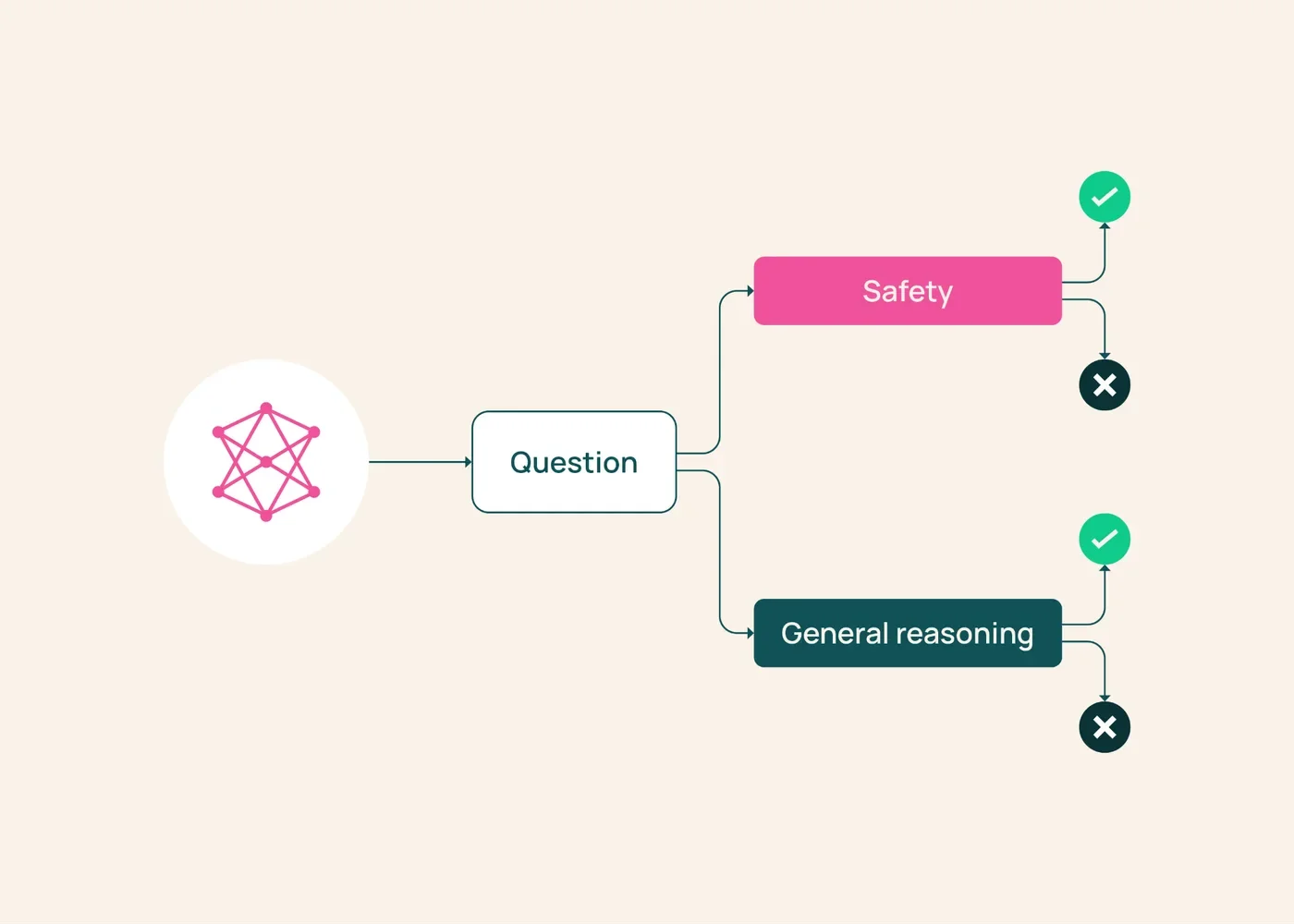
Ai2 introduced BenchMIRT on September 1 as a method for examining what individual benchmark questions measure. Its analysis uses multidimensional item response theory to relate model performance to underlying capability dimensions. The announcement describes results across 100 language models, 16 benchmarks and more than 34,000 questions, with safety and general reasoning emerging as important dimensions. Those findings describe the study's selected models and tests, not an exhaustive map of intelligence.
The practical lesson is easy to miss when scanning a leaderboard: the name of a benchmark is a description of its intent, not proof that every question measures only that intent. A score can combine several kinds of success and failure into one convenient number.
A question can require several abilities
Imagine an evaluation item asking a model to summarize a dispute without making an unsupported assumption. To answer well, the model may need to understand the text, track who said what, follow the instruction and handle uncertainty appropriately. A wrong answer could arise from failure in any of those steps.
Now imagine grouping many such questions under a single label. That label is useful for organizing the test, but it does not identify the cause of every error. Before changing a model or training procedure in response to a low score, inspect examples. The attempted repair may target the wrong problem if the score is treated as a diagnosis rather than an observation.
Distinguish measurement from interpretation
Item-level analysis begins with a record of which models succeed on which questions. Statistical structure in those responses can help identify groups of items that behave similarly. Interpreting those groups as meaningful capabilities requires additional judgment and evidence.
This is an important boundary. A mathematical model can provide a useful account of the observations without proving that its dimensions are universal or uniquely correct. Different model populations, test collections and scoring rules may expose different patterns. Read the study design before applying its labels to a new application.
Build a decision-oriented evaluation set
For an illustrative internal research assistant, the relevant requirements might include citing evidence, distinguishing uncertainty and extracting exact values. A broad public benchmark can inform the initial shortlist, but a small application-specific set should test those requirements directly.
Create questions with clear expected behaviours and retain the evidence needed to score them. Avoid making every item depend on the same superficial format. If all difficult questions also happen to be much longer, an observed difference may reflect context handling as well as the ability you intended to measure. Document these potential confounders rather than assuming the test isolates one variable perfectly.
Inspect regressions by failure type
Suppose a new model improves the total score but becomes more likely to refuse harmless requests. Another model might answer more questions while making unsupported claims. Depending on the application, either regression could outweigh a small aggregate improvement.
Maintain separate counts for clearly defined failure categories, and review a sample of borderline cases. If human judgments are involved, provide scoring guidance and examine disagreement. An evaluation procedure that changes between model versions can create an apparent performance change even when the models behave similarly.
Reduce testing only after checking coverage
A smaller test set can make repeated evaluation cheaper, but it should preserve the behaviours that matter. Selecting only questions that distinguish current models sharply can neglect rare but important failures. The most statistically informative item is not always the most consequential one for users.
Keep a core acceptance set for critical requirements alongside any efficient diagnostic subset. Revisit both when the application changes. A tool-using assistant, for example, introduces execution and recovery behaviours that a text-only benchmark may never test. Evaluation should evolve with the system rather than remain fixed because a leaderboard is familiar.
Benchmarks are most useful when they support an explanation of a decision. A good selection record says not only which model scored higher, but what it did better, where it failed and why those differences matter. Item-level thinking turns evaluation from a ranking exercise into a practical tool for understanding system behaviour.
Source: BenchMIRT: What are LLM benchmarks actually measuring? ↗. How we write