ToyBlocks Turns Robot Learning Into a Testable Science
Ai2’s ToyBlocks framework uses a deliberately constrained tabletop world to generate demonstrations, separate planning from control, and expose where robot-learning systems fail to generalize.

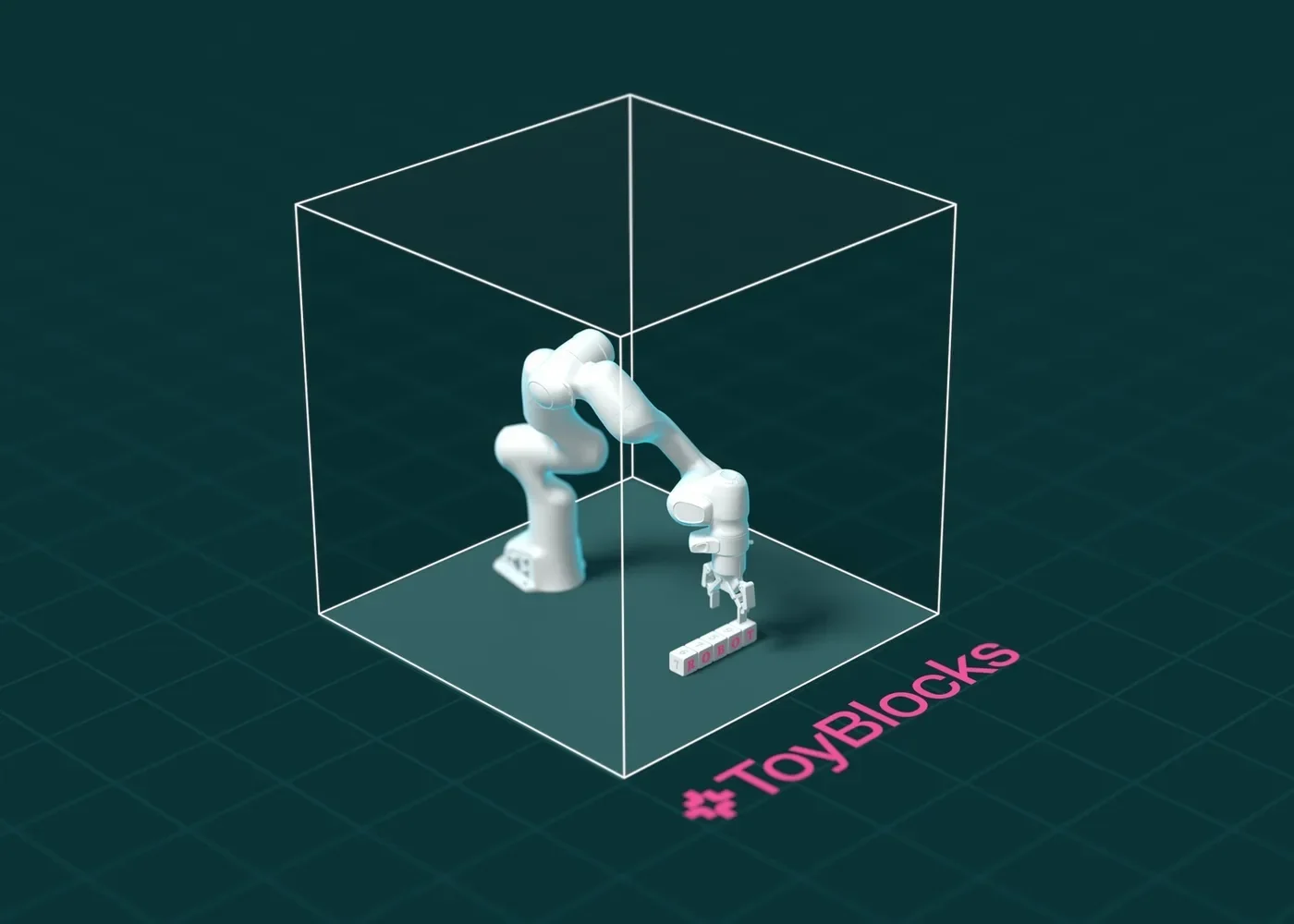
ToyBlocks is most valuable as a diagnostic laboratory: it lets researchers isolate data, planning, control, and transfer failures instead of hiding them behind one success rate.
Robot demonstrations can look impressive while answering surprisingly few scientific questions. A successful stack or flip does not reveal whether the policy understood the instruction, memorized a workspace, benefited from a forgiving object layout, or recovered from a control error. Ai2’s newly introduced ToyBlocks framework takes the opposite approach: simplify the world enough that researchers can vary one factor at a time and trace failures through the system.
ToyBlocks places a robot arm, labeled blocks, and a tabletop in a simulated environment. Its narrow scope is a feature. The framework can automatically generate tasks and demonstrations, connect high-level planners to low-level manipulation policies, and evaluate more than final success. Ai2 presents it as the first example of a broader “FoundationWorld” concept: controlled domains meant to support repeatable studies of robot learning.
Why a small world can produce stronger evidence
Robotics experiments combine perception, language, planning, geometry, and physical control. When all of those change at once, a failed episode is difficult to interpret. A constrained environment creates useful experimental controls without making the problem trivial. Blocks can move to unfamiliar positions, hide letters on unseen faces, require flipping before stacking, or appear in combinations excluded from training.
That distinction matters because “generalization” is not one test. A model may handle a new arrangement inside the region covered during training yet fail just beyond that boundary. It may combine familiar two-block actions into a taller stack, but confuse a rotated character. ToyBlocks gives researchers a way to define these cases separately. The result can be a diagnostic matrix rather than a single headline score.
A practical evaluation should therefore split novelty into dimensions: position, appearance, object count, action sequence, and task length. Training and test sets can then differ along one dimension while holding the others stable. If performance drops only when positions leave the training region, the evidence points toward spatial extrapolation rather than a general inability to follow instructions.
Separating the planner from the hands
ToyBlocks supports hierarchical systems in which one model chooses a skill and target while another executes the movement. This decomposition is valuable even when an end-to-end policy is the eventual goal. An oracle planner can test the controller without planning mistakes; an oracle controller can test whether a high-level model selected the right sequence. Comparing those conditions localizes the bottleneck.
Consider an instruction to build a three-letter stack when some letters face away from the camera. The planner must first gather information, decide which blocks are relevant, choose rotations or flips, and order the final placements. The controller must then realize each command without collisions or drift. Recording only final success collapses all of these decisions into one bit. Recording intermediate task progress, forces, execution time, selected skills, and observed faces makes the same episode much more informative.
This structure also exposes compounding reliability. If a task requires eight dependent actions, modest per-action error can create poor end-to-end results. Teams should report atomic skill performance alongside complete-task performance and categorize failures by stage. Otherwise, an improvement in planning can be hidden by unchanged control errors—or vice versa.
Generated data is an experimental variable
The framework uses reinforcement learning and motion planning to create short skills, then a task-and-motion planner sequences them into demonstrations. Because generation happens in simulation, researchers can deliberately alter the mixture: more flips, fewer familiar positions, additional failed attempts, or balanced coverage of workspace regions. This turns dataset composition into something that can be tested rather than accepted as a fixed artifact.
The important question is not simply whether more demonstrations help. Better experiments ask which demonstrations help which capability. A useful protocol could train equal-sized datasets with different spatial coverage, evaluate them on identical held-out layouts, and repeat across several seeds. A second study could keep positions fixed while varying the proportion of rotation examples. Such comparisons make it possible to distinguish the value of diversity from the value of volume.
Synthetic generation still has boundaries. Simulator state can provide exact object poses unavailable to a physical robot, and simulated contact, cameras, friction, and latency remain approximations. Policies should therefore be evaluated from realistic sensor observations, with privileged state reserved for generating labels, building oracles, and diagnosing errors. Domain randomization can broaden coverage, but it does not prove that the chosen variations match reality.
Reading sim-to-real results carefully
Ai2 reports experiments that transfer policies trained in ToyBlocks to a physical arm, including comparisons of individual manipulation skills and longer spelling tasks. The reported similarity between simulated and physical results is encouraging, but it should be treated as evidence for this setup, hardware, task family, and sample—not as a universal validation of simulation. The authors likewise note that more trials are needed for statistical confidence on long-horizon tasks.
For teams evaluating the framework, the strongest next step is to pre-register a transfer test: define scenes, failure rules, intervention criteria, and confidence intervals before running the robot. Report both the simulation-to-reality gap and absolute performance. A small gap can still describe two weak systems, while a larger gap may be acceptable if physical performance is useful and failure modes are understood.
What ToyBlocks is best used for
ToyBlocks is not a substitute for homes, factories, deformable objects, or human interaction. Its value is methodological. It offers a place to test claims about data mixtures, spatial generalization, hierarchical control, world models, and transfer under conditions that are easier to reproduce and inspect.
The clearest research projects will use that control to make narrow claims: which held-out variation caused a failure, which layer of the stack was responsible, and which added experience corrected it. If the framework helps robotics results become easier to falsify and reproduce, its intentionally small world will have served a large purpose.
Source: ToyBlocks: A controlled world for robot learning and evaluation ↗. How we write