Plug-and-Play Robotics Is an Integration Goal, Not a Model Feature
Generalist policies can transfer more skills into unfamiliar settings, but deployment still depends on planning, state tracking, verification, adaptation, and trustworthy simulation. A practical path to plug-and-play robotics is to make those layers reusable and measurable.

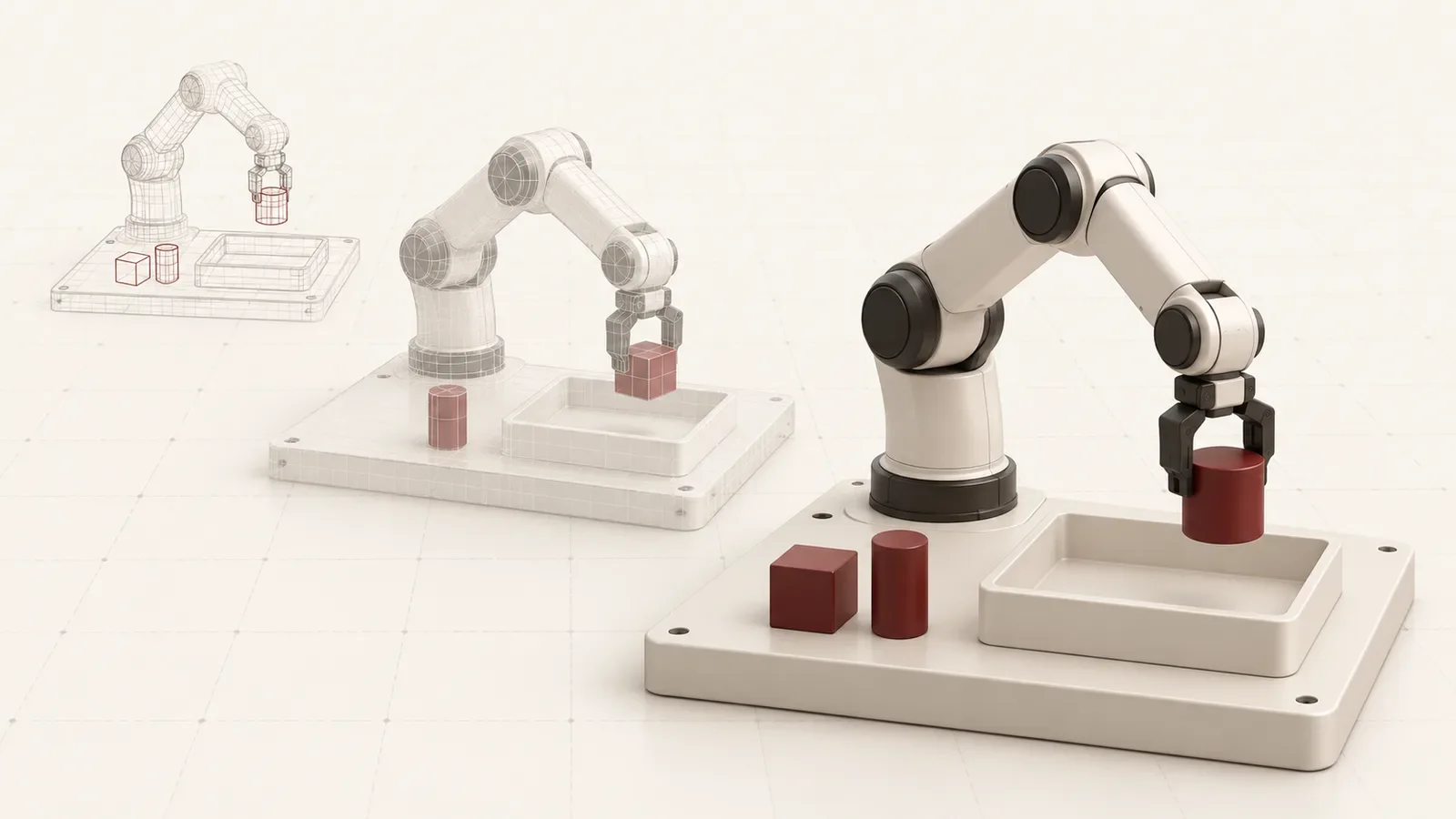
Measure plug-and-play progress by how much less specialist work each deployment requires, while validating the full stack of skills, planning, verification, adaptation, and simulation.
A robot policy can know how to grasp, move, and place objects without being ready to complete a customer’s job. Real deployments add questions that a single action model may not answer: Is the object actually in the container? Will this grasp leave enough clearance for the next motion? Should the system retry, observe from another angle, or ask for help?
A community article published on October 30, 2026, frames plug-and-play robotics around this gap between a capable policy and a dependable deployment. Its examples span planning, persistent scene representations, policy adaptation, and simulation. The central lesson is useful for evaluating today’s robotics systems: capability transfer is improving, but integration work has not disappeared. It is becoming a system layer that can itself be designed, tested, and reused.
Define “plug-and-play” as reduced marginal work
Plug-and-play should not mean that one checkpoint controls every robot in every environment without configuration. A more productive definition is that each additional deployment requires less specialist effort than the previous one. Under that definition, progress can be measured in setup time, demonstrations required, manual interventions, and the share of evaluation reused from earlier projects.
This changes what teams optimize. A large skill repertoire remains valuable, but deployment readiness also depends on stable interfaces between components. The planner must express bounded goals the policy can follow. The controller must expose enough state for monitoring. The monitor must distinguish success, recoverable failure, and uncertain observation. Safety rules must be able to stop or redirect execution without corrupting task state.
These interfaces matter because individually strong modules can produce a weak system. A planner may choose a sensible subtask that the executor interprets inconsistently. A vision-language monitor may confidently declare success after a failed placement. A grasp may be mechanically secure yet make the following placement impossible. Integration tests should therefore evaluate transitions and outcomes, not only isolated actions.
Separate skill, specification, and verification
A practical deployment stack can be reviewed as three distinct layers. The skill layer contains reusable behaviors such as grasping, navigation, or folding. The specification layer turns a job into ordered goals and constraints. The verification layer decides whether those goals were achieved and whether execution may continue.
Keeping these layers explicit makes failures easier to diagnose. If a robot selects the wrong container, the specification or grounding may be at fault. If it approaches the correct container but drops the object, the skill is the likely target. If it drops the object and proceeds as though placement succeeded, verification has failed. Without this separation, teams can waste demonstrations retraining a policy for what is actually an observation or orchestration problem.
Verification should use evidence appropriate to the claim. A single camera classification may be enough to confirm that a light turned on, but it is weak evidence that an occluded object remains inside a drawer. Persistent object records, multiple viewpoints, force signals, or a deliberate inspection motion can reduce uncertainty. The system should represent “not yet known” as a valid state rather than forcing every check into success or failure.
Treat adaptation as a controlled experiment
Demonstrations can specify a new task economically when a generalist policy already has the underlying skills. But a successful demonstration does not explain every constraint that will appear during execution. The operational question is what happens after the first failure.
A safe adaptation loop starts by preserving the failed attempt: observations, actions, controller state, task constraints, and the verifier’s conclusion. The team or an agent can then form a narrow hypothesis, such as changing the grasp orientation to preserve clearance. That change should be tested against the original failure and a small regression set. Only a measured improvement should enter the reusable playbook.
This discipline is especially important when AI agents propose fixes. Agents can inspect traces, choose experiments, or revise task instructions, but plausible reasoning is not evidence that a physical intervention works. Bound the parameters they may change, cap retries, retain rollback points, and require outcome checks independent of the agent’s explanation. The result is an auditable adaptation process rather than open-ended trial and error on hardware.
Use simulation as an evaluation instrument
Simulation can supply parallel experience and repeatable tests, yet volume alone does not create useful evidence. A simulator must preserve the difficulty that determines success. Clearance, friction, controller timing, articulation, sensing, and contact behavior can each matter more than visual polish, depending on the task.
Build validation around the intended conclusion. If the experiment compares grasp strategies for a constrained opening, measure geometry and contact behavior against representative hardware trials. If it ranks policy checkpoints, check whether simulated rankings remain consistent with real execution on a smaller calibration set. A mismatch should block the conclusion until the environment, controller mapping, or metric is corrected.
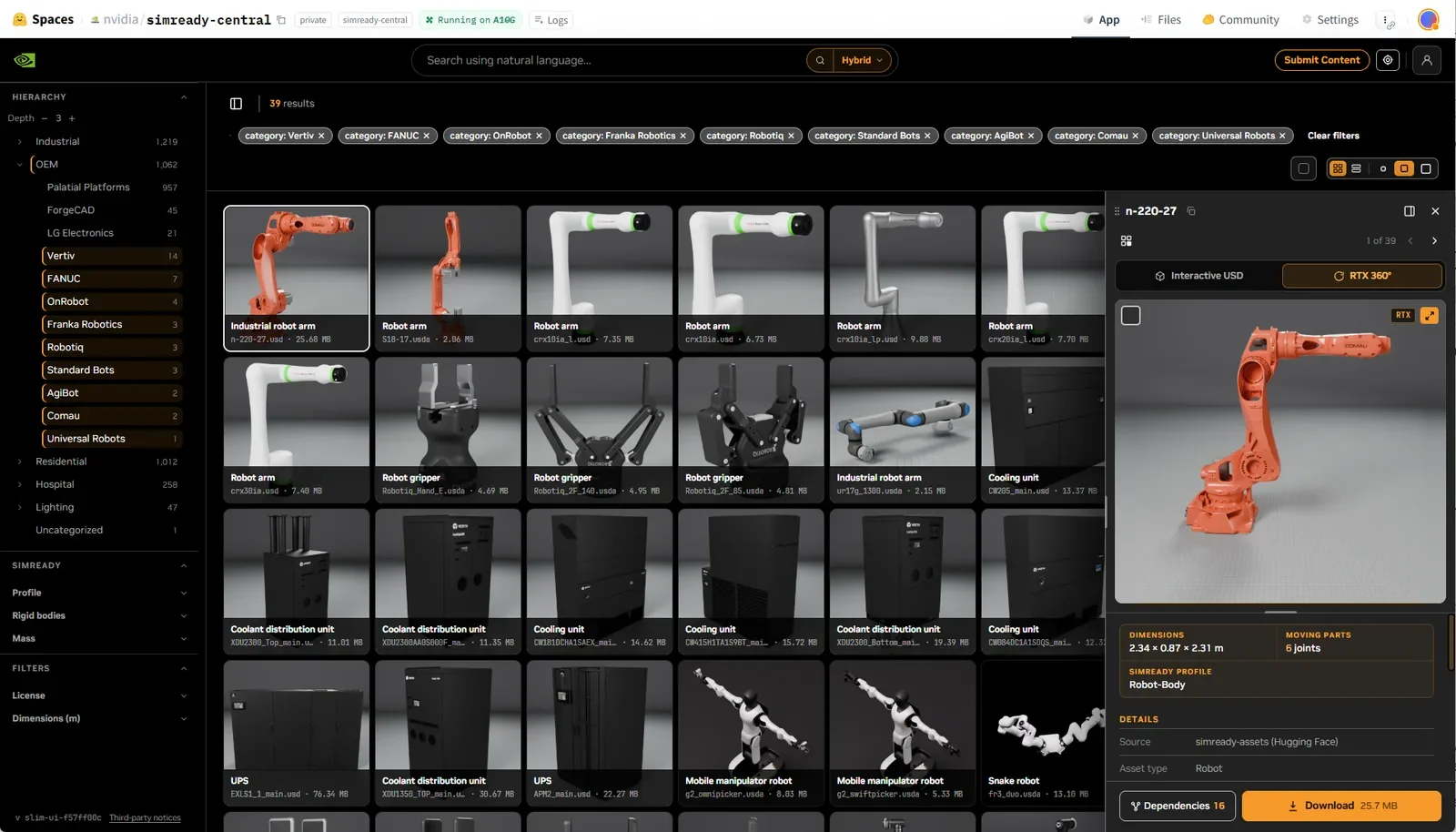
Reusable scenes can reduce setup cost, but they should be versioned with assets, physics settings, controller configuration, initial-state distributions, and success predicates. This turns a simulation from a demo into a regression test. When a deployment reveals a new failure, reproduce the relevant condition, add it to the suite, and verify that a proposed fix does not damage earlier capabilities.
Evaluate the whole deployment envelope
A convincing benchmark should vary more than task names. Test unseen objects and layouts, observation loss, ambiguous completion states, failed grasps, constrained transitions, and recovery limits. Report full-task completion alongside intervention rate and false-success rate; an optimistic monitor can make a system appear autonomous while hiding unfinished work.
The route to plug-and-play robots is therefore cumulative. Better foundation policies reduce how much must be learned locally. Clear interfaces make planning and verification portable. Controlled adaptation turns failures into reusable knowledge. Calibrated simulation moves more learning and testing away from scarce robot time. None of these elements alone removes deployment engineering, but together they can make that engineering repeatable—and make the next installation meaningfully easier than the last.
Source: How do we get to plug-and-play robots? ↗. How we write