A Three-Lens Dashboard for Comparing AI Models
AI Model Market Daily separates capability, adoption, and security instead of compressing model selection into one leaderboard. Here is how to read that design without mistaking a composite score for a deployment decision.

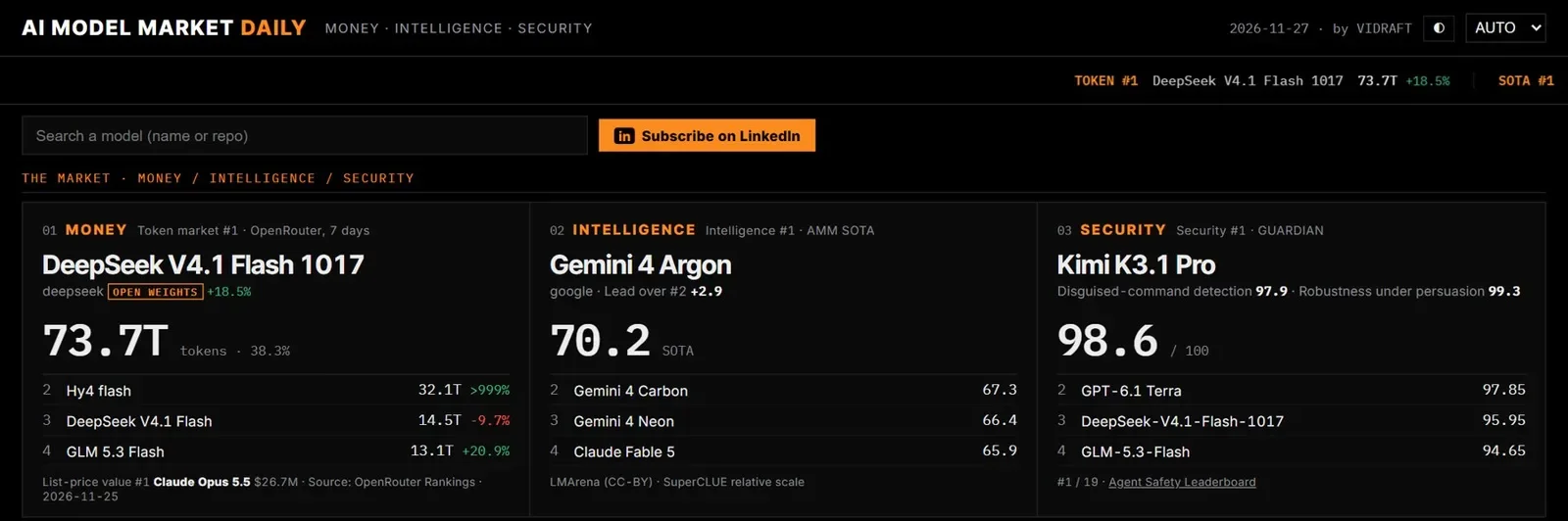
Use composite rankings to discover candidates, then inspect capability, adoption, and security separately before running workload-specific acceptance tests.
Model leaderboards are easy to scan and equally easy to overinterpret. A high position can reflect benchmark strength, broad adoption, narrow specialization, or the way missing data is handled. AI Model Market Daily proposes a market-board metaphor: track capability, usage, and security as related but distinct signals. That separation is more useful than a single universal winner, provided readers understand what each number can and cannot establish.
The project says its November 27 snapshot covered 885 models, ranked 211 downloadable models represented on at least two of 63 official Hugging Face benchmark boards, and performed supply-chain checks on 538 models. It publishes daily snapshots as a dataset and offers separate rankings for the mixed open-and-closed frontier and for models whose weights can be downloaded from a developer's Hugging Face organization.
Three signals answer three different questions
Capability measures whether a model performs well on selected evaluations. Adoption signals whether people are downloading or paying to use it. Security checks highlight risks around packaging, provenance, unsafe files, remote code, or behavior under attack. None is a substitute for the others.
This matters because model selection is a constrained decision. A team may need a downloadable checkpoint, a permissive license, support for a particular language, predictable latency on available hardware, and acceptable behavior with tools. The most capable hosted model might fail the deployment constraint. The most downloaded checkpoint might be popular because it is small or heavily adapted, not because it is best for a specific workload. A clean repository scan cannot prove that an agent will resist prompt injection.
Read the dashboard horizontally. Start with the requirement, then compare candidates across the three columns. Divergent leaders are expected: they reveal that demand, measured performance, and risk controls do not move in lockstep.
Why the two rankings should stay separate
The project's frontier view combines sources that include proprietary and downloadable systems. Its open-model view instead requires downloadable weights and combines benchmark performance, wins, and ecosystem popularity. Keeping these views apart avoids assigning a model a poor score merely because the evidence required for one ranking is unavailable to it.
The open score gives performance half of the weight, popularity 35 percent, and board wins 15 percent. Performance is averaged across board-relative percentiles, with a coverage adjustment capped after ten boards. That adjustment has a sensible goal: a single favorable result should not outweigh broader evidence. But it also means the final number represents both achievement and evidence breadth. A model evaluated on fewer relevant boards may be promising without ranking highly.
Composite scores are best treated as discovery tools. Before choosing between two close candidates, inspect their component scores and the underlying tasks. A five-point gap caused by broad download activity has a different operational meaning from a five-point gap caused by repeated wins on evaluations that resemble the intended application.
Security is a stack, not a badge
The board presents three security layers rather than merging them: repository supply-chain hygiene, resistance to attacks in mock-tool scenarios, and agent-safety evaluation. This is the right conceptual shape because these layers fail differently.
A repository check can flag pickle files, custom remote code, missing licensing information, or unclear provenance. It cannot determine whether the model follows malicious instructions once connected to email or a shell. An attack-resistance test probes behavior in defined scenarios, but its result depends on the tested harness, prompts, tools, and defenses. An agent-safety score adds another behavioral view, yet it still does not certify a production system assembled with different permissions and context.
For evaluation, record each layer independently. Require an explicit review for executable repository code. Re-run behavioral tests using the actual tool schema and permission boundaries. Treat a protective gateway as a separate control whose effectiveness must be tested, not as a reason to ignore the base model's behavior. A missing or unfinished scan should remain missing evidence rather than being interpreted as either safe or unsafe.
A practical shortlist workflow
First, define hard constraints: weight availability, license, context length, languages, deployment environment, budget, and maximum latency. Remove candidates that cannot satisfy them.
Second, choose evaluations that resemble the real workload. For a retrieval assistant, measure citation support and abstention on private documents. For code maintenance, use representative repository tasks rather than a generic coding score. For an agent, include attempts to redirect tools, leak data, or exceed permissions.
Third, use popularity as a maintenance signal, not a quality verdict. Downloads and trending activity can point to richer community tooling, more quantizations, and more examples. Confirm that the activity belongs to the exact model family and that available derivatives preserve the properties you need.
Finally, retain a small candidate set and run the same local acceptance suite against every model. Log model revision, inference settings, prompts, hardware, failures, and cost. Daily market-style movement can help identify models worth reevaluating, while controlled tests provide the evidence needed to change a deployed system.
The useful lesson is the decomposition
The dashboard's lasting value is not any day's top position. It is the decision to expose several kinds of evidence side by side and publish traceable snapshots. Readers should preserve that decomposition when building their own selection process. Rankings can narrow the search; requirements, component-level inspection, and workload-specific tests still make the decision.
Source: AI Model Market Daily: Reading AI Models Like a Stock Market Board ↗. How we write