Nemotron Parse 3.5 Turns Document Extraction into a Verifiable Pipeline
NVIDIA's Nemotron Parse 3.5 release combines open synthetic data, supervised fine-tuning, verifiable rewards, and speculative decoding. The useful lesson is how to design document extraction as a measurable system rather than a single model call.

Treat document parsing as a verifiable pipeline: teach the format, validate structural facts, reprocess difficult regions selectively, and benchmark the complete serving path.
Document parsing is easy to underestimate. A page may look like one image, but an extraction system must recover text, reading order, regions, table relationships, chart values, and a representation that downstream software can trust. A plausible transcript is not enough: one displaced table cell or an invented chart value can silently corrupt retrieval and analysis.
NVIDIA's Nemotron 3.5 Parse update is notable because it treats those failures as a pipeline problem. The release pairs synthetic datasets and an adaptation recipe with reinforcement learning based on checkable outputs, then addresses serving cost through architectural changes and speculative decoding. That combination offers a useful design pattern even for teams that never adopt this particular model.
Separate page reading from semantic validation
A robust parser should produce more than flattened text. Regions need classes such as heading, paragraph, table, or chart; their locations need coordinates; and structured elements need relationships that survive serialization. This gives downstream code something concrete to inspect. A retrieval system can preserve section boundaries, while a table validator can check row widths and headers before indexing the result.
The release says Parse 3.5 emits content in reading order, class labels, bounding boxes, and structured records for tables and charts. NVIDIA also published three synthetic collections: nearly 10 million chart examples, 1 million table examples, and 7.9 million multilingual OCR examples. Their main value is not scale alone. Because the rendering process starts from known structure, every image can retain exact labels for otherwise ambiguous visual content.
Synthetic data is especially appropriate when the target has a deterministic representation. A generated bar chart already has its series and numerical values; an HTML table already has row and column relationships. The same approach is less reliable for characteristics that are hard to encode in the generator, such as damage from real scanners, handwritten corrections, or organization-specific visual conventions. Teams should therefore mix controlled generation with representative held-out documents rather than assume more synthetic variety guarantees production coverage.
Train capability, then reward dependable completion
Supervised fine-tuning teaches the mapping from pixels to a desired output format. It works well for common layouts and establishes the vocabulary of the task, but it does not directly optimize every operational failure. A model can know the schema yet repeat a section, stop mid-record, or choose a different valid serialization from the reference.
Verifiable rewards provide a second layer. Instead of demanding one exact token sequence, a reward function can check invariants: required fields are present, table dimensions agree, predicted chart series match known values, boxes are valid, and generation terminates without repetition. NVIDIA reports using GRPO after supervised fine-tuning and finding fewer looping or token-limit outputs in a controlled development-checkpoint comparison. The figures are specific to its evaluation, but the underlying separation is broadly useful: demonstrations teach what an answer looks like, while validators define what makes it acceptable.
The difficult part is verifier design. A strict string comparison may penalize harmless formatting differences. A permissive schema check may accept numerically wrong content. For a domain adaptation project, each reward should correspond to a downstream consequence. Invoice totals can be recomputed; identifiers can follow a checksum or pattern; table cells can be checked against row and column constraints. Free-form prose may need a different evaluation path and should not be forced into a falsely objective reward.
Spend extra computation where uncertainty is concentrated
Parsing every page at maximum resolution wastes capacity, while treating every page as simple misses dense regions. The release describes single-pass parsing plus optional second or third passes that crop tables and charts for closer inspection or repeat detection before re-extraction. This creates an explicit quality-versus-latency control.
A practical system can make that control conditional. Reprocess a region when boxes overlap unexpectedly, a table fails structural checks, chart labels are too small, or the output approaches a generation limit. Clean narrative pages can remain single-pass. This is preferable to an unconditional multi-pass policy because the additional requests, image crops, and merge logic all introduce cost and new failure modes.
Merging also needs rules. A refined crop should not silently replace a full-page result unless coordinates and element identities can be reconciled. Keep provenance for each field, record which pass produced it, and surface unresolved conflicts. That audit trail is often more valuable than a small aggregate benchmark improvement because it makes individual errors diagnosable.
Faster decoding changes the operating envelope
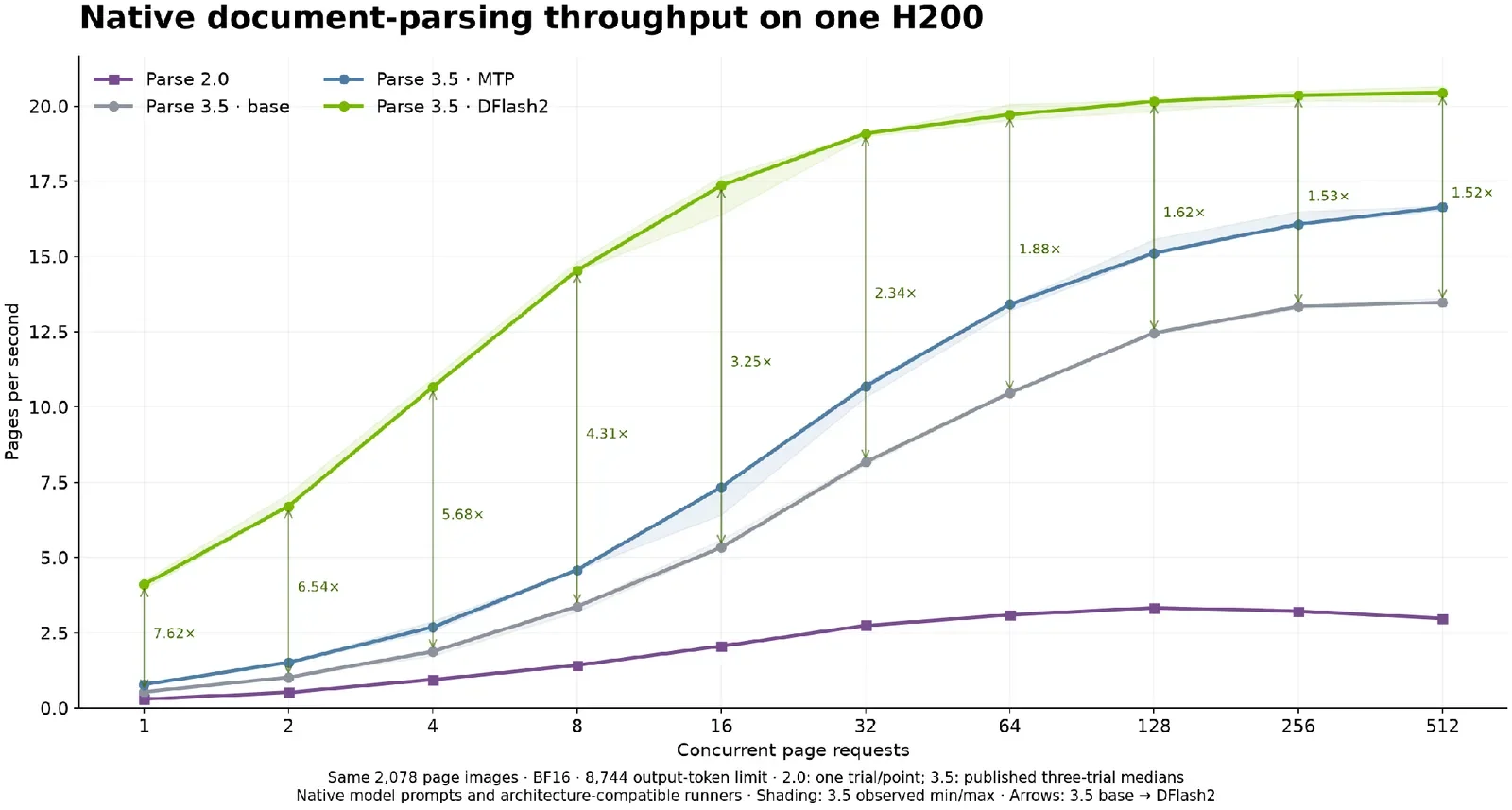
Structured extraction can require long outputs, so decoding becomes a material part of latency. Parse 3.5 uses dynamic rectangular image inputs, compressed visual tokens as a causal prefix, grouped-query attention, and an optional DFlash2 draft model. The draft proposes multiple tokens and the main model verifies them together. NVIDIA reports that the benefit varies substantially with concurrency, which is an important warning against transferring a headline speedup directly to another workload.
Evaluate serving changes on the intended document mix and queue pattern. Track pages per second, time to first completed page, output length, peak memory, acceptance rate for drafted tokens, and accuracy after every optimization. At low concurrency, one technique may dominate; under a saturated batch workload, memory pressure or verification overhead can change the result. Hardware and numeric precision must remain part of the benchmark description.
A deployment checklist for document parsers
Before adapting a parser, define the output contract and failure budget. Assemble a held-out set containing ordinary pages plus rare layouts, low-quality scans, multilingual text, dense tables, and charts without printed values. Measure fields separately instead of hiding them in one score: text fidelity, layout coverage, table structure, chart facts, completion, and repetition.
Then build validators that can run both during training and after inference. Route failed checks to targeted reprocessing or human review, and retain the original page alongside structured output. Finally, benchmark the entire pipeline—including preprocessing, retries, crops, and serialization—rather than only model generation.
The broader lesson from Parse 3.5 is that document intelligence improves when data generation, optimization, verification, and serving are designed together. A stronger model matters, but dependable extraction comes from knowing what can be checked, when to spend more computation, and how to expose uncertainty before a bad record reaches the rest of the system.
Source: Building on Nemotron 3.5 Parse: Open Data, Fine-Tuning, and Faster Inference ↗. How we write