Lumma-Fev-27B Turns Model Outputs Into Explicit Decisions
FrontiersMind’s 27B-parameter decision model returns choices and probabilities instead of generated labels. Here is how to assess its calibration, task fit, multilingual limits, and infrastructure cost before using it in an automated workflow.

Structured choices and probabilities can simplify automation, but production thresholds must be calibrated on representative traffic and evaluated per task and language.
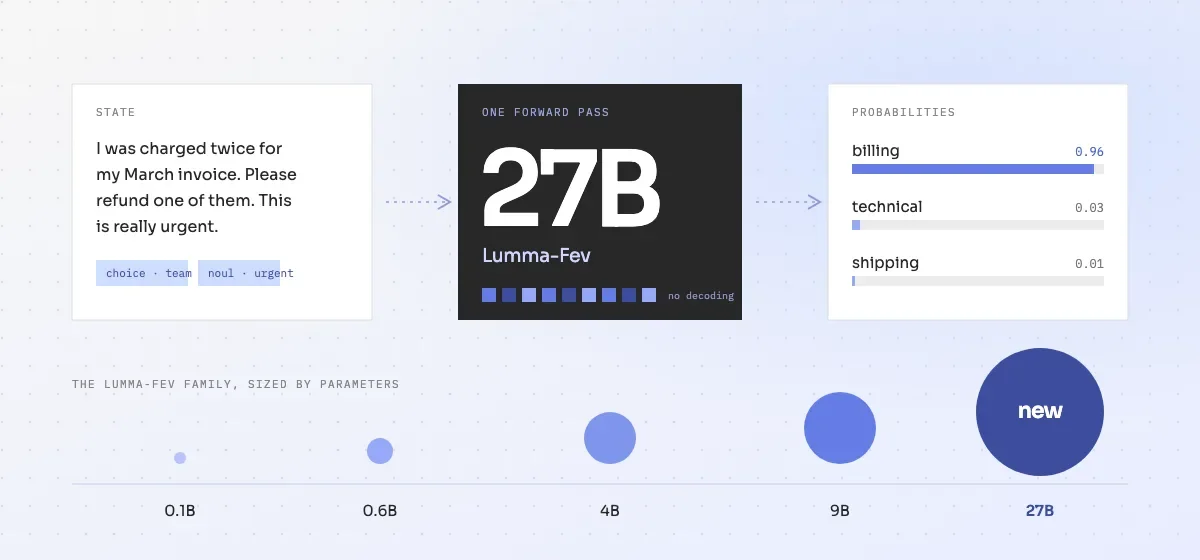
FrontiersMind has released Lumma-Fev-27B, the largest member of its family of models designed to score user-supplied options in one forward pass. Rather than asking a generative model to produce a label and then parsing its text, an application supplies a state, a question, and the permitted answers. The model returns a selected choice plus a probability distribution, or a yes probability for a binary gate.
The release is based on Qwen3.8-27B and was fully fine-tuned on about 100,000 decision samples. It supports English, Hindi, Tamil, and Kannada. The authors report 90.7% accuracy on 4,454 held-out decisions, compared with 83.9% for TypeSafe Jev on the same rows, and expected calibration error of 0.009 versus 0.045. They also say Jev remains ahead on reasoning benchmarks including BBH and WinoGrande. Those results describe the authors’ evaluation, not a guarantee for unrelated production traffic.
A narrower interface can be an advantage
Many operational tasks are not open-ended generation problems. Ticket routing, policy gates, content triage, and workflow selection usually have a fixed set of outcomes. A constrained decision interface makes the application contract explicit: the caller defines the available labels, and downstream code receives structured probabilities instead of interpreting prose.
That changes where engineering effort goes. Prompting still matters because the state and decision criteria define the task, but output parsing becomes less fragile. The probability map also permits policies that a single hard label cannot express. A system might automatically process high-confidence cases, send ambiguous cases to a person, and reject malformed inputs before either path.
The design does not make every classifier obsolete. A small classifier trained for one stable domain may be faster, cheaper, and easier to validate. Lumma-Fev-27B is more plausibly useful when one shared service must handle several option-based tasks, when criteria change regularly, or when teams want to describe a decision without training a separate head for every label set.
Calibration matters more than an impressive top-line score
Accuracy answers whether the winning choice was correct on average. Calibration asks whether confidence values correspond to observed success rates. Automation needs both. A model that is accurate overall but overconfident on difficult inputs can send its worst mistakes directly into the highest-trust path.
The reported calibration result is encouraging, but it is distribution-specific. Before setting a threshold, collect a labeled sample that resembles real traffic, including uncommon languages, short or noisy inputs, changing option sets, and cases that do not cleanly belong to any option. Group predictions into confidence bands and compare average confidence with actual accuracy in each band. Also inspect error rates separately for consequences that are not equally costly. Misrouting a routine question and approving a risky action should not share a threshold merely because both are represented as choices.
A practical policy can use three bands. High-confidence predictions proceed automatically, a middle band receives human review, and low-confidence or invalid cases fall back safely. Thresholds should be chosen from the cost of errors and review capacity, then monitored after launch. They should not be copied from the release’s held-out set.
Test the contract, not only the model
The release supports choice questions and binary noul gates. Although the interface accepts ordered score levels, the authors state that this release was not trained on them. Treating an accepted field as a validated capability would therefore be a mistake. If an application needs ranking or severity levels, test that behavior independently or express it as a clearly defined choice task.
Evaluation should cover the full contract. Verify that option descriptions are mutually understandable, measure what happens when the correct answer is absent, and test whether irrelevant details in the state change the outcome. Reorder labels to detect position sensitivity. Add near-duplicate options to reveal whether the criteria distinguish them. For binary gates, test positive and negative examples near the operational boundary rather than relying on obvious cases.
Multilingual support deserves the same discipline. The announcement includes internal Indic-language evaluation but notes the absence of a public benchmark for this decision setting. Build a review set with native speakers and production-like phrasing for each intended language. Translated English examples alone may miss code-switching, local terminology, spelling variation, and culturally specific ambiguity. Report results per language instead of hiding weak segments inside a combined average.
Infrastructure and comparison boundaries
The published bfloat16 weights are about 49 GiB, and the authors recommend planning around an 80 GB GPU for a single-device setup. That is a meaningful serving commitment. Teams should benchmark end-to-end latency, concurrency, memory headroom, cold starts, and cost on their own hardware before deciding that a general decision service is preferable to smaller specialized models. The weights are released under Apache 2.0, which enables local experimentation, but deployment still requires review of dependencies, data handling, and operational controls.
The comparison with Jev is also deliberately mixed: Lumma-Fev-27B leads on the authors’ held-out decision set, while Jev leads on cited reasoning tasks. This is useful evidence that task definition shapes the result. A routing benchmark does not establish broad reasoning superiority, and a general reasoning benchmark does not automatically predict reliable calibrated routing. Choose comparison sets that mirror the decisions the application will actually make.
A responsible adoption sequence
Start with one bounded, reversible workflow and a labeled evaluation set. Define the permitted options and abstention behavior before tuning prompts. Compare against the current process, a simple baseline, and any smaller model that meets latency constraints. Then calibrate thresholds on representative data, run in shadow mode, and review disagreements without allowing the model to act.
Only after those checks should automation expand gradually. Log model version, input schema, option set, probabilities, selected action, and later corrections, subject to privacy requirements. Watch for drift as products, languages, and user behavior change. This approach treats Lumma-Fev-27B’s structured output as a useful component rather than proof that a decision is safe. Its strongest promise is not that one model wins every benchmark, but that fixed-choice model behavior can be measured and governed more directly than free-form generated labels.
Source: Introducing Lumma-Fev-27B ↗. How we write