ModernBERT made the case for modernizing encoders
Longer sequences and a revised architecture challenged the idea that useful NLP always needs a decoder LLM.


A better encoder can be more relevant than a larger chatbot when the task is understanding rather than generation.
ModernBERT introduced base and large encoder-only models with support for substantially longer sequences than older BERT-style defaults. The announcement positioned the family for established encoder tasks, including classification and retrieval after appropriate fine-tuning, rather than conversational text generation.
The release is a reminder to match the model to the job. A system that needs representations or labels may not benefit from the overhead of a general-purpose chat model. Encoder improvements can matter in high-volume pipelines where latency and cost accumulate quickly.
Review the downstream task you need before selecting a loading class or fine-tuning recipe. The original article explains the model’s masked-language-model foundation and its integrations; a useful retrieval system still needs task-appropriate training and evaluation.
Encoders solve a different problem from chat generators
A text encoder produces representations that can support classification, retrieval and related tasks. It does not need to generate a conversational answer to be useful. For many applications, a compact score or representation is exactly the desired output.
This distinction matters because a general chat model can be an unnecessarily complicated tool for a task such as classifying documents or finding relevant passages. An encoder-based system may offer a more direct path with different latency and resource characteristics.
Match the architecture to the output contract
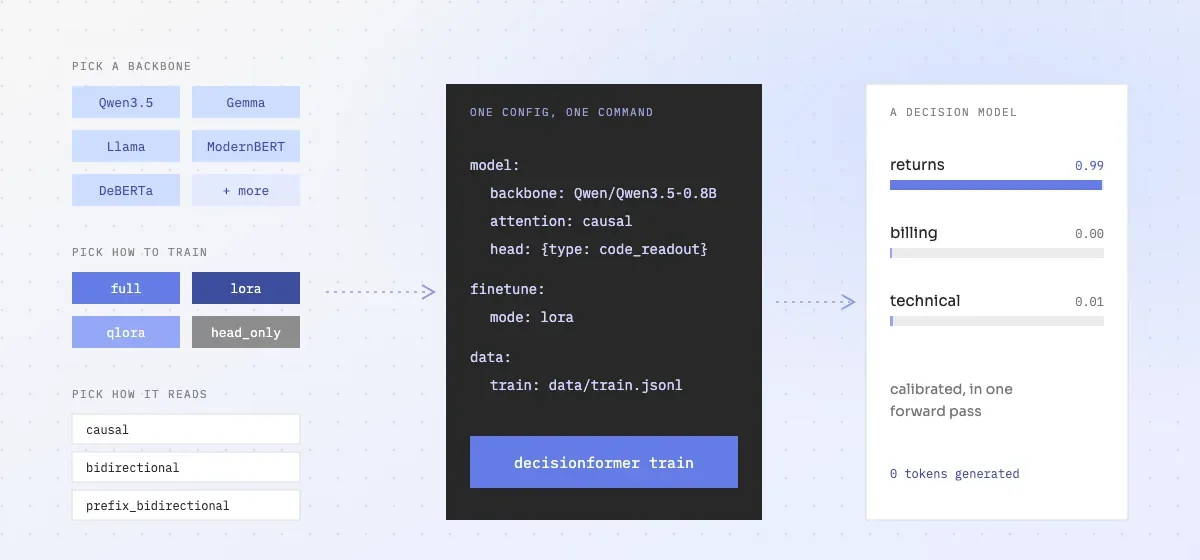
Start by describing what the application needs: a label, a similarity score, a ranked list or a generated explanation. If the required output is a fixed decision, evaluate a model designed for that decision before building a large prompting workflow around a generator.
Keep the training or adaptation setup appropriate to the task. A general representation is not automatically an optimal classifier for a specialized domain, and a classification checkpoint is not automatically a good retrieval model.
Evaluate long inputs deliberately
Document length affects both resource use and the information available to the model. If an application truncates text, confirm that the relevant evidence is not routinely removed. If it splits documents, preserve the relationship between chunks and the original source.
Create evaluation examples where the important detail appears in different parts of a document. This can reveal whether the apparent quality depends on a convenient placement of information near the beginning.
Compare with practical baselines
For classification, include a simple established model or rules where appropriate. For retrieval, include keyword search and the current embedding approach. The comparison should answer whether the new encoder improves the actual workflow enough to justify a change.
Inspect errors by category and input length. A strong aggregate result can hide a weakness in the subset that matters most to users. Keep the evaluation split independent from any tuning process.
Preserve the preprocessing contract
Tokenizer, normalization and task-specific input formatting belong to the model setup. Pin the relevant revisions and test a small reference collection after dependency changes. An encoder can return a correctly shaped tensor while the application has changed the meaning of the input.
The useful story in modernized encoder models is not that one architecture replaces every other. It is that focused text-processing tasks deserve current tooling and careful evaluation too. A well-chosen encoder can make a system simpler and more efficient when its representation or score directly matches the job the application needs to perform.
Source: Finally, a Replacement for BERT: Introducing ModernBERT ↗ · bwarner, NohTow, bclavie, orionweller, ohallstrom, staghado, alexisgallagher, rbiswasfc, fladhak, tomaarsen, ncoop57, griffin, jph00, johnowhitaker, iacolippo. How we write