A Practical Test Plan for Moving Robot Simulation onto the GPU
NVIDIA’s Warp and MuJoCo Warp can batch compatible robot simulations on a GPU. The important engineering work is preserving task behavior, sizing resources, and measuring throughput without confusing queue time for completed physics.

Validate one world before scaling, treat buffer overflows as failed runs, and benchmark synchronized completed work with batch size and latency reported together.
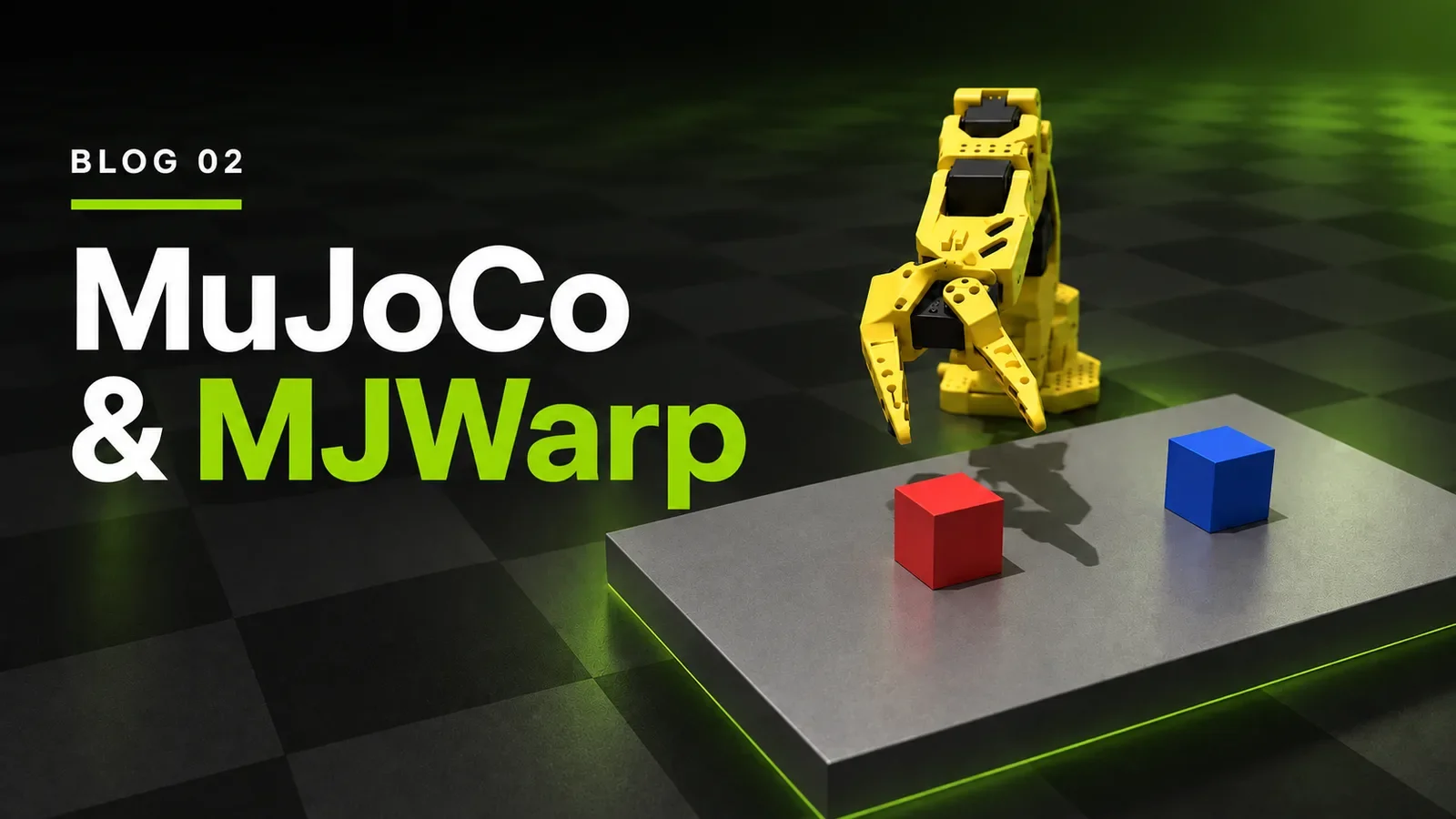
Moving a robot simulator from CPU execution to a GPU is not merely a backend switch. It changes the unit of performance that matters, introduces explicit device state, and creates new ways for a benchmark to look successful while measuring the wrong thing. NVIDIA’s new walkthrough presents Warp and MuJoCo Warp (MJWarp) through an SO-101 pick-and-place example, scaling a compatible MuJoCo scene to a batch of 2,048 worlds. The most reusable lesson is the validation sequence behind that number.
Warp is a Python framework for authoring typed computational kernels that can run on CPUs or CUDA devices. MJWarp implements the MuJoCo physics pipeline with Warp and represents simulation state in batches. That combination targets workloads such as reinforcement learning and large-scale sampling, where advancing many independent environments can matter more than minimizing the latency of one environment.
Start with the performance question
Before migrating anything, decide whether the workload needs lower single-world latency or greater aggregate throughput. They are different objectives. Teleoperation, interactive debugging, and some model-predictive control loops may benefit more from a responsive CPU simulation. Policy training, domain randomization, or broad parameter searches can benefit from thousands of worlds progressing together.
A useful benchmark therefore reports at least three values: batch size, elapsed time per batched step, and total world-steps per second. Reporting only the last number hides latency; reporting only step time hides how much work was completed. The comparison must also use the same simulated timestep and the same number of physics substeps per control update. Otherwise the faster system may simply be simulating less time or integrating at a different resolution.
Treat the CPU implementation as an executable specification. Record the initial state, control rate, physics rate, task success conditions, and the derived quantities used by the controller. For a manipulation task, an exit code or visually plausible trajectory is weak evidence. Geometric thresholds, contact outcomes, and final object poses make a better acceptance test.
Cross the device boundary deliberately
The conceptual change in MJWarp is that one data object contains a leading world dimension. Joint positions, velocities, and controls are no longer just one scene’s vectors; they are rows in a batch. This is powerful, but it makes initialization part of correctness. A parity test should begin with one GPU world seeded from the same initialized CPU state. Only after that trajectory passes the task checks should the state be replicated into a larger batch.
Device transfers deserve equal scrutiny. Copying GPU arrays back to NumPy after every substep can be appropriate during validation because an existing CPU controller or viewer may need refreshed state. It is not representative of a device-resident training loop. Separate this diagnostic path from the throughput path so synchronization and bus transfers are not silently included in one result and omitted from another.
Framework interoperability can reduce unnecessary copies when tensors remain on the device, but zero-copy sharing does not remove ownership, lifetime, or synchronization concerns. Document which component writes each buffer and when consumers may read it. This becomes especially important when controls change between captured graph replays.
Make capacity failures visible
Batched physics requires preallocated space for contacts and constraints. A quiet overflow is more dangerous than an obvious crash because a rollout may continue while its physical result is no longer trustworthy. Capacity should be tested at the task’s busiest contact phase, not while the robot is idle. For pick-and-place, that could be the moment gripper, object, and support surface interact simultaneously.
Start with conservative limits, run the complete task, inspect overflow indicators, and then tighten allocations if memory pressure demands it. Repeat the check whenever collision geometry, batch size, solver settings, or task layout changes. The right capacity is a property of the scenario, not a permanent constant attached to the robot model.
This process exposes a central tradeoff: oversized buffers consume memory across every world, while undersized buffers undermine validity. Batch scaling should therefore be evaluated jointly with contact complexity rather than as a simple race toward the largest world count that fits on the GPU.
Benchmark completed work, not queued work
GPU launches are asynchronous. Timing a Python loop without synchronizing can measure how quickly commands enter a queue instead of how long physics takes to finish. A credible measurement warms up compilation and allocation, synchronizes immediately before the timed region, submits a fixed number of steps, then synchronizes again before stopping the clock.
CUDA graph capture can reduce repeated launch overhead when the workload and buffers are stable. It should be recaptured after replacing buffers, rebuilding the model, or changing the batch shape. Graph replay is an execution optimization, not proof that separate kernels were fused or that task behavior remained unchanged. Parity tests still apply after performance-oriented changes.
Sweep several batch sizes rather than publishing one favorable point. The curve shows where fixed overhead is amortized, where throughput plateaus, and where memory or compute limits begin to dominate. Include hardware, software versions, scene settings, solver configuration, warm-up policy, and overflow status so another team can interpret the result without assuming it transfers directly to a different robot.
A migration checklist that scales
A disciplined evaluation can be summarized as four gates. First, establish a CPU baseline with explicit task assertions. Second, run one identically initialized GPU world and compare behavior. Third, stress contact and constraint capacity over the full scenario. Fourth, remove diagnostic host copies, scale the batch, warm up, synchronize, and measure.
Passing each gate answers a different question: does the task work, does the backend preserve it, are resources sufficient, and does batching improve the metric the project actually values? Keeping those questions separate prevents a large throughput number from substituting for simulation correctness. Warp and MJWarp provide the machinery for GPU-scale physics; a careful test plan determines whether that machinery is producing useful learning data.
Source: How to Use NVIDIA Warp and MjWarp to Accelerate Robotics Simulation and Learning Workflows ↗. How we write