SimReady Assets Move Robot Simulation Closer to Reproducible Assembly
NVIDIA’s SimReady pick-and-place walkthrough shows how validated OpenUSD assets can reduce scene setup work in Isaac Sim—but reliable robotics evaluation still depends on testing the complete controller, contacts, and task assumptions.

Validated simulation assets reduce setup ambiguity, but only staged integration checks and task-level evaluation can establish that a complete robot scene behaves reliably.
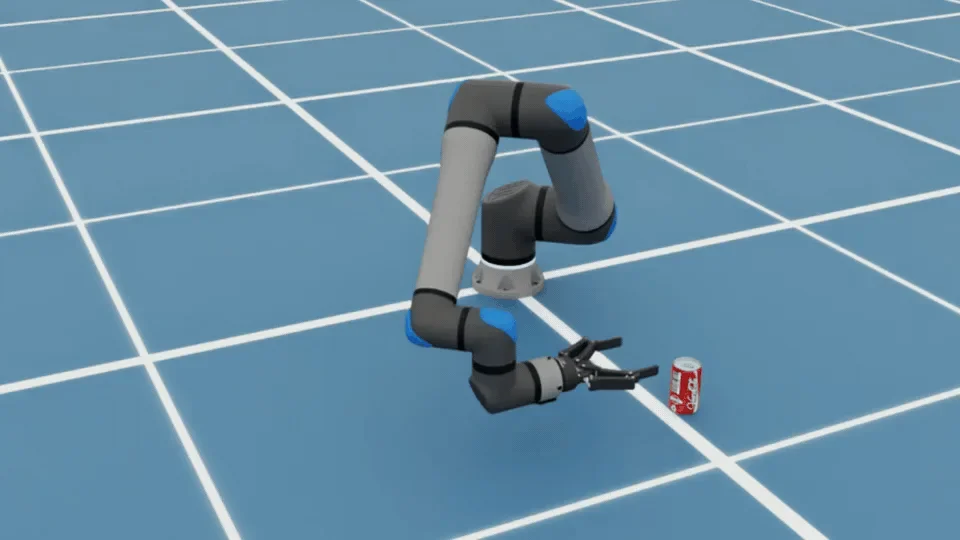
A robot model can look perfect in a viewport and still be unusable in motion. Joints may rotate around the wrong axes, drive limits may be unsuitable, collision geometry may be incomplete, or an object may fall through a work surface. NVIDIA’s new walkthrough on Hugging Face addresses that gap with a pick-and-place scene assembled from SimReady assets: a UR17G arm, a Robotiq 2F-140 gripper, and a beverage can.
The example is useful less as a claim that pick-and-place is solved than as a demonstration of a more disciplined asset pipeline. The packages arrive with authored simulation properties and validation evidence, while the user supplies the scene composition, controller, and task-specific evaluation. That separation can make experiments easier to reproduce, but it also clarifies where validation ends and application responsibility begins.
What “simulation-ready” actually buys you
SimReady describes OpenUSD assets prepared for a defined simulation use case. Instead of distributing only visual geometry, an asset can include mass, collisions, joints, joint drives, and other properties needed by a simulator. SimReady Foundation organizes expectations into profiles, features, and individual requirements. In the walkthrough, the arm and gripper reports use robot-oriented profiles and pass driven-joint checks.
This structure offers two practical benefits. First, it turns hidden setup assumptions into inspectable metadata. A team can examine whether an arm exposes controllable joints or whether an object has collision and mass properties before building a larger scene. Second, profile versions provide a shared vocabulary. When an asset changes, developers can compare its validation target instead of relying only on a filename or an appealing preview.
However, a passing asset report is not an end-to-end task certificate. It does not prove that independently authored assets have compatible scales, frames, contact materials, control gains, or attachment conventions. It also does not prove that a controller will grasp an object reliably. Profile validation answers whether specified properties meet a baseline; task testing answers whether the assembled system behaves as intended.
Treat composition as its own engineering stage
The walkthrough uses Isaac Sim 6.2 and keeps each downloaded asset folder intact so referenced files remain available. The arm and gripper must then be assembled into one controllable articulation, placed with the can and work surface, and connected to controls. An AI agent can assist with those steps through Isaac Sim skills and a remote Python interface, but generated code remains something to inspect rather than an authoritative controller.
A good composition check starts small. Load each asset and resolve missing references before joining anything. Confirm stage units, orientations, and articulation roots. Inspect joint limits and drive settings, then command a small, reversible arm movement. Open and close the gripper without an object. Finally, place the can on the work surface and run the physics timeline to verify that gravity and collision behavior are plausible.
These checks isolate faults. If the can falls through the table, debugging inverse kinematics is premature. If the gripper fingers do not move symmetrically, a failed grasp may have nothing to do with friction. If attaching the gripper creates a second articulation root or an unexpected transform, waypoint tuning will only conceal the structural problem.
Evaluate the sequence, not just the final frame
A successful final screenshot cannot reveal whether a task was stable or repeatable. Evaluate pick-and-place as a state sequence: approach, grasp, lift, hold, transfer, release, and settle. Record the first state that violates expectations. That produces a more actionable result than a single pass/fail label.
For example, a can that slips during transfer points toward contact, friction, acceleration, or gripping configuration. A can that is lifted reliably but released far from the target points instead toward waypoint frames, controller timing, or placement criteria. Reset the robot and object to identical initial states between runs so changes can be compared fairly. Useful observations include whether contacts occur on both fingers, whether the object remains supported during the entire transfer, and whether the released object settles inside a declared target region.
The source example deliberately uses a constrained setup: known object position, an anchored robot, a clear flat workspace, fixed waypoints, no vision, and limited collision checking. It also models neither can deformation nor liquid motion. Its reported 2 N·m drive-effort cap was selected in simulation and is not presented as a hardware force recommendation. Those boundaries matter because success here does not establish robustness to pose uncertainty, changing payloads, clutter, compliant objects, or a physical robot.
A practical path from demo to benchmark
Teams adapting this workflow should define success before tuning the controller. Specify the initial-pose distribution, allowed collisions, target region, placement tolerance, time limit, and number of resets. Then vary one factor at a time: object translation, object rotation, friction, payload mass, or waypoint noise. Preserve the asset versions, simulator version, scene file, controller revision, and random seeds with the results.
The most valuable role for reusable validated assets is not eliminating verification. It is moving verification upward. Developers can spend less time reconstructing basic physics metadata and more time testing interfaces and task behavior. SimReady Central’s library and reports provide a credible starting point; the assembled scene and evaluation protocol determine whether that starting point becomes a reproducible robotics experiment.
Source: Build a Robot Pick-and-Place Simulation with SimReady Assets ↗. How we write